

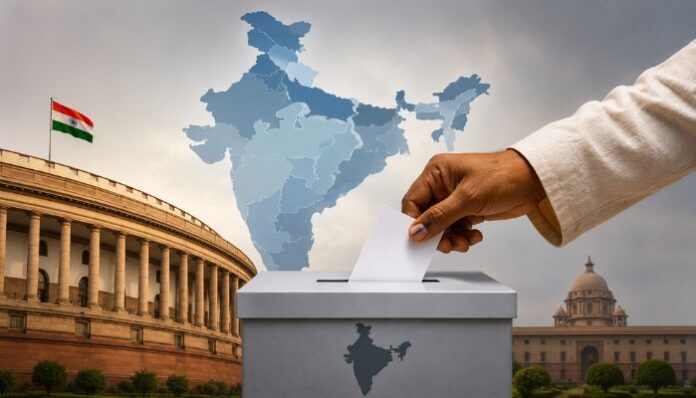
The NDA is exploring the possibility of holding Assembly elections in 22 NDA-ruled states and Union Territories along with the 2029 Lok Sabha elections, instead of waiting until 2034, according to a report by The Indian Express. The plan could involve dissolving several state Assemblies before the end of their terms to bring their election schedules in line with the Lok Sabha polls.
The development comes while the Joint Parliamentary Committee (JPC) examining the One Nation, One Election Bills is still holding consultations with Chief Ministers, legislators, officials and other stakeholders. The committee has been studying how simultaneous elections could work and what constitutional and administrative changes would be needed.
The idea of bringing the first simultaneous elections forward to 2029 has gained attention in recent months. JPC chairman P P Chaudhary has also said that the panel is working on a mechanism that could make simultaneous elections possible by the 2029 general elections.
How could 22 states be brought into the 2029 election cycle?
Of the 22 NDA-ruled states and Union Territories being considered, 11 are scheduled to hold Assembly elections during the two years before the 2029 Lok Sabha elections. Four- Andhra Pradesh, Arunachal Pradesh, Sikkim and Odisha- already hold their Assembly elections along with the Lok Sabha polls.
The proposal under discussion would require some of the remaining Assemblies to be dissolved before their normal terms end. If the NDA governments in these states remain in power and agree to the plan, the Assemblies could potentially be dissolved by January 2029.
Article 174(2)(b) of the Constitution gives the Governor the power to dissolve a state Assembly. In normal circumstances, this is done on the advice of the Council of Ministers. Once an Assembly is dissolved, elections have to be conducted within the period prescribed under election law.
This would mean that several states could see their Assembly terms shortened by years. Goa, Gujarat, Manipur, Uttar Pradesh and Uttarakhand, for example, could have their terms cut by around three years, while Chhattisgarh, Madhya Pradesh, Meghalaya, Nagaland, Rajasthan and Tripura could see terms shortened by around four years if the plan is implemented.
Some NDA Chief Ministers back simultaneous elections
The proposal has already received support from some NDA Chief Ministers. Chief Ministers of Goa, Uttarakhand, Haryana and Delhi have expressed support for synchronising elections during their interactions with the parliamentary committee.
Delhi Chief Minister Rekha Gupta, who met the committee during its consultations, said Delhi would be willing to make adjustments if required in the national interest. “If aligning election schedules at the national level requires a suitable adjustment in Delhi’s tenure, the Delhi Government is willing to consider it with a positive approach,” Gupta said.
She added, “If required in the national interest, Delhi could be among the leading states to extend such cooperation.”
In Delhi’s case, aligning the Assembly election with the 2029 Lok Sabha polls would mean cutting the existing Assembly’s term by around a year.
The JPC has been conducting consultations across several states. It has so far interacted with stakeholders from states including Maharashtra, Uttarakhand, Haryana, Punjab, Himachal Pradesh, Karnataka, Gujarat, Delhi, Goa and Uttar Pradesh. The committee’s consultations have also examined issues such as premature dissolution of Assemblies, mid-term elections and the constitutional implications of synchronising election cycles.
Opposition raises constitutional and democratic concerns
The possible early dissolution of Assemblies is likely to intensify the political debate around One Nation, One Election. Opposition parties have already strongly opposed the proposal, arguing that shortening the terms of elected state governments could affect federalism and democratic accountability.
Congress general secretary Jairam Ramesh said the party’s position had not changed. “The Congress is opposed to One Nation One Election. It is unconstitutional, anti-democratic and against accountability,” Ramesh said.
He added that the JPC was still examining the issue and was expected to submit its report after completing its consultations.
Congress and DMK MPs had opposed the introduction of the Bills in Parliament in 2024. Karnataka Chief Minister D K Shivakumar also opposed the proposal when he appeared before the committee.
The issue could become particularly sensitive in states where Assembly terms would be cut short by several years. Opposition-ruled states such as Punjab, Himachal Pradesh, Karnataka, Mizoram and Telangana also have elections scheduled before the 2029 Lok Sabha polls. Unlike the NDA-ruled states being considered for early alignment, their governments may not have an incentive to voluntarily shorten their terms.
What does the One Nation, One Election Bill propose?
The proposal is based on the Constitution (One Hundred and Twenty-Ninth Amendment) Bill [pdf], 2024 and the Union Territories Laws (Amendment) Bill, 2024.
The Constitution Amendment Bill was introduced in the Lok Sabha on 17th December 2024 by then Law Minister Arjun Ram Meghwal. It was later referred to a Joint Parliamentary Committee after a vote in which 269 MPs supported the move, and 196 opposed it.
The Bill proposes changes to Articles 82, 83, 172 and 327 of the Constitution to create a framework for simultaneous elections to the Lok Sabha and state Assemblies. Under the proposed system, Assemblies elected after the first sitting of the Lok Sabha following a general election could have their terms adjusted so that their next elections are held together.
The government’s proposal is based largely on the recommendations of the high-level committee headed by former President Ram Nath Kovind, which was constituted in September 2023. The committee submitted its report to President Droupadi Murmu after extensive consultations and research.
The JPC is still examining the Bills. Its deadline was recently extended to the Winter Session of Parliament, giving it more time to complete consultations and prepare its recommendations.
