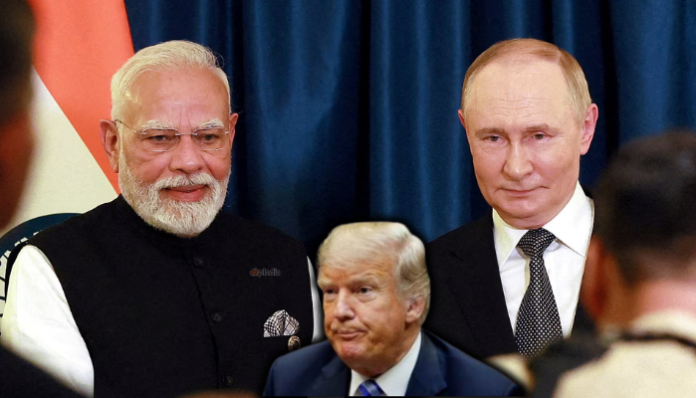
On 16th September, the US House of Representatives passed a bipartisan sanctions bill on Russia by a margin of 262-159. Passed in the Senate, the Lindsey O. Graham Sanctioning Russia and Iran Act of 2026 grants the President authority to impose tariffs up to 100% on the top five purchasers of Russian oil: China, India, Slovakia, Hungary and Azerbaijan. Following the Senate passage, the bill will now head to US President Donald Trump’s desk to be signed into law.
In August this year, the Lindsey O. Graham Sanctioning Russia and Iran Act of 2026 was passed by an 86-11 margin in the US Senate. However, it faced challenges in the House of Representatives.
While the bill’s fate was uncertain given it lacked the required majority support, the procedural hurdle was overcome after r two Democratic lawmakers voted with Republicans, and it was advanced with 214-211 votes.
Following the Sanctioning Russia and Iran Act, 2026, passage on 16th September, US senator from the Democratic Party, Richard Blumenthal issued an open threat to China and India, saying that it would be better if the two countries ‘improved their performance’.
“For China and India, it would be better if you improve your performance. Buy your oil and gas from somewhere else,” Blumenthal said.
"For China and India, It would be better if you improve your performance. Buy your oil and gas from somewhere else", says US lawmaker Senator Blumenthal after passage of bill that imposes tariffs on those importing Russian energy
— Sidhant Sibal (@sidhant) September 17, 2026
Video source: Senator Blumenthal X pic.twitter.com/d20ps8Ojh2
From Russia Sanctioning Act, Lindsey Graham Russia Accountability Act to Lindsey O. Graham Sanctioning Russia and Iran Act
In July 2026, a group of US senators introduced an updated version of the earlier proposals, particularly the 2025 Sanctioning Russia Act. Senators Jeanne Shaheen, Richard Blumenthal, and Roger Wicker, among others, held a press conference in Washington to announce the proposal and expressed confidence that the bill has the required senatorial backing and will be passed by August 2026.
The revised version came to be referred to as the Lindsey Graham Russia Accountability Act, in honour of the late Republican Senator Lindsey Graham who championed the original Sanctioning Russia Act.
The Graham-introduced Sanctioning Russia Act of 2025 proposed that “the [US] President must increase the rate of duty on all goods and services imported into the United States from countries that knowingly engage in the exchange of Russian-origin uranium and petroleum products to at least 500% relative to the value of such goods and services.”
The bill proposed measures against the shadow fleet of Russian tankers used to evade existing sanctions. The bill included visa bans, asset freezes, and sanctions on Russian officials, banks, and energy firms. The bill also imposes sanctions on Russia’s shadow fleet of tankers that do not depend on Western maritime services, on Russian financial institutions, including the Central Bank of the Russian Federation, and on Russia’s largest state-owned energy projects, including Yamal LNG and Arctic LNG 1, 2 and 3.
The bill’s most interesting provision, however, is the natural gas exception. The Lindsey Graham Russia Accountability Act largely exempted countries importing less than 15% of their total natural gas from Russia and actively reducing purchases, granting relief to most European allies of the US.
Key provisions of the Lindsey O. Graham Sanctioning Russia and Iran Act
Section 102 of the passed bill provides for mandatory sanctions on Russian officials, military figures, oligarchs, and supporters. The targeted Russian officials include the President of the Russian Federation, Prime Minister, Defence Minister, and other key officials.
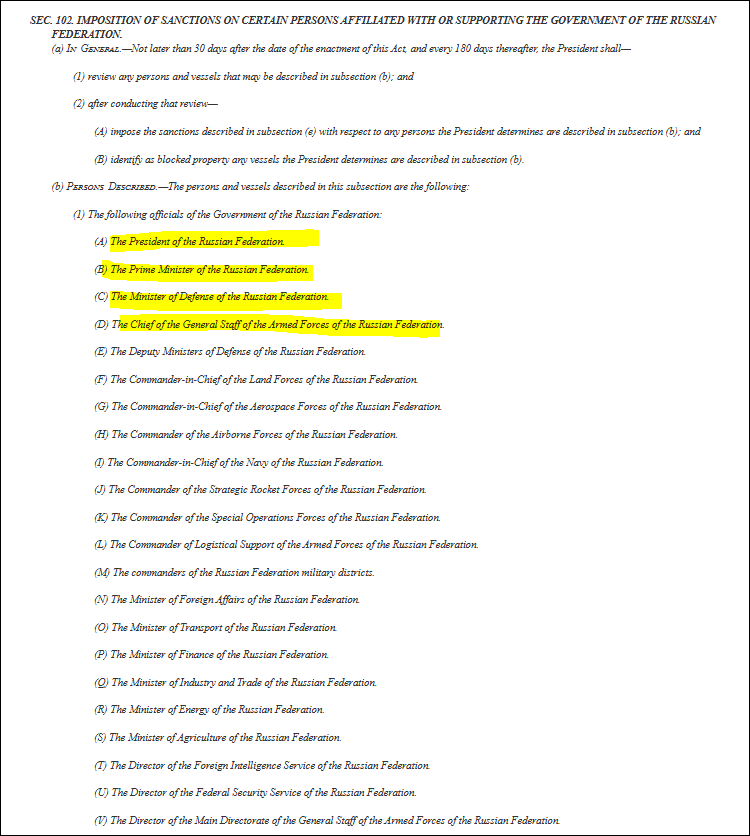
As per the bill, the US President must, within 30 days of enactment and every 180 days thereafter, impose blocking of property and visa ineligibility on specific persons, like the Russian president, certain military commanders, persons providing goods or services to Russia’s defence industrial base, persons ‘undermining’ Ukraine, as well as those involved in energy projects or sanctions evasion.
“The President shall exercise all of the powers granted by the International Emergency Economic Powers Act (50 U.S.C. 1701 et seq.) to block any vessel described in subsection (b), and block and prohibit all transactions in all property and interests in property of a person described in subsection (b), if such property and interests in property are in the United States, come within the United States, or are or come within the possession or control of a United States person,” the bill reads.
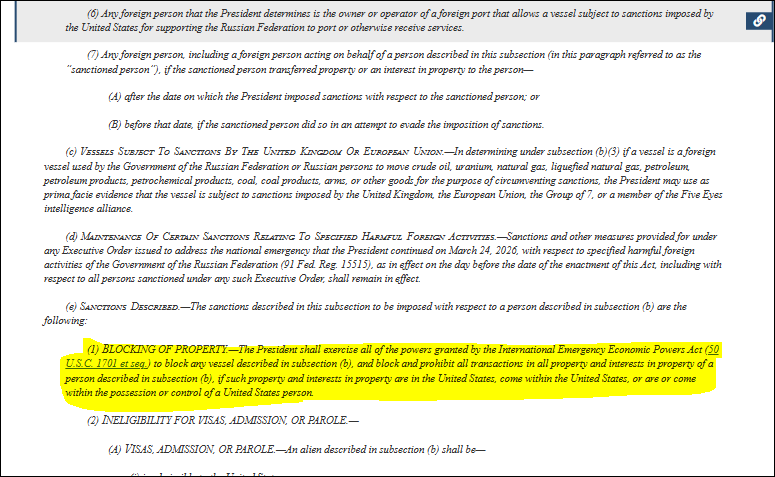
Regarding visa and admission restrictions, the bill provides, “An alien described in subsection (b) shall be—(i) inadmissible to the United States; (ii) ineligible to receive a visa or other documentation to enter the United States…”
Sanctions on Russian financial institutions
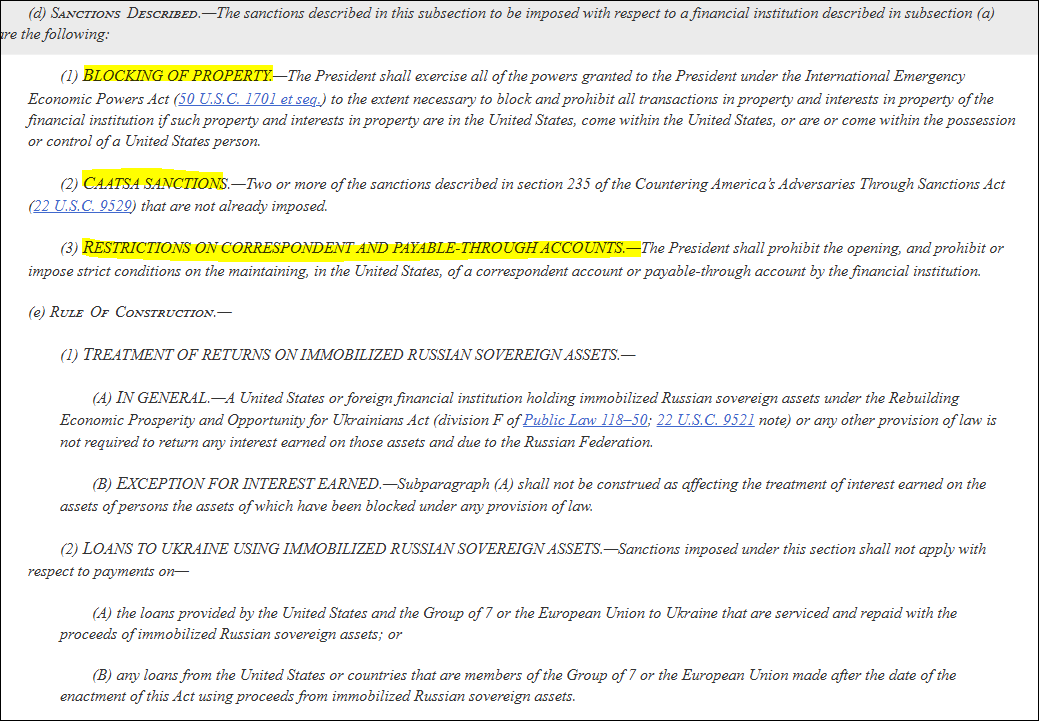
Section 103 of the passed legislation states that the US President must sanction the Central Bank of Russia, Sberbank, VTB Bank, Gazprombank, other state-owned or affiliated Russian financial institutions, and, with limited exceptions, foreign institutions that indulge in significant transactions with them. The measures primarily include property blocking additional CAATSA sanctions, as well as restrictions on correspondent/payable-through accounts.
Prohibitions on investment, energy, debt, and securities
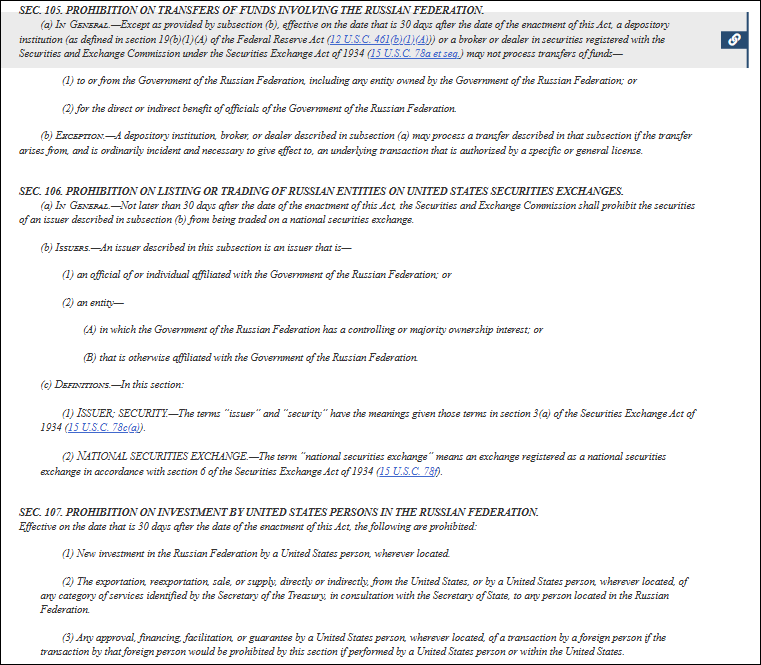
Sections 105 to 111 detail provisions for prohibiting US citizens or the government from making new investments in Russia or purchases of Russian sovereign debt.
In addition, the bill prohibits export, reexport, or in-country transfer of US-produced energy or energy products to Russia.
It further prohibits listing or trading of securities in Russian government-owned, controlled or affiliated entities on US exchanges.
Moreover, the bill restricts financial-messaging services to sanctioned Russian banks.
The bill also bolsters restrictions on Russian uranium imports and sanctions Rosatom leadership. Section 111’s “Sanctions” clause reads, “—Beginning on the date described in section 3112A(d)(2)(C) of the USEC Privatization Act (42 U.S.C. 2297h–10a(d)(2)(C)), and every 180 days thereafter, the President shall impose sanctions described in section 102(e) with respect to any leaders, officials, senior executive officers, or members of the board of directors of, or principal shareholders with a controlling or majority interest in, Rosatom State Atomic Energy Corporation or any subsidiary or successor entity.”
Surge in duties on Russian goods by 500%
Under Section 112, the bill provides for increasing duties on Russian goods, including oil, natural gas, liquefied natural gas, petroleum, petroleum products, petrochemical products, coal, and coal products, imported into the US from Russia up to a massive 500%.
“Not later than 30 days after the date of the enactment of this Act, the President shall, notwithstanding any other provision of law, increase the rate of duty for all goods, including oil, natural gas, liquefied natural gas, petroleum, petroleum products, petrochemical products, coal, and coal products, imported into the United States from the Russian Federation to a rate of up to 500 percent ad valorem,” the bill states.
Secondary tariffs on top purchasers of Russian energy and ‘sanctions-evasion’ facilitators: US bill targets India and China
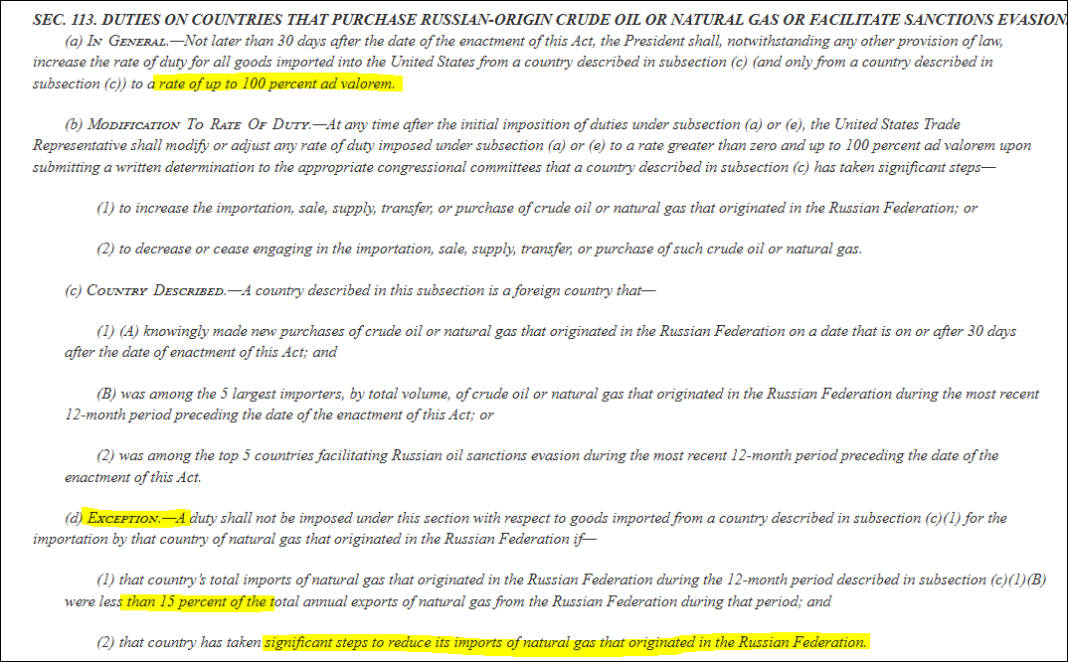
Section 113 is the most discussed provision of the Lindsey Graham Sanctioning Russia and Iran Act of 2026. Under this, the US President must raise duties of up to 100% ad valorem on “all” goods imported from major purchasers of Russian energy, particularly China and India.
“Not later than 30 days after the date of the enactment of this Act, the President shall, notwithstanding any other provision of law, increase the rate of duty for all goods imported into the United States from a country described in subsection (c) (and only from a country described in subsection (c)) to a rate of up to 100 percent ad valorem,” it states.
About the “country described”, the bill states:
- (1) (A) knowingly made new purchases of crude oil or natural gas that originated in the Russian Federation on a date that is on or after 30 days after the date of enactment of this Act; and
- (B) was among the 5 largest importers, by total volume, of crude oil or natural gas that originated in the Russian Federation during the most recent 12-month period preceding the date of the enactment of this Act; or
- (2) was among the top 5 countries facilitating Russian oil sanctions evasion during the most recent 12-month period preceding the date of the enactment of this Act.
The Bill, however, ensures that America’s European allies do not bear the brunt of the US’s manoeuvers to undermine Russia and cripple its economy. For this, the bill adds an “exception” clause.
It states that a duty will not be imposed under this section with respect to goods imported from a country described in subsection (c)(1) for the importation by that country of natural gas that originated in Russia, if its total imports of natural gas from Russia were less than 15% during the specific 12-month period.
In addition, the countries that have undertaken significant steps to reduce their imports of natural gas from Russia shall also be exempt from duties.
Iran sanctions extension
Under Section 201, the bill extends authority to sanction persons involved in Iran’s energy sector or weapons-related activities.
“Section 13(b) of the Iran Sanctions Act of 1996 (Public Law 104–172; 50 U.S.C. 1701 note) is amended by striking “2026” and inserting “2031”,” it states.
Will a 100% tariff get imposed automatically now that the sanctions bill is passed?
The passed bill authorises the US President to impose up to 100% tariffs on the five countries; it does not make them mandatory or come into effect automatically. This law grants the US President legal room to impose tariffs or grant waivers or exemptions.
Even if President Trump does not immediately impose a full 100% tariff, the bill has now created a permanent legal authority to threaten and influence negotiating terms while dealing with the targeted countries.
India and the US are engaged in extensive talks for a bilateral trade deal; imposition of a 100% tariff on Indian exports to the US would put pressure on India to demonstrate a meaningful reduction in Russian oil purchases to secure an exemption.
However, India has maintained that its energy imports are not governed by the whims of a foreign country but by their domestic needs and geopolitical interests.
Ever since the Russia-Ukraine war broke out in 2022, India has played the anchor role and kept the oil flowing globally. In fact, the US earlier lauded India for saying that Washington encouraged India to buy Russian oil, as stabilizing energy supplies and prices. However, as the Trump administration failed massively to secure even a ceasefire, let alone a complete end to the war, the US is vilifying India and China.
All this while, the US itself continued to import fertilisers, uranium, palladium, and base metals, among other products, from Russia, saying that these products are critical for American industries and hard to replace. OpIndia has reported earlier how the same US that accused India of profiteering from the Russia-Ukraine war is itself the biggest beneficiary of the prolonged war.
Committed to ensuring energy security for Indians: Ministry of External Affairs hits back
In response to media queries about the passage of the Sanctioning Russia and Iran Act in the US Congress, India’s Ministry of External Affairs said India remains committed to ensuring energy security for its people through diversified sources, in line with evolving market dynamics.
“The Government of India has noted the passage of the Sanctioning Russia and Iran Act in the US Congress. We are monitoring further developments on this matter. As stated on several earlier occasions, India remains firmly committed to ensuring energy security for its 1.4 billion people. It will continue to do so through diversified sourcing and on the basis of evolving market dynamics,” the MEA said.
It further informed the country that the issue of Russian oil purchases has been discussed with US interlocutors in recent months,
“Its potential implications for not just the bilateral relationship but also the international energy market have been very clearly articulated by the Indian side,” the MEA stated.
Furthermore, the MEA stated that it has made it clear that India will take all requisite measures to protect its trade and economic interests.
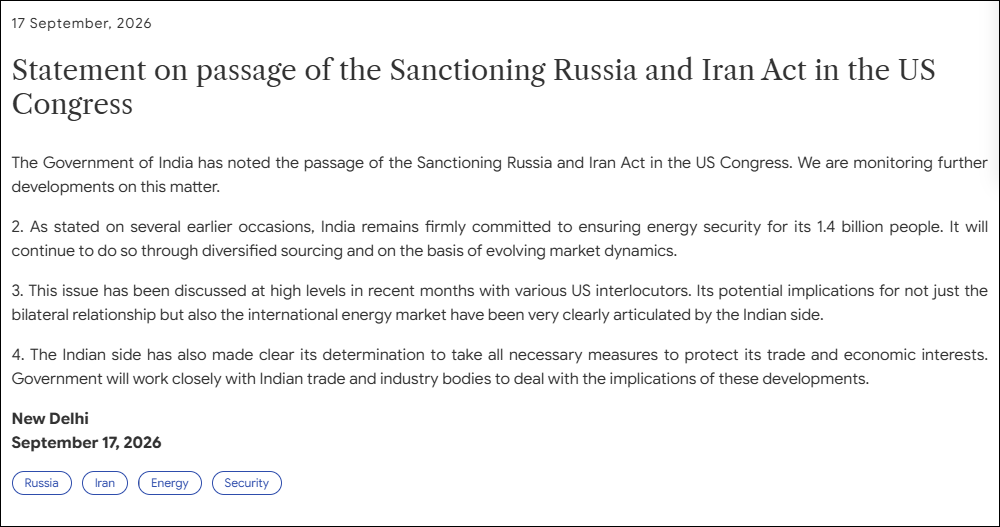
“The Indian side has also made clear its determination to take all necessary measures to protect its trade and economic interests. The government will work closely with Indian trade and industry bodies to deal with the implications of these developments,” it added.