

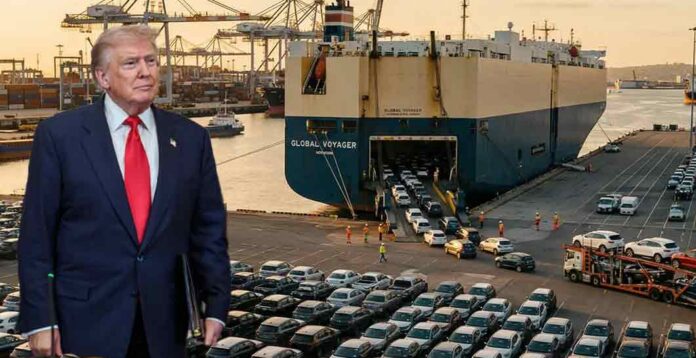
President Donald J. Trump has announced that he will impose a 25% tariff on cars and trucks imported from the European Union beginning next week, escalating a long-running trade dispute and signalling a tougher stance on international manufacturing agreements. This is the first time the president has announced a major tariff after the war against Iran started.
In a post on Truth Social today, Trump stated: “I am pleased to announce that, based on the fact the European Union is not complying with our fully agreed to Trade Deal, next week I will be increasing Tariffs charged to the European Union for Cars and Trucks coming into the United States. The Tariff will be increased to 25%. It is fully understood and agreed that, if they produce Cars and Trucks in U.S.A. Plants, there will be NO TARIFF.”
He claimed that several automobile manufacturing plants are being built in the US. Trump said, “Many Automobile and Truck Plants are currently under construction, with over 100 Billion Dollars being invested, A RECORD in the History of Car and Truck Manufacturing. These Plants, staffed with American Workers, will be opening soon — There has never been anything like what is happening in America today!”
The announcement of the tariff hike comes as a direct response to perceived EU violations of the trade agreement signed last year. It exempts vehicles produced in U.S.-based plants, aligning with the administration’s “America First” economic policy aimed at boosting domestic jobs and attracting foreign investment in manufacturing.
This move comes amid broader efforts to reshape global trade dynamics. Trump has repeatedly used tariffs as a tool to pressure trading partners into concessions, often tying them to domestic production incentives. The decision could impact major European automakers such as Volkswagen, BMW, Mercedes-Benz, and Stellantis, which export significant volumes of vehicles to the U.S. market.
In July 2025, the US and EU reached the Turnberry trade framework, which capped most US tariffs on EU goods at 15% and aimed to bring stability to the massive transatlantic economic relationship. The agreement required European Parliament ratification to take full effect.
In January 2026, President Trump threatened 10% tariffs, rising to 25%, on several EU countries and the UK unless they supported US control of Greenland, an autonomous Danish territory. In protest, the European Parliament suspended work on ratifying the deal on January 21, citing the threats as undermining the agreement’s spirit and EU sovereignty.
Trump later suspended the immediate tariffs after announcing a “framework” understanding on Greenland, allowing the Parliament to lift its freeze. However, compliance issues persisted, resulting in today’s announcement of higher 25% tariffs on EU cars and trucks.
