

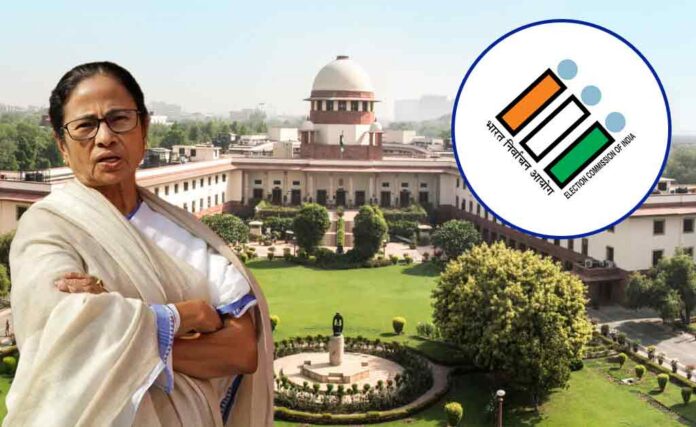
In an unprecedented move, the Supreme Court of India today ordered the deployment of serving and retired judicial officers to oversee the Special Intensive Revision (SIR) of electoral rolls in West Bengal, highlighting an “unfortunate blame game” and “trust deficit” between the state government and the Election Commission of India (ECI). The directive comes as the state prepares for upcoming polls, with the SIR process stalled due to disputes over the qualification of officers provided by the West Bengal government.
A three-judge bench led by Chief Justice of India Surya Kant, along with Justices Joymalya Bagchi and N.V. Anjaria, instructed the Chief Justice of the Calcutta High Court to nominate judicial officers at the rank of district judges or additional district judges to handle claims and objections related to voter inclusions and exclusions. These officers will be assisted by micro-observers from the ECI and state-deputed personnel, ensuring fairness in verifying documents and resolving discrepancies.
“We are left with hardly any option but to request the Chief Justice of the High Court at Calcutta to spare some serving judicial officers along with former judicial officers with impeccable integrity,” the bench stated in its order, describing the situation as “extraordinary” and invoking Article 142 of the Constitution to enable complete justice. The court emphasised that the process had reached an impasse at the stage of addressing “logical discrepancies” in the voter lists, fuelled by allegations from both sides.
The bench said that the blames and counter blames by ECI and Mamata Banerjee government show trust deficit between the two authorities. The court said, “There is an unfortunate blame game of allegations and counter allegations which shows trust deficit between two constitutional functionaries – that is the State government and the Election Commission of India. Now the process is stuck at the stage of claims and objections of the persons who have been included in the logical discrepancy list. Most of the persons to whom notices were issued have submitted their documents in support of their claim for inclusion in the voter list. These claims are required to be adjudicated in a quasi-judicial process by Electoral Registration Officers (EROs).”
The controversy stems from the ECI’s complaints that the West Bengal government, led by Chief Minister Mamata Banerjee, has failed to provide adequately qualified Group A officers for the SIR exercise. Instead, the state reportedly offered Group B officers, which the ECI deemed insufficient.
Earlier the apex court on February 9 had issued directive for the state to ensure over 8,000 nominated officers report for duty, and on 4th February, the court had requested a list of available Group B personnel. Despite these, the bench noted a lack of consensus and a week-long delay in the state’s response to ECI communications.
The SIR is a targeted drive to update and cleanse electoral rolls by identifying duplicates, deceased voters, and other anomalies, ensuring accurate voter lists ahead of elections.
