

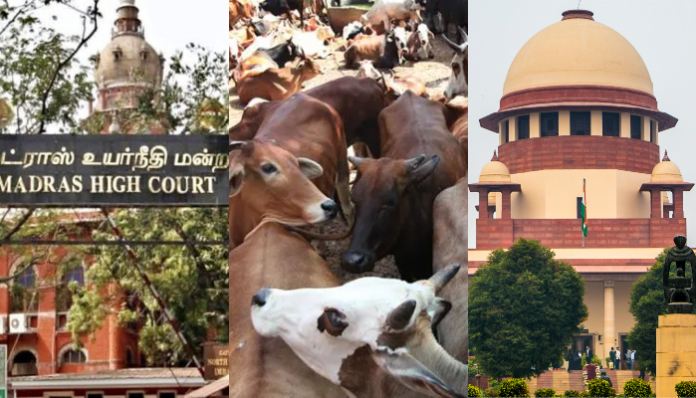
The Madras High Court’s judgment directing the state to enforce a ban on cow slaughter by enforcing a 1976 government directive has been challenged by the Tamil Nadu government in the Supreme Court. A Special Leave Petition (SLP) has been presented through the state secretary in the apex court on 9th June and is presently on the defect list for fixing filing errors.
With the exception of situations allowed by Section 4 of the Tamil Nadu Animal Preservation Act, which permits the slaughter of cows only if they are over 10 years old, unsuited for labour or breeding and certified as such by the appropriate authority, the high court outlawed the slaughter of cows throughout the state on 27th May.
The state government argued that the high court had overreached the scope of the act’s provisions by imposing a blanket ban on cow slaughter. Other relevant laws, such as the Prevention of Cruelty to Animals Act 1960, the Prevention of Cruelty to Animals (Slaughter House) Rules 2001, the Tamil Nadu Urban Local Bodies Act 1998 and the Tamil Nadu Urban Local Bodies Rules 2023 govern the circumstances in which animal slaughter is approved but do not completely forbid it.
The state insisted that the court replaced statute law with judicial legislation through its decision. It submitted that an order conflicting with a statutory requirement cannot be maintained when the law permits the killing of a specific class of cows in particular places.
The state objected to the usage of the Government Order No 1715 even though its applicability or validity never came under scrutiny in court. It contended that the legislative laws controlling animal slaughter in Tamil Nadu could not be superseded or overridden by the presidential order.
The state claimed that the writ suit was limited to forbidding the killing of cows in public areas during the Islamic festival in Coimbatore. The petitioner had not requested such relief, but the court extended the issue to impose an “absolute and blanket ban” on cow slaughter even in designated slaughterhouses, which resulted in the granting of a remedy that was neither prayed for nor pleaded.
According to the state, the court declared that no cow or calf be killed on Bakrid or any other day, even though it rightly highlighted that animal slaughter can only occur in licensed slaughterhouses during the decision, leading to a judgement that was internally contradictory.
The court’s finding that the authorities had essentially acknowledged that cows were being or would be killed in public locations was also contested in the petition. The government alleged that the police had repeatedly stated that precautions had already been taken to guarantee that no such activity would take place in public spaces in their counter-affidavit and stressed that any ritual sacrifice would be limited to enclosed and private spaces. It added that the state’s asserted position is at odds with the court’s conclusion.
The high court’s verdict
The court had asked authorities to convey proper instructions to state officials to ensure that the judgement was followed. The Chief Secretary and Director General of Police were told to make sure that no cow or calf was killed in Tamil Nadu on Bakrid or otherwise by the Division Bench of the Madras High Court comprising Justices G.R. Swaminathan and V. Lakshminarayanan.
A government order noting that a prohibition on cow slaughter was required to enhance milk output and the rural economy was cited by the high court. Article 48 of the Constitution, which obligates the state to take action to prevent the slaughter of cows, calves and other milch and draught livestock was pointed out in its consideration of the case.
The court decided that slaughter could only be sanctioned after getting the required certificate, holding that Section 4 of the Tamil Nadu Animal Preservation Act must be carefully interpreted in light of Article 48.
Supreme Court’s judgements holding that cow slaughter was not an integral part of Bakrid celebrations were also mentioned. “Sacrifice of a cow on that day is not an obligatory overt act for a Musalman to exhibit his religious belief and idea. Sacrifice of any animal by the Muslims for religious purpose on Bakrid does not include the slaughtering of cows as the only way of carrying out that sacrifice. Slaughtering of cows on this occasion is neither essential to nor necessarily required as part of the religious ceremony,” the high court expressed.
The court issued the verdict in response to a plea submitted by Surya, the state general secretary of the Indu Makkal Katchi, who asked for instructions to stop the unlawful killing of cows in public areas. He asserted that no action had been taken in spite of filing a representation to the authorities.
