

There has been an ongoing debate revolving around why a basic need such as Sanitary Napkins can’t be made ‘tax free’, considering many women, especially from the rural belt need to be motivated to use this hygiene product.
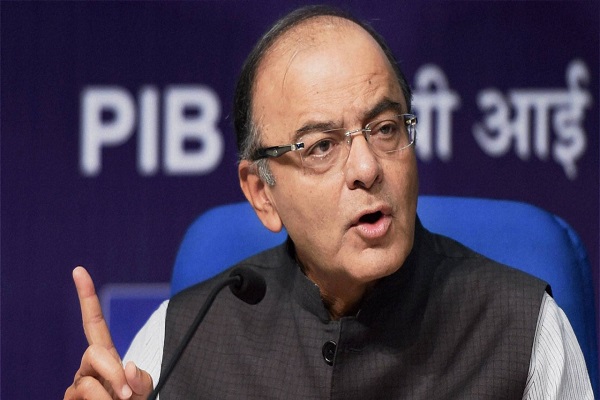
During the Hindustan Times Leadership Summit, an audience question was posed to Mr. Arun Jaitley, who is the current Finance Minister as to why the Government has decided to levy GST on sanitary napkins at while it has made Bindis tax free and what factors decide whether the product should be included in GST.
Arun Jaitley said that there are various economic factors that need to be kept in mind while making such decisions. He said that the first question that needs to be answered is what was the tax on sanitary napkins prior to 1st of July.
If one is to take all the taxes, by the centre, the state and the embedded taxes, Sanitary Napkins were already being taxed at around 13%. The GST Council put it in the 12% category. In the 12% category one has the additional benefit of availing input credit. So a lot of adhesives and additional materials that are used in the manufacturing of Sanitary Napkins are all 18% tax items. Hence, all the input items are taxed at 18% while the final item is taxed at 12%. Owing to this, after one avails of Input Credit, the next tax on the product is nominal as against the 13% tax bracket the Sanitary Napkins used to be in.
He then went on to directly address the ongoing debate by mentioning that ‘some television anchor and some MP’ started a debate that Sanitary Napkins shouldn’t be taxed at all. He said that firstly, as opposed to 13%, the effective tax rate post GST has come down to about 3-4% (after availing Input Credit) as explained above.
He then proceeded to explain why Sanitary Napkins needed to be in the 12% GST category to ensure that local manufacturing thrives without the market being taken over by Chinese goods.
He said that if the Government exempts Sanitary Napkins from GST, then all the input taxes payable on raw materials used for manufacturing of Sanitary Napkins, which are mostly taxed at 18%, won’t be eligible to claim Input Credit. Consequently the local manufacturer would add it to the cost of the finished product which would ultimately be paid by the consumer. This would make locally manufactured Sanitary Napkins more expensive for the consumers.
Other than that, the Chinese goods would be taxed at a lower rate, considering they would only have to pay 12% IGST (integrated GST). This would effectively make the Chinese product cheaper than the local manufacturer (because the Chinese products being exported from China are exempt from export duty in their country).
The ultimate effect would severely compromise the Indian manufacturing sector in this category considering the market would be flooded with cheaper Chinese products are compared to locally manufactured products.
#HTLS2017 with CNN-News18 | Finance Minister @arunjaitley responds to a question asked on why sanitary napkins need to be taxed | WATCH here: https://t.co/yrpi7tYfjcpic.twitter.com/wBHgUAbHKe
— News18 (@CNNnews18) November 30, 2017
This ill-informed controversy was advertised recently by Ms. Faye D’Souza of ‘Mirror Now’.
2. This resulted in the effective tax on sale being far lower than the MAXIMUM 13.65% for women in those states. These women have gone from 4 or 5% to 12% GST
— Faye DSouza (@fayedsouza) November 11, 2017
The argument that Urban women can afford to pay the tax may work if you assume that we can have different rates of GST for different products.
— Faye DSouza (@fayedsouza) November 11, 2017
Many, at the time, had tried to counter her misplaced understanding of taxation, but to no avail.
Hi Faye … In India that I live in
VAT on sanitary napkins varied between 5% to 14.5%. Add excise duty of 6%. Total tax was almost same or more than current GST rate of 12%. https://t.co/c1UopR7Lbh— Jiggs (@Sootradhar) November 12, 2017
Can’t exempt inputs too coz they are generic. Like say processed cotton. How will GOI know if cotton going to Sanitary pad co or textile co
— Ashu?? (@muglikar_) October 7, 2017
We now hope Ms. D’Souza and others who outraged on the issue can understand nuances and perhaps refrain from creating fear psychosis.


