

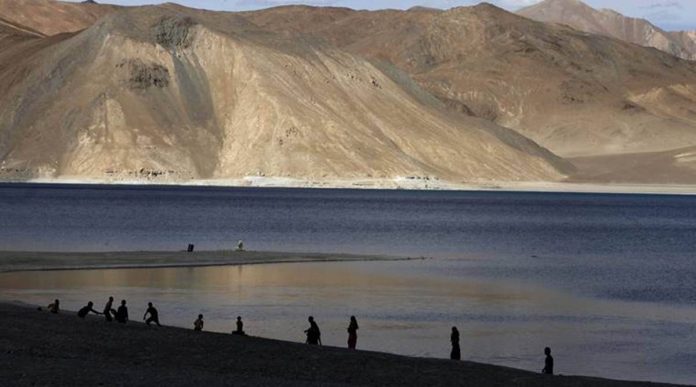
The Indian Army announced on Monday that on the intervening night between the 29th and 30th of August, the Chinese PLA “carried out provocative military movements to change the status quo” but the Indian Armed Forces personnel thwarted their nefarious intentions by pre-empting their movements on the Southern Bank of the Pangong Tso lake and strengthening their positions to stop the unilateral Chinese expansionism.
Now, more details are emerging regarding the events of the particular night. National Security Analyst Nitin Gokhale said that the Indian Army had noticed suspicious PLA movements in response to which they moved to occupy “unheld features along LAC to dominate” the South Bank of Pangong Tso. He said that Indian troops had not breached the LAC.
3. LAC has not been crossed but Indian Army has thwarted PLA design to change the LAC along the ridge from South Bank.
— Nitin A. Gokhale (@nitingokhale) August 31, 2020
4. India’s move has come in response to PLA aggressiveness despite the mil-diplomatic talks that are on
Vishnu Som of NDTV also said that the Indian Army has occupied the heights in response to Chinese aggression while discussions were on to resolve the conflict. According to Som, “the ball is now in China’s court”.
3. For the first time in months, the ball is now in China’s court – will there be sanity in a mutual disengagement across the region, a protracted standoff through the winter or, I dare say, will shots be fired.
— Vishnu Som (@VishnuNDTV) August 31, 2020
According to information received by ANI from unnamed sources, a special operations team occupied the heights on the particular night. The Chinese troops were barely a few hundred metres away from the said heights. The height is claimed to be south of South Bank near Thakung. The height is on the Indian side of the LAC, however, China claims it is on their side as well.
The height is in the area under Indian side of the LAC but the Chinese also claim it to be on their side. Two brigade commander level meetings have already been held in Chushul/Moldo for resolving the matter and the tension but it has not yielded any result: Sources
— ANI (@ANI) August 31, 2020
Hu Xijin, the Editor-in-Chief of the Global Times (Chinese state media), claimed on social media that Indian troops “again pulled a stunt at border”. Maintaining the pompous sense of bravado that has become the hallmark of Chinese communication in recent times, he said, “Don’t misjudge the situation anymore. If there is a conflict in Pangong Lake, it will only end in new defeat of Indian army.”
In a separate tweet, Hu Xijin said that the south bank of the Pangong Tso lake is under the actual control of China. The PLA statement on the matter claimed that Indian troops ‘illegally crossed’ the KAC at South Bank and ‘seriously violated China’s sovereignty’. The statement also threatens retaliation.
The south bank of Pangong Lake is under actual control of China. In 1962, the Chinese army beat the Indian army there. This time it is the Indian army that tried to break the status quo. I hope India will not make the same mistake.
— Hu Xijin 胡锡进 (@HuXijin_GT) August 31, 2020
The recent clashes indicate that the issue at the LAC in Ladakh is far from being resolved. While discussions are underway to resolve the dispute, China appears to be adamant on altering the status quo. However, consensus appears to be emerging that in the fresh clashes, India has made some decisive gains in the conflict.


