

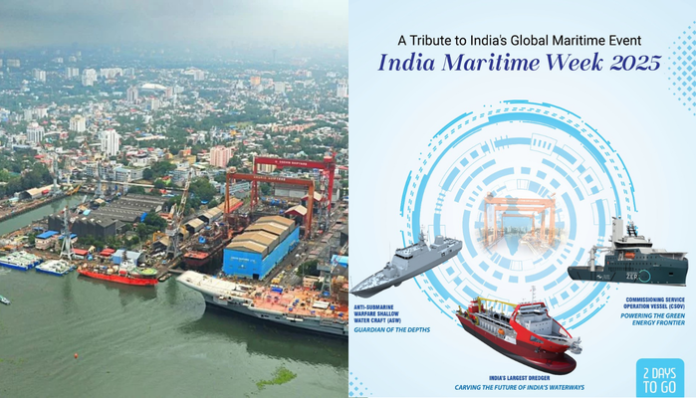
A tribute to India’s maritime might!
— Cochin Shipyard Limited (@cslcochin) October 15, 2025
Resonating the spirit of #IndiaMaritimeWeek2025, CSL, proudly prepares to launch three technologically advanced vessels, each a symbol of India’s growing prowess in #shipbuilding & #Atmanirbharta on 18 Oct 2025.#Mastering complexity &… pic.twitter.com/ofmUTmQq8D
The three vessels represent three emerging industries of defence shipbuilding, dredging, and offshore renewables. Highlighting India’s growing maritime might, each of these vessels fulfils a national strategic requirement.
The Anti-Submarine Warfare Shallow Water Craft, a 78-metre-long water shaft to be commissioned as the INS Magdala, is a demonstration of India’s emerging self-reliance in the field of defence manufacturing. It was indigenously developed as part of a contract for eight vessels signed in April 2019. It will be launched at the Kochi Yard of the CSL. The 896-tonne vessel is capable of achieving a speed of up to 25 knots. The craft is equipped with underwater sensors, lightweight torpedoes, ASW rockets and mine-laying capabilities. It is capable of conducting low-intensity maritime operations, Anti-Submarine Warfare missions in coordination with aircraft, in addition to search and rescue operations in coastal waters. It will replace the Indian Navy’s Abhay-class corvettes.
The Trailer Suction Hopper Dredger is not only the largest dredger in the country but is also among the biggest in Asia. The 93-metre-long and 19.3-metre-wide, 12,000 cubic-metre trailer suction hopper dredger is developed in collaboration with the global leaders Royal IHC, Netherlands. The DCI Dredge Godavari will be India’s most sophisticated dredger so far. It is 127 metres long and has a dredging depth of 36 metres. It will enhance DCI’s capacity manifold with respect to port deepening, reclamation and maintenance dredging activities.
The Hybrid Electric Methanol-Ready Commissioning Service Operation Vessel (CSOV) has been built in association with the globally acclaimed Kongsberg Maritime, Norway. It is a 93 metre long vessel, which is an example of India’s expanding capabilities in building advanced, next-generation offshore support vessels. It will support commissioning, installation and maintenance of offshore wind turbines. The vessel is equipped with hybrid-electric propulsion, methanol-ready engines, large lithium-ion battery packs, dynamic positioning (DP2), and a motion-compensated gateway system. Its advanced features make it capable of carrying out operations with safety and efficiency even in rough seas.
