

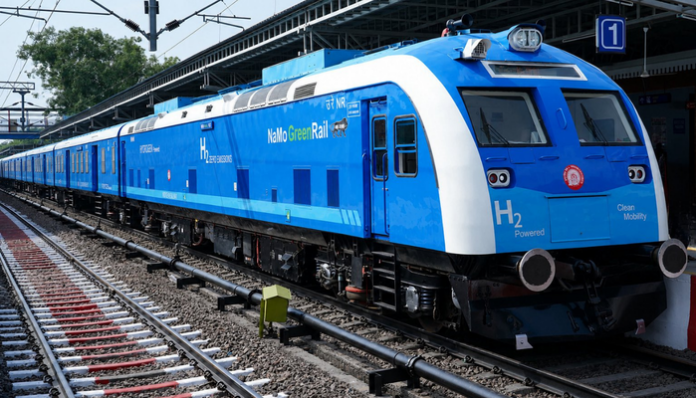
Marking a major step towards clean mobility in the railway sector, Prime Minister Modi will inaugurate India’s first hydrogen-powered train in Haryana today. The indigenously developed 10-coach trainset will run along an 89-km stretch between Jind and Sonipat, marking a significant leap towards sustainable train travel in the country.
The train will connect Jind Junction, Gohana Junction and Sonipat while serving intermediate stations. The proposed halts of the train include Jind City, Pandu Pindara Junction, Lalit Khera Halt, Bhambhewa, Isapur Kheri Halt, Butane Halt, Khandrai Halt, Rabrah Halt, Lath Halt, Mohana, Barwasni Halt and Sonipat New. The rail project serves the dual purpose of promoting clean energy and enhancing regional connectivity.
Bharat's First Hydrogen Train all set for its first journey!!#HydrogenTrain#भारत_की_पहली_हाइड्रोजन_ट्रेन pic.twitter.com/DZVJW2PPkj
— Ministry of Railways (@RailMinIndia) July 17, 2026
The project places India among a select group of nations
The rail project uses hydrogen fuel cell technology, which has emerged globally as a sustainable alternative to fossil-fuel-based traction systems. With the project, India has joined the league of countries, including Germany, Japan, China and the United States, which have been exploring hydrogen-powered rail transportation.
Since Hydrogen fuel cell technology is currently in its nascent stage, the project, which was developed as a pilot initiative, will provide valuable operational experience and support future applications of hydrogen-powered mobility in the railway sector.
#WATCH | Jind, Haryana | The first hydrogen-powered train between Jind and Sonipat tomorrow reached the Jind Railway Junction. Prime Minister Narendra Modi will flag off the train later today. (16.07) pic.twitter.com/qv8OIiI9Cv
— ANI (@ANI) July 17, 2026
How the Hydrogen Fuel Cell technology works
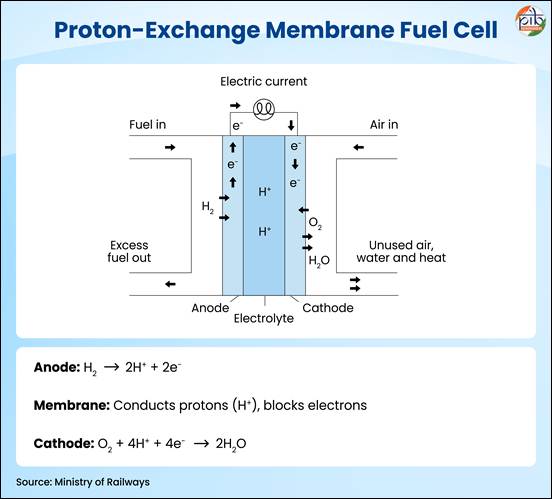
While conventional electric trains that draw power from overhead wires or diesel locomotives that burn fuel, this hydrogen-powered trainset generates its own electricity onboard through Proton Exchange Membrane (PEM) fuel cells.
The Hydrogen Fuel Cell Technology used in the rail project is a clean and sustainable method of generating power. The technology produces electricity through a chemical reaction using hydrogen. The main component of the system is a Proton Exchange Membrane Fuel Cell (PEMFC), which is the primary source of energy. The fuel cell generates energy by reacting hydrogen and oxygen across a proton-conducting Perfluorosulfonic Acid (PFSA) polymer membrane. The membrane allows only hydrogen ions (protons) to pass through while blocking electrons. The electrons are forced to travel through an external circuit, creating an electric current. This electricity is then used to run the train’s electric motors.
The train is equipped with two Hydrogen Driving Power Cars (DPCs) and eight Trailer Coaches (TCs). In every DPC, there are fuel cells, lithium iron phosphate (LFP) batteries and hydrogen storage cylinders and produces 1,200 kW (around 1,600 hp) of power. Together, the two power cars provide sufficient propulsion for the full train set.
Only water vapour and heat are produced as byproducts in the process. No harmful emissions take place during the process, as no fuel is burned. This makes hydrogen the cleanest propulsion technology currently available for rail transport. Hydrogen is a high-energy fuel (120 MJ/Kg (megajoules per kilogram)) compared to diesel (43 MJ/Kg). It is low maintenance with a manageable carbon footprint.
An integrated rail project for reliable and safe travel
The project will be supported by the country’s largest railway hydrogen storage and refuelling facility been established at Jind, Haryana. The facility stores nearly 3,000 kg of hydrogen at a time. The Petroleum and Explosives Safety Organisation (PESO) has granted the required licence, which covers the storage and dispensing of compressed hydrogen gas at the site.
The entire hydrogen ecosystem has been designed in accordance with internationally accepted standards, including the NFPA-2 (National Fire Protection Association) and ISO (International Organisation for Standardisation) 19880 Series. It has undergone an independent third-party safety assessment by TÜV SÜD, Germany, one of the world’s leading technical inspection and certification agencies.
The project has been developed as per the design and technical features approved by the Research, Design & Standards Organisation (RDSO). It combines advanced propulsion technology with dedicated hydrogen storage, refuelling and operational infrastructure. It emits only water vapour, requires no overhead electrification, and reduces noise and fossil fuel dependence.
For ensuring reliable and safe rail operations, the facility has an integrated infrastructure. It has been equipped with a hydrogen compression system for refuelling operations, technical support and critical spares for reliable functioning and a standby compressor to ensure uninterrupted refuelling.
As hydrogen is highly inflammable and cannot be seen or smelled, great emphasis has been given in the rail project on detecting even the smallest leak instantly. A multi-layered “defence-in-depth” approach has been adopted in the project by installing continuous detection systems to monitor for hydrogen leaks, heat, flames and smoke on the train and at the plant.
The project aligns with the National Green Hydrogen Mission
The train project aligns with the National Green Hydrogen Mission and Indian Railways’ broader journey towards net-zero carbon emissions. After achieving more than 99 per cent electrification of broad-gauge routes and sharply reducing diesel dependence, the introduction of hydrogen propulsion represents the next logical step in clean mobility.


