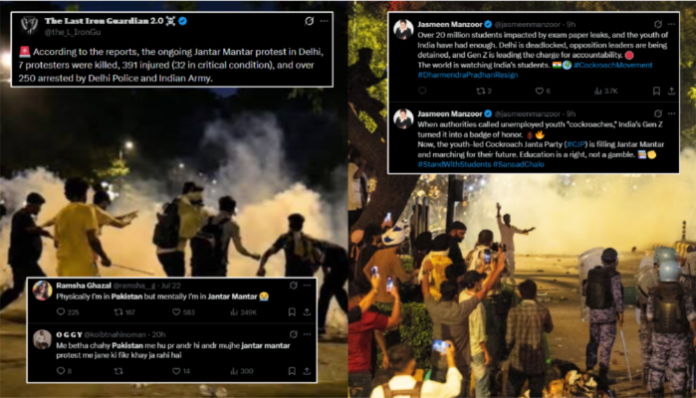
The Cockroach Janta Party (CJP) agitation that began against the NEET paper leak and demanding accountability from the government for shortcomings in the education system has escalated into a violent movement. What started as a “peaceful protest” soon turned into aggressive clashes with the police, resulting in injuries to at least 100 personnel, including senior officials. Chaos erupted in the national capital and the situation appeared to be spiralling out of control, after which the authorities had to take firm action to restore law and order.
Notably, CJP sought Education Minister Dharmendra Pradhan’s resignation, but senior government functionaries have categorically denied the “political” demand. They highlighted that the centre has taken substantial steps to resolve the concerns of students, stating that those affected by these issues have already registered for upcoming courses in colleges and universities. It was strongly insinuated that the demonstration is orchestrated by vested interests rather than authentic participants.
CJP has exploited the hardships faced by students and resorted to perilous pressure tactics in a desperate bid to replicate the anarchy that swept through Nepal and Bangladesh to overthrow the democratically elected Modi government.
Pakistan amplifies the fabricated narrative
Of course, it is only natural that those across the border would want to use such an opportunity to advance their own agenda and further exacerbate the crisis. The people from Pakistan could barely hide their delight at the unrest and almost portrayed it as India’s own “Tiananmen Square” moment.
Notably, the Islamic Republic, which uses terrorism as a tool of foreign policy and wants to bleed India by a thousand cuts, has spent much of its existence as a direct or indirect colony of its military establishment. However, its citizens are preoccupied with elevating a politically motivated struggle to the status of an organic phenomenon for a nation they perceive as an existential threat and their primary adversary.
Thus, it raises the question of why there has been such an unexpected display of support for Indians, and the answer is evident. Pakistani army, politicians, celebrities, influencers and the general populace have no love lost for their neighbours.
In fact, their animosity towards the Bharatiya Janata Party (BJP) government, which refuses to compromise on national security for the inconsequential “Aman ki Asha” production and is perceived as pro-Hindu due to its rejection of the Muslim victimhood narrative, is more pronounced than their disdain for other “secular” parties that cater to Islamists and Islamabad, regardless of the consequences.
Moreover, “Operation Sindoor” and the suspension of the “Indus Water Treaty” have rubbed salt into their festering wounds. Therefore, any action that could undermine the current government will undoubtedly receive full support from Pakistan, which is keen to witness bloodshed and confrontations on the streets of India. The truth remains that they wish India to be set ablaze by turmoil and anyone who can thwart these malicious ambitions is their greatest foe.
Pakistani celebrities, people show their “support” for Indian students: The truth behind the pretence
Popular Pakistani rapper Talha Anjum, who abused India, claimed that Indian forces occupy Kashmir, mocked Group Captain Abhinandan Varthaman and endorsed a post calling Prime Minister Narendra Modi a terrorist, expressed “solidarity with the students staging protest against their government.”
He then returned to his agenda of spreading lies, derogatorily terming Indian media as PM Modi’s “b*t*h” and alleging that police are murdering students in the name of performing their duty of maintaining law and order. His objective was obviously to contribute to the unrest, irrespective of the veracity of his wild statements.
Anjum then attacked figures from politics, Bollywood and the bureaucracy for their supposed indifference towards the common masses. “All you have is your resilience, keep resisting, keep fighting,” he concluded dramatically in his disinformation post, interfering in India’s internal matters.
Standing in solidarity with the students staging protest against their government in Delhi, India. The news channels are Modi’s b!tch, the police who is killing you all in the name of law & order is only doing their “job” & the most consequential figures in politics, bollywood &…
— Talha Anjum (@talhahanjum) July 22, 2026
Anjum did not need to look outside his nation’s soil to denounce the real injustice. Pakistan-occupied Kashmir has been witnessing major turmoil for months, with those demanding autonomy, basic rights and facilities or simply raising their voices against inflation being labelled as terrorists, banned, arrested, killed and subjected to harsh state crackdowns. The less said about the violation of human rights and state repression in Balochistan, including enforced disappearances, extrajudicial killings, the targeting of peaceful activists and exploitation of its natural wealth at the expense of the natives, the better.
Anjum and others like him do not dare to speak out against the oppression endured by their own people, yet they are quick to side with the “protesters” in India. Why do their hearts not ache for their fellow citizens who are suffering immensely? This should be sufficient to clarify the performative support for Indians and the hidden motives behind it.
Journalist Mahwash Ajaz, who is another Zohran Mamdani fangirl, has been actively promoting the ongoing protest in India, even sharing misleading videos to illustrate the growing attendance. She lamented, “Nothing will change in India unless there are actual alternatives to PM Modi.”
Ajaz then remarked that the saffron party has significant influence and his support base remains substantial across politics, real life and the media. She then expressed uncertainty about whether CJP founder Abhijeet Dipke could serve as the “antidote,” adding that the Indian National Congress was not the solution.
Real talk re India.
— Mahwash Ajaz 🇵🇰 (@mahwashajaz_) July 22, 2026
Nothing will change in India unless there are actual alternatives to Modi. The BJP has far too many inroads & Modi’s support base continues to exist in big numbers. In politics, even IR — heck even in the media — these numbers mean everything.
The protests…
Ajaz commented that “things might change,” contradicting her earlier remarks after violence erupted during the unauthorised “Chalo Sansad” procession by CJP. She accused that “hate-filled rhetoric floods the BJP vein” and appeared to harbour a flicker of hope that such actions by nefarious elements could lead to the removal of PM Modi, which is unlikely to occur through elections given his solid voter support.
NGL, didn’t think anything would ever change in India given how much support their govt enjoys — despite the hate filled rhetoric that floods the BJP veins — but wow. Things might actually change if the people keep demanding accountability.
— Mahwash Ajaz 🇵🇰 (@mahwashajaz_) July 22, 2026
Many Pakistanis, impelled to display their support for the protesters, started to declare that they were spiritually present at Jantar Mantar.
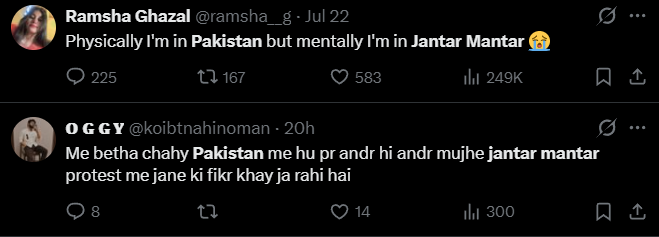
Ahsan Mirza, a digital creator, attempted to draw parallels between the demonstrations in India and Pakistan, declaring that the students of his nation back those at Jantar Mantar. He self-projected and dubbed Indians as “terrorists” who would rightly call out his sinister propaganda disguised as support.
“We are one. Our ancestors have partaken from the same source as your forefathers. All Pakistani students are with you. We are students. Who else could we possibly support? Those in positions of power will inflict greater atrocities upon you. However, you should not sacrifice yourself and retreat to your homes,” he stated.
“Life is far more important. Protests keep happening. Otherwise, your government will blame your deaths on us,” Mirza quipped, reflecting the level of sensibility expected from his jihadi kind. He also wanted protesters to create a “change” in India and reiterated that Pakistani students were in support of this venture.
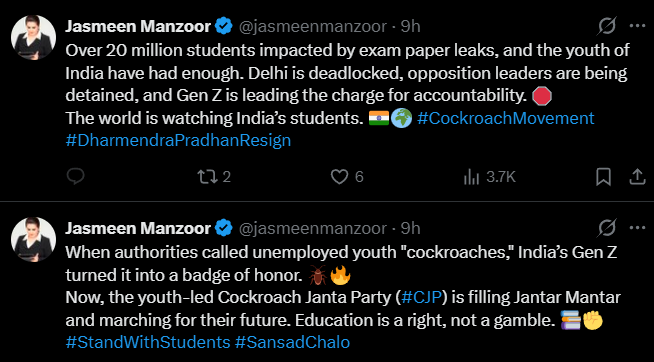
Jasmeen Manzoor, another journalist from Pakistan, stated that Bollywood, which has historically functioned as a diplomatic extension of Islamabad, has ultimately turned against the government. “What started as a protest over exam paper leaks has officially snowballed into Pm Modi’s toughest political storm yet. The youth are rewriting India’s political future,” she added gleefully.
Tears, batons, and Bollywood outrage. 🛑 From Salman Khan to Shabana Azmi, the film industry is turning against the state's handling of the CJP student protests.
— Jasmeen Manzoor (@jasmeenmanzoor) July 23, 2026
What started as a protest over exam paper leaks has officially snowballed into Modi's toughest political storm yet.…
She asserted that the world is observing as baton charges and tear gas confront Gen Z, who are leading the charge amidst a stalemate, while opposition leaders are being detained as if India is experiencing an emergency. Rahul Gandhi and other Congress leaders had to be removed because they continued their demonstration outside PM Modi’s residence, which is a high-security zone, despite repeated requests and agreeing to leave earlier.
Furthermore, Chief Justice Surya Kant used the term “cockroach”, and it had nothing to do with the ruling party, contrary to the deceptive portrayal by the conniving Pakistani who tweeted multiple times to praise the “student protest” for obvious reasons.
British Pakistani writer Dan Qayyum also joined the chorus to vilify the Modi government, insisting that it had suffered a defeat because it had become fearful of the students rather than intimidating them as it had intended. “You were supposed to be afraid. Yet it’s those attacking you with sticks that are terrified of you. This is the bravest thing happening anywhere in the region right now, and you have our absolute respect,” he argued.
A government that is afraid of its children has already lost. My message to the young people of India. You were supposed to be afraid. Yet it's those attacking you with sticks that are terrified of you. This is the bravest thing happening anywhere in the region right now and you… https://t.co/RlPPjptuhd pic.twitter.com/nKKXCSoie6
— Dan Qayyum (@DanQayyum) July 22, 2026
Qayyum shared similar tweets and even authored an article comparing the protests in India and Pakistan. He outlined that individuals set aside their castes, religions and identities to come together in Delhi, but such unity is unattainable in his home country as people are divided by ethnicity, party and sect but refrained from mentioning faith as it would have revealed the brutal persecution of dwindling minorities and the deafening silence from his ilk who spot injustice everywhere, especially in relation to India and Muslims but never in their own backyard, particularly when the victims are Hindus.
The boy in Kanpur and the boy in Korangi have the same complaint. India spent twelve years making sure its half never assembled. Ours was already split by ethnicity and party and sect, so nobody here had to build anything.
— Dan Qayyum (@DanQayyum) July 23, 2026
India's lines failed this month. https://t.co/0QZChOfcxY
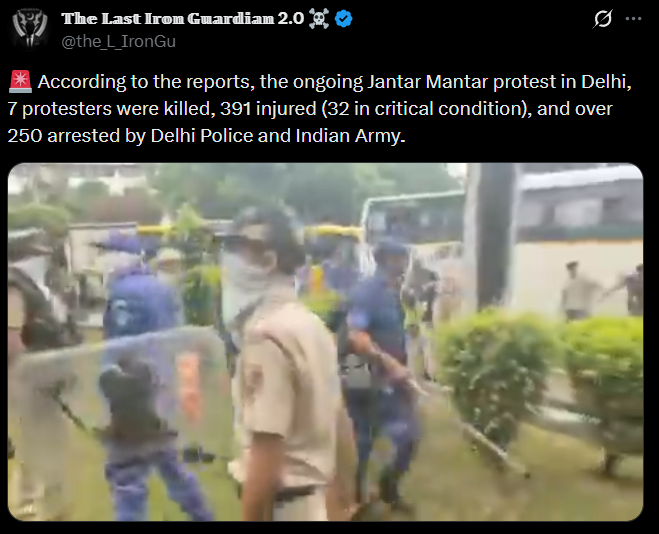
It was not unexpected that Pakistani accounts were also sharing bogus reports on social media. “7 protesters were killed, 391 injured (32 in critical condition) and over 250 arrested by Delhi Police and Indian Army,” a post read, which aimed to intensify tensions and create panic under the guise of support.
The real goal masquerading as endorsement
Pakistan is confronted with a continuous stream of major difficulties stemming from a faltering economy, surging inflation, increasing poverty, crippling education and health facilities, climbing unemployment, unstable government, non-existent democracy, volatile provinces, mounting attacks by Tehreek-e-Taliban Pakistan (TTP), Baloch fighters struggling for their independence, among other groups.
However, Pakistanis have extended their support to the agitation in India while Balochistan and PoK are in profound distress, encountering repeated crackdowns for wanting their rights and freedom. This outrage is also rarely visible when military dictators dismantle governments and imprison or execute their prime ministers. It is peculiar that the human rights activists and protesters in Pakistan evoke negligible sympathy from their countrymen who have suddenly found compassion for Indians.
More importantly, these are the very people who spare no opportunity to criticise India regarding Kashmir, even glorifying terrorists and terming Indian women as spoils of war, ready to be seized during “Operation Sindoor.” This ongoing support is reminiscent of Lashkar-e-Taiba’s co-founder Hafiz Muhammad Saeed’s praise for Barkha Dutt and the Congress. From Pakistani terrorists to every last member of this rotten extremist society, they are adept at misusing India’s internal affairs and issues to create division and discord.
The rogue state has historically been obsessed with India and strives to exploit any minor issues to its advantage.
A noticeable pattern has also come to light with Pakistani accounts regularly amplifying uploads by CJP leaders, including Dipke and those involved with the agitation. It appears that both sides have found common ground in their opposition to PM Modi. Meanwhile, Pakistani social media handles are already under scrutiny for circulating false claims of violence to add to the upheaval and tarnish India’s reputation.
This should act as a cautionary signal, as when the enemy supports your cause, it indicates that you are either serving their purpose or playing into their hands. However, their final goal appears to be a push for a regime change in India with the help of global powers. It has glaring similarities to when former Congress leader Mani Shankar Aiyar appealed to Pakistan to help remove the Modi government.
On the other hand, the centre has consistently engaged with the protesters, and the police only intervened when public safety and security were under threat. Furthermore, the police were attacked and had to respond accordingly. PM Modi has assured that the responsible will be brought to justice and no one will be allowed to jeopardise the future of children.