

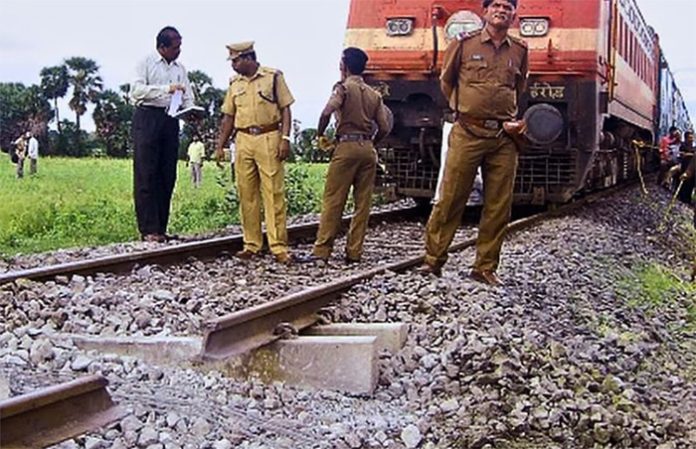
In a significant breakthrough for security forces, a suspected Maoist operative linked to Thursday’s improvised explosive device (IED) blast on a railway track in Assam’s Kokrajhar district was killed during a fierce encounter with police early Saturday morning.
The deceased has been identified as Ipil Murmu alias Rohit Murmu, a resident of Jharkhand with a history of insurgent activities in multiple cases across the state. Police sources confirmed that Murmu had infiltrated Assam in recent months to establish a Maoist base and coordinate subversive operations, including the October 23 blast that targeted a goods train between Kokrajhar and Salakati stations.
Acting on credible intelligence about militants hiding in the Nadangiri Hills area under Salakati Police Outpost, a joint team from Assam Police, led by Kokrajhar Superintendent of Police Pushpraj Singh, launched a cordon-and-search operation around 2 a.m. When the forces closed in, the suspects opened fire, triggering a gun battle that lasted approximately 20 minutes.
Murmu sustained critical injuries during the exchange and was rushed to a nearby hospital, where he was declared dead on arrival. His associate managed to escape into the dense forest, prompting intensified searches in the region. From the encounter site, security personnel recovered a 9mm pistol, two hand grenades, live ammunition, and two identity cards, one in the name of Ipil Murmu and another as Rohit Murmu, along with other incriminating materials.
“We received specific inputs about armed militants planning a major incident. Upon reaching the spot, they fired at us, and in retaliation, one was injured and later succumbed to his wounds,” SP Pushpraj Singh told reporters. Investigations are ongoing to link Murmu to similar blasts in Jharkhand, and forensic teams are analysing the recovered explosives.
The encounter came after an incident in the early hours of October 23, when an IED exploded around 1 a.m. on a railway track in Kokrajhar district, damaging nearly two feet of the track between Salakati and Kokrajhar. The blast briefly halted train services, with engineers working overnight to repair the line.
A goods train narrowly escaped derailment, as the explosion’s impact was insufficient to dislodge the tracks fully. No casualties were reported, but the attempt raised alarms about escalating Maoist incursions into Assam’s lower districts.
Murmu’s presence and activities in Assam were known to the authorities, and a Jharkhand Police team had recently arrived in the state to coordinate with local authorities in tracking him down.
Assam Chief Minister Himanta Biswa Sarma, who had flagged the Maoist angle hours after the blast, confirmed Murmu’s involvement. Speaking to reporters in Silchar on October 24 before the encounter, Sarma said, “There is a person in Kokrajhar who is also operating from Jharkhand and he has a Maoist link. According to our information, this person is trying to create a new outfit in Assam. He has a close link with Jharkhand and Jharkhand police is also after him. Jharkhand and Assam will launch a joint operation against him.”
A suspected Maoist with links to Jharkhand attempted to derail a train in Assam by detonating railway tracks near Kokrajhar.
— Himanta Biswa Sarma (@himantabiswa) October 24, 2025
This attempt has not succeeded and police forces of both our states have launched a joint manhunt to nab the suspect. pic.twitter.com/kMIdOd3qd1
Elaborating on the blast, the CM added, “They triggered the blast but somehow the wheel of the train is bigger than the damage to the track and a big mishap was averted. They have targeted a goods train, they didn’t target a passenger train.” Sarma emphasized that the attempt underscored the need for heightened vigilance.
