

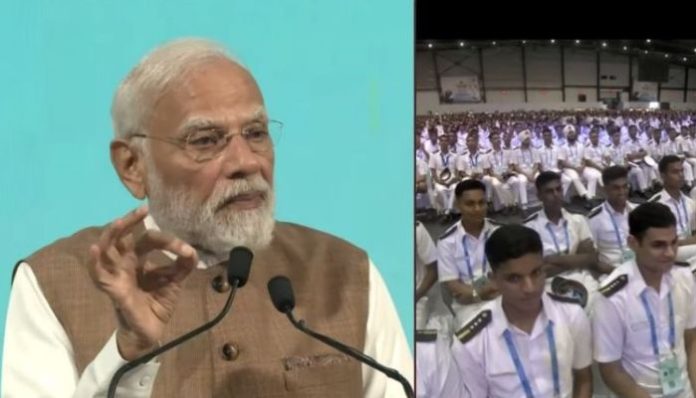
Prime Minister Narendra Modi addressed the Global Maritime Leaders Conclave in Mumbai on Wednesday (29th October), marking the third day of India Maritime Week 2025. Addressing a gathering of international delegates, naval cadets, and industry captains, the Prime Minister referred to the event as a proud moment in the maritime journey of India.
मैं आप सभी का Global Maritime Leaders Conclave में अभिनंदन करता हूं। साल 2016 में मुंबई में ही इस आयोजन की शुरुआत हुई थी।
— BJP (@BJP4India) October 29, 2025
हम सभी के लिए यह खुशी की बात है कि आज यह समिट एक Global Event बन गई है।
आज यहां इस कार्यक्रम में दुनिया के 85 से अधिक देशों की भागीदारी अपनेआप में एक बहुत… pic.twitter.com/D8RBOqbz4R
“This event began in 2016, and today it has become a truly global summit,” PM Modi said, adding that participation from over 85 countries “sends a strong message to the world about India’s growing maritime strength.” He also announced the inauguration of several major projects in the shipping sector and the signing of Memorandums of Understanding (MoUs) worth crores of rupees. “Your presence at this event reflects the world’s confidence in India’s maritime capabilities,” he said.
#WATCH | Mumbai: Addressing the Maritime Leaders' Conclave, Prime Minister Narendra Modi says, "This event began in 2016, and it is a matter of great pride for all of us that today this summit has become a global event. The participation of more than 85 countries from around the… pic.twitter.com/5T5g9U7Yt9
— ANI (@ANI) October 29, 2025
India’s maritime sector setting new records
Highlighting the progress achieved in recent years, PM Modi said that the year 2025 has been a landmark one for India’s maritime industry. “In 2024–25, India’s major ports handled the highest-ever cargo in our history,” he said. “Not only that, Kandla Port has become the first in India to start a megawatt-scale indigenous green hydrogen facility.”
#WATCH | Mumbai: Addressing the Maritime Leaders' Conclave, Prime Minister Narendra Modi says, "… In this era of the 21st century, India's maritime sector is moving forward with rapid speed and energy. The year 2025 has been a very important year for India's maritime sector. In… pic.twitter.com/vxCXzvQRvx
— ANI (@ANI) October 29, 2025
He also spoke about key developments at the Jawaharlal Nehru Port Authority (JNPA), where the Bharat Mumbai Container Terminal Phase 2 has now begun operations. “This expansion has doubled the port’s handling capacity, making it the largest container port in India,” Modi said. He added that the achievement was made possible through the biggest-ever foreign direct investment (FDI) in India’s port infrastructure, thanking Singapore for its partnership in the project.
#WATCH | Mumbai: Addressing the Maritime Leaders' Conclave, Prime Minister Narendra Modi says, "Another major milestone has been achieved at Jawaharlal Nehru Port Authority. The Bharat Mumbai Container Terminal Phase 2 has also commenced operations at JNPT. This has doubled the… pic.twitter.com/8KrQ1ThFu1
— ANI (@ANI) October 29, 2025
The Prime Minister further noted that outdated, colonial-era shipping laws had been replaced with modern, forward-looking legislation designed for the 21st century. “These new laws empower state maritime boards, prioritise safety and sustainability, and promote the integration of digital technology in port management,” he said.
Massive maritime investments announced
PM Modi’s speech also included a string of new investment announcements worth nearly $26 billion (around Rs 2.2 lakh crore), signalling a massive boost to India’s maritime capabilities. He began by by talking about how Vizhinjam International Seaport, India’s first deepwater transhipment hub in Thiruvananthapuram, became fully operational this year and docked the world’s biggest container vessel, the MSC-Irina.
Mumbai, Maharashtra: Prime Minister Narendra Modi launched initiatives for the shipping and shipbuilding sector and inaugurated Investment MoUs at the Maritime Leaders' Conclave pic.twitter.com/9mt93G5lvi
— IANS (@ians_india) October 29, 2025
Building on that momentum, Modi unveiled plans to strengthen India’s shipping and port infrastructure even further. He announced that the Shipping Corporation of India will expand its fleet to 216 vessels, including bulk carriers, tankers, and offshore vessels, by 2047.
He also launched India’s very own Bharat Container Shipping Line with 51 container vessels on a Rs 60,000 crore investment. In addition, oil and gas public sector undertakings have placed orders for 59 new ships worth Rs 47,800 crore.
A new Green Tug Programme was also introduced, under which 100 eco-friendly tugs will be acquired for Rs 12,000 crore to make Indian ports more sustainable. Alongside these, the Dredging Corporation of India will acquire 11 dredgers worth Rs 3,775 crore. Together, these initiatives account for 437 new vessels being built or acquired under the Rs 2.2 lakh crore maritime investment plan.
Union Minister for Ports, Shipping and Waterways, Sarbananda Sonowal, praised the Prime Minister’s vision, calling the conclave a meeting point of “vision, education, policy, and innovation.” He said the government’s latest reforms in maritime laws and logistics were making India a hub for global maritime activity.
Maharashtra Chief Minister Devendra Fadnavis also addressed the gathering and said the India Maritime Week has evolved into a platform to bring global innovations to India’s ports and waterways. He announced that Maharashtra alone had signed MoUs worth Rs 56,000 crore during the event, thanking PM Modi for “reimagining the maritime landscape of India.”
India Maritime Week 2025: Uniting oceans under one vision
India Maritime Week 2025 is the Government of India’s flagship global event that aims to showcase the country’s long-term maritime vision. Organised under the theme “Uniting Oceans, One Maritime Vision,” the event is being held from 27th to 31st October 2025. The landmark maritime event, inaugurated by Union Home Minister Amit Shah on Monday, 27th October.
The five day event has brought together major stakeholders from shipping, ports, shipbuilding, cruise tourism, and the blue economy. Over 85 countries are participating, with more than 1,00,000 delegates, 500 exhibitors, and 350 international speakers attending the sessions.
