

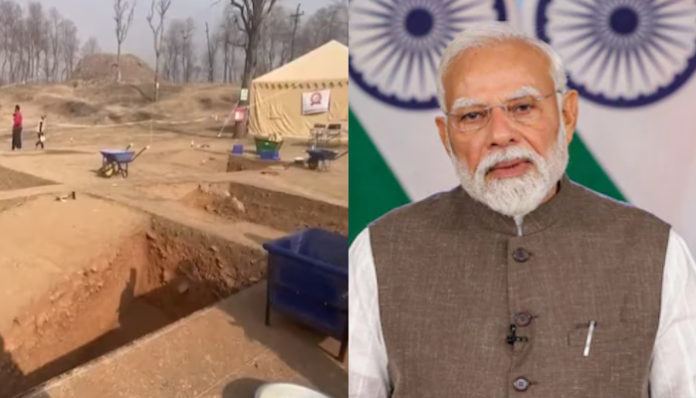
On 28th December (Sunday), Prime Minister Narendra Modi shed light on the discovery of ancient Buddhist stupas in Zehanpora village of the Baramulla area of north Kashmir. He hailed the findings as a matter of national pride and proof of the region’s illustrious cultural legacy while addressing the 129th episode of his monthly radio programme “Mann Ki Baat.”
बारामूला के जेहनपोरा का बौद्ध परिसर बताता है कि जम्मू-कश्मीर की सांस्कृतिक पहचान कितनी प्राचीन और समृद्ध रही है। यहां के बौद्ध स्तूपों का पता जिस तरह से चला, उसकी कहानी भी बहुत दिलचस्प है!#MannKiBaat pic.twitter.com/rw5UxMXva8
— Narendra Modi (@narendramodi) December 28, 2025
The prime minister highlighted that what were previously considered to be natural mounds were recently found to be the remnants of a massive and ancient Buddhist complex. According to him, archaeologists thoroughly inspected the site and determined that the mounds were peculiar, resulting in a comprehensive scientific probe of the region.
PM Modi expressed, “A scientific study of these mounds began, and drones were used to take photographs from above, and the land was mapped. And then some surprising things started to emerge,” He further conveyed, “It turned out that these mounds weren’t natural. They were the remains of a large human-made structure.”
Thousands of kilometers away from Kashmir, an old, faded photograph was discovered in the archives of a museum in France. The photograph, taken in Baramulla, showed three Buddhist stupas #MannKiBaat pic.twitter.com/xtPgsC0EqH
— MyGovIndia (@mygovindia) December 28, 2025
This research revealed an amazing transnational relationship. PM Modi elaborated that an old and fuzzy photo featuring three stupas was found in a French museum’s archives thousands of kilometres from the valley. Researchers were able to make connections and validate the Zehanpora site’s historical significance owing to this uncommon visual evidence.
PM Modi outlined, “Three Buddhist stupas were visible in that photograph of Baramulla. From here, time took a turn, and Kashmir’s glorious past was revealed to us. This history dates back nearly two thousand years.” He added, “The Buddhist complex in Zehanpora reminds us of Kashmir’s past and its rich identity.”
PM Modi emphasised the area’s important contribution to the growth and dissemination of Buddhist culture in history. He noted that these results indicate Kashmir’s longstanding status as a hub for education, spirituality and cross-cultural interaction. He stressed the importance of comprehending and protecting such heritage since it fosters cultural pride and ties current generations to their origins.
The Prime Minister stated that instances like these show how technology, history and international collaboration can all work together to bring back overlooked aspects of India’s past. He then concluded that Jammu and Kashmir’s legacy constantly inspires people and teaches important lessons about harmony, knowledge and shared history that are applicable even in this day and age.
The Buddhist complex in Baramulla
The valuable discovery has already been reported by OpIndia. Large architectural remnants of a pivotal Buddhist complex from the Kushan era have been unearthed by archaeologists in Zehanpora in the Baramulla area of north Kashmir. The location has produced Buddhist stupas, walls, copper artefacts, ceramic shards from the Kushan era, an urban settlement complex (perhaps chaityas and viharas), and more revelations are anticipated in later excavation stages.
The project is a joint effort between the Jammu & Kashmir Department of Archives, Archaeology and Museums (DAAM), Centre of Central Asian Studies (CCAS) and the University of Kashmir. Their goal is to enhance knowledge of the cultural and religious backdrop of ancient Kashmir.
These excavations shed light on the extraordinary sociocultural sophistication of ancient Kashmir. The region was recorded to be situated at the intersection of trade routes connecting the Himalayan realm, Central Asia and the plains of the country. The material culture that has been found thus far points to a prosperous community with robust creative traditions and potential ties to the wider Gandhara and Central Asian Buddhist domains.
