

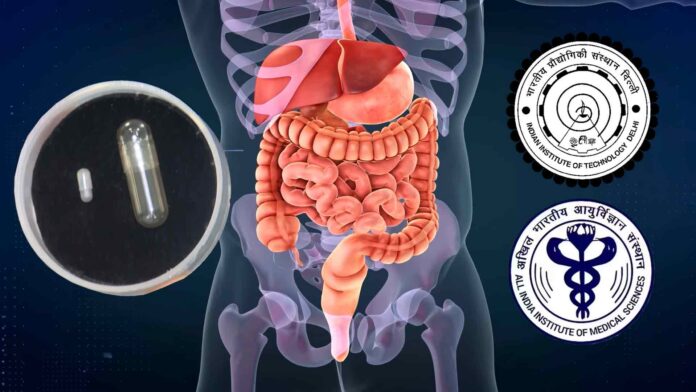
In a significant advancement for medical diagnostics, researchers from the Indian Institute of Technology (IIT) Delhi and the All India Institute of Medical Sciences (AIIMS) New Delhi have developed and successfully tested a swallowable “smart capsule” designed to collect microbiome samples directly from the small intestine. This innovative device promises to revolutionise the study and diagnosis of digestive diseases by providing non-invasive access to previously hard-to-reach gut bacteria.
The project, funded by the Indian Council of Medical Research (ICMR), addresses a critical gap in microbiome research. Traditional methods rely on invasive procedures like endoscopy or indirect stool samples, which often fail to capture the full diversity of microbes in the small intestine. The smart pill, developed at IIT Delhi’s Medical Microdevices and Medicine Laboratory, offers a safer, more accurate alternative by autonomously navigating the digestive tract to gather site-specific samples.
Measuring just 7 mm by 2.7 mm, about the size of a regular capsule, the device is encased in an enteric-coated gelatine shell that protects it from harsh stomach acids. The device is taken by mouth just like pills and capsules are taken. Once it reaches the higher pH environment of the small intestine, the coating dissolves, allowing intestinal fluid to enter, thereby collecting microbial samples. A specialized hydrogel then swells to seal the inlet, preventing contamination as the pill continues through the gut and exits naturally.
Testing conducted on Sprague-Dawley rats demonstrated the pill’s efficacy. In experiments, the device successfully transited from the stomach to the intestine in four out of five animals, collecting sufficient genetic material for detailed microbial sequencing using nanopore technology. It identified gut microbes down to the species level and even detected biochemical markers like intestinal alkaline phosphatase, an indicator of gut health. No injuries or surgical interventions were required, highlighting the safety of the device.
Prof. Sarvesh Kumar Srivastava, principal investigator at IIT Delhi, compared the human microbiome to a “hidden universe” of living microbes. “Just as we send rovers to explore outer space, we need miniaturised devices to explore the inner space of the human body,” he said.
Co-senior author Dr. Samagra Agarwal from AIIMS New Delhi’s Department of Gastroenterology and Human Nutrition Unit emphasised the clinical potential, saying, “Understanding the microbes and chemicals released there could be key to early disease detection, monitoring chronic conditions, and developing more targeted treatments.”
The findings, published in the Wiley Online Library in November 2025, have paved the way for human clinical trials, which will be conducted in the next phase of the project.
This “Made in India” innovation could transform personalised medicine, aiding in the management of conditions such as inflammatory bowel disease, infections, diabetes, and neurological disorders by unlocking deeper insights into the gut’s role in immunity, digestion, and metabolism.
