

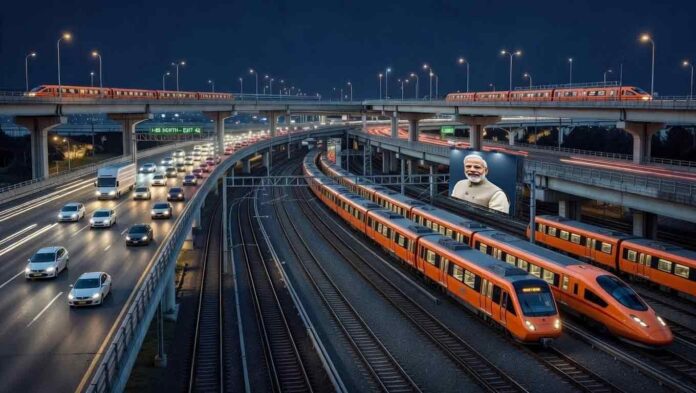
The Union Cabinet, chaired by Prime Minister Narendra Modi, approved several major infrastructure projects on February 13, 2026, focusing on enhancing railway capacity, national highway networks, and urban metro connectivity across multiple states. These decisions aim to boost economic growth, reduce congestion, improve logistics, generate employment, and support sustainable development under initiatives like PM GatiShakti.
The approvals include three significant multitracking railway projects, highway upgradations in Maharashtra, Gujarat, and Telangana, and a key metro rail extension in Noida.
Railway Multitracking Projects
The Cabinet gave the nod to three multitracking initiatives covering Delhi, Haryana, Maharashtra, and Karnataka, adding approximately 389 km of train tracks to the Indian Railways network at a total estimated cost of ₹18,509 crore. These projects, set for completion by 2030-31, include Kasara–Manmad 3rd and 4th lines, Delhi–Ambala 3rd and 4th lines, and Ballari–Hosapete 3rd and 4th lines.
The enhancements will improve operational efficiency, alleviate congestion, and facilitate better movement of goods such as coal, steel, iron ore, cement, and foodgrains. They are expected to generate around 265 lakh person-days of direct employment during construction, handle additional freight traffic of 96 million tonnes per annum (MTPA), reduce oil imports by 22 crore litres, and cut CO2 emissions by 111 crore kg (equivalent to planting 4 crore trees).
The projects will benefit about 97 lakh people across 3,902 villages and enhance access to key tourist sites like Trimbakeshwar Jyotirlinga, Hampi (UNESCO World Heritage Site), and Tungabhadra Dam.
Highway Upgradations
Several national highway projects were cleared by the cabinet to improve connectivity in key regions.
Approval was granted for the rehabilitation and upgradation of the Ghoti–Trimbak (Mokhada)–Jawhar–Manor–Palghar section of NH-160A in Maharashtra. Total length of the road is 154.635 km, which will be upgraded to 2-lane and 4-lane highway with paved shoulders configuration, at a cost of ₹3,320.38 crore. This will provide an alternate freight route bypassing Nashik city, connect industrial areas, tribal regions in Palghar district.
This section of the road connects NH-160A to Delhi-Mumbai Expressway (NE-4) and NH-48. It is projected to generate nearly 45 lakh person-days of employment and support PM GatiShakti nodes.
In Gujarat, the Dhamasiya–Bitada/Movi (47.46 km) and Nasarpore–Malotha (60.21 km) sections of NH-56 will be upgraded to four-lane standard, totalling 107.67 km at ₹4,583.64 crore. The project will improve access to tribal areas like Dahod, Chhota Udepur, Tapi, and Bharuch, reduce travel time by about 40%, and enhance links to the Statue of Unity. The project will ease congestion on NH-56 and enhance further connectivity to NH-53, NH – 48 and the Delhi–Mumbai Expressway (NE – 4).
In Telangana, NH-167 from Gudebellur to Mahabubnagar (80.01 km) will be widened to four-lane standard on the Hyderabad-Panaji Economic Corridor, at ₹3,175.08 crore. The project will provide significant benefits to Narayanpet & Mahabubnagar districts in the state of Telangana. This will enhance the efficiency of freight movement, reducing logistics cost and driving socio-economic growth in the region.
The project alignment integrates with 2 major National Highways, NH-150 and NH-167N, and provides connectivity to three PM GatiShakti Economic Nodes, nine Social Nodes and seven Logistic Nodes in the region.
Metro Rail Extension in Noida
The Cabinet also approved the extension of the metro rail corridor from Noida Sector 142 to Botanical Garden (Noida) under the Noida Metro Rail Project, spanning 11.56 km with 8 elevated stations. This will bring the total active metro network in Noida and Greater Noida to 61.62 km. The project aims to improve public transport in a rapidly growing area lacking efficient options, connect commercial hubs like IT parks of Microsoft, TCS, Infosys, educational institutions like Amity University, healthcare facilities like Max Hospital, and tourist spots like Botanical Garden.
Benefits of the metro rail extension include reduced traffic congestion, lower carbon emissions, shorter travel times, economic stimulation, and better access to Delhi’s major transport hubs. This extension will significantly improve public transportation in Noida city, which currently lacks efficient connectivity. It will also provide direct connectivity with high-demand corridors, including interchange at Botanical Garden (Blue Line) and Magenta Line.
