

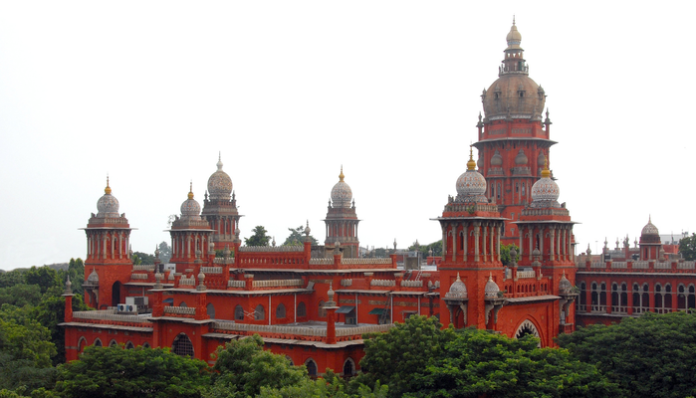
The Madras High Court has decided that caste could not be perpetuated through the temple festivals organised by the Dravida Munnetra Kazhagam (DMK) government of Tamil Nadu through the Hindu Religious and Charitable Endowment Department. The verdict was pronounced by Justice Bharata Chakravarthy on 17th February (Tuesday).
According to him, treating everyone equally was the primary reason for the country to turn into a republic. He further observed that every Indian authority should work to eradicate caste rather than to maintain it. Therefore, he conveyed that the use of caste designations in the invitations for a temple celebration organised by the state could not be permitted.
The court stated, “Caste is a thing, that exists only in the minds of the people. Article 14 of the Constitution of India, enshrines the principle of equality. The very purpose of India becoming a republic is to treat everyone equally and the concept of caste is based only on birth and birth alone divides people. The endeavour of every authority in the country, should only be to annihilate caste and not to perpetuate the same.”
It further declared, “If the festival in which the Government Department namely, the HR and CE Department, is also involved, is conducted in a manner so as to propagate caste and prominently to advertise or take pride in one’s caste, the same cannot be permitted. Therefore, the prayer made by the learned Additional Advocate General that it should be left to open to the Ubhayatharar or to the temple, cannot be considered. From the next festival onwards, whenever any pamphlet is printed, the temple concerned is directed to print the name of the Ubayadharar alone without mentioning the caste name.”
N Samaran submitted a case with the court asking the Commissioner, HR & CE, the Joint Commissioner of HR & CE and the Executive Officer of the Arulmigu Kandhasamy Thirukovil to forbid the use of caste names in the invitation for the prominent “Masi Brahmotsavam” temple festival. The petitioner also wanted to limit participation in the procession to “Sri Padhamthangis” to those approved by the Executive Officer carrying the idol.
The state argued that the temple was not using any caste names and then informed that the invitation had printed the caste names of the individuals. It mentioned that no more instructions could be given for the current year because the invitations had already been produced.
The order read, “The learned Additional Advocate General submitted that the temple, as such, is not using any caste name. However, it can be seen that when Ubayatharars give their names along with caste names, as per the import contained in the judgment of the Division Bench, the caste name should be avoided. Since the invitation for this year has already been printed and circulated and the festival commences on 20.02.2026, no further directions can be issued for the present year.”
“However, from the ensuing festival onwards, whenever any Ubayadharar gives his name with the suffix indicating his caste, the suffix alone should be dropped and only the name shall be printed,” the judge announced.
The court expressed that volunteers usually carry the idol and that capable devotees handle the same on the moment in relation to the prayer about selecting participants for the procession. The court believed that it should be left to the people running the temple on the ground since establishing rules for the procession or micromanaging would not be feasible.
It stated, “As far as the issue of Sri Padhamthangis are concerned, whenever there is an Utchavar purapadu in any temple, volunteers will be there normally to act as Padhamthangis to carry the idols and the same is managed on the spot by able- bodied devotees. To frame Rules or to micromanage the same through Courts would only open in a Pandora’s box and it should be best left to the persons who are managing the festival on the ground.”
“Therefore, in that regard I am not able to accept the contention of the learned counsel for the petitioner that a Standard Operating Procedure should be framed. Leaving open the said issue to be managed by the Executive Officers and the Trustees of the temple in the best interests of the devotees and the rituals of the temple, the writ petition stands disposed of. No costs,” the order concluded.
