

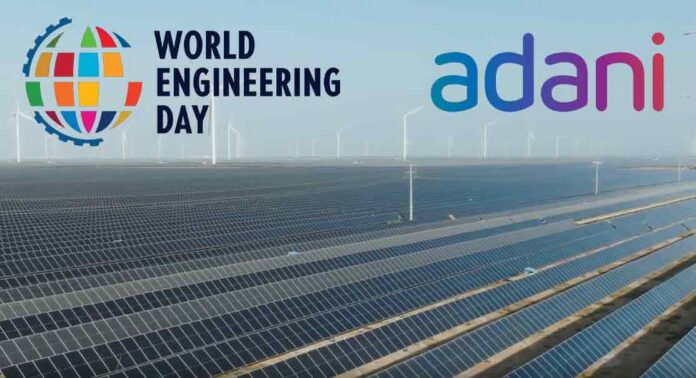
The Adani Group has been named an official partner for World Engineering Day for Sustainable Development 2026, an international day proclaimed by UNESCO and delivered by the World Federation of Engineering Organizations (WFEO). This marks the first time an Indian organisation has been selected by WFEO as an official partner for the event, which is celebrated annually on 4 March.
On this date, UNESCO recognises the vital role that engineers play in addressing global challenges such as climate change, digital transformation, sustainable infrastructure, food and water security, and inclusive economic development. This year, the celebration was co-organized by the World Federation of Engineering Organizations (WFEO) and the Institution of Engineers Indonesia with the support of UNESCO in Jakarta, Indonesia.
The theme for 2026 was “Smart engineering for a sustainable future through innovation and digitalization.”
The partnership highlights the Adani Group’s work in renewable energy, particularly its Khavda renewable energy project in Gujarat’s Kutch region. WFEO has featured the Khavda project in its World Engineering Day 2026 programme, including a short film on its scale and impact.
The project, led by Adani Green Energy Limited (AGEL), covers 538 square kilometres and aims for a total capacity of 30 GW by 2029. It combines solar and wind power, using technologies such as 5.2 MW onshore wind turbines, bifacial solar PV modules, single-axis trackers, and waterless robotic cleaning systems for solar panels.
To date, around 8 GW of renewable capacity has been operationalised at the site, with further additions continuing. The completed project is projected to generate approximately 87.4 billion units of clean electricity annually, avoid 63.6 million tonnes of CO₂ emissions per year, and create more than 15,200 green jobs. The Khavda plant deploys a waterless robotic cleaning system that not only leads to near-zero usage of water for module cleaning – saving 1,716 million litres
The Adani Group stated that the initiative aligns with India’s target of 500 GW non-fossil fuel capacity by 2030 and supports global sustainability goals, including Sustainable Development Goal 7 on affordable and clean energy.
WEFO stated that Adani’s initiatives align with SDG 7 – advancing access to affordable, reliable, sustainable, and modern energy for all. “The rigorous planning and accelerated execution embedded in its projects is helping to shape the next phase of renewable energy growth in India and beyond,” it added.
