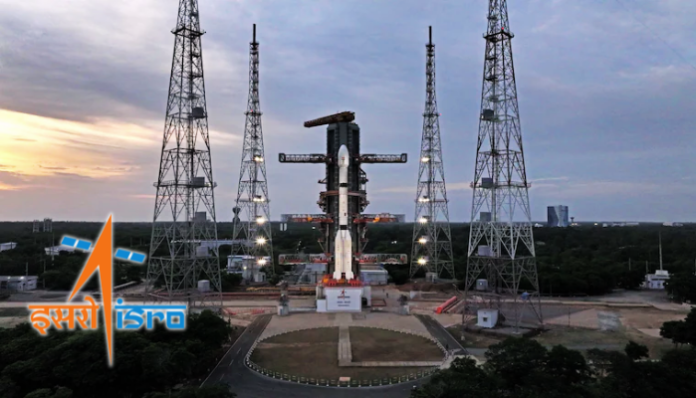
At 2:55 am on 4th September 2026, when most of India will be asleep, the Indian Space Research Organisation (ISRO) will attempt the launch of the ‘Naughty Boy’ Geosynchronous Satellite Launch Vehicle, or GSLV-F17, from the Second Launchpad at Sriharikota to deploy EOS-5, India’s first Earth Observation Satellite to operate from geosynchronous orbit, 36,000 kilometres above India. ISRO is looking forward to achieving a turnaround after recent PSLV setbacks.
GSLV-F17 carrying EOS-05 was moved from the Vehicle Assembly Building (VAB) to the Umbilical Tower (UT) on 28th August 2026 at Satish Dhawan Space Centre, SHAR, Sriharikota, as preparations continue for the scheduled launch on:
— ISRO (@isro) September 1, 2026
🗓️ 04 Sept 2026 | ⏰ 02:55 AM IST
Livestreaming… pic.twitter.com/4nW2MUgeYh
ISRO relying on ‘Naughty Boy’ GSLV to PSLV setbacks into GSLV comeback
The recent months have not been very positive for ISRO, as the Polar Satellite Launch Vehicle (PSLV) suffered consecutive failures in 2025 and 2026, prompting the government to ground the launcher and initiate an investigation. The PSLV shockers were even more unsettling given that this workhorse has been not only India’s but the world’s one of the most reliable rockets.
Since the reliable one has disappointed lately, the ISRO has pinned its hopes for a spectacular comeback on ‘Naughty Boy’, the GSLV.
Notably, GSLV is a three-stage launch vehicle, having most of its components, like the Vikas engine and booster motors, imported from PSLV technology. ISRO developed three staged GSLV with four boosters to send satellites to Geosynchronous Transfer Orbits (GTO) and Low Earth Orbit (LEO), which PSLV could not.
The GSLV has earned this moniker due to its mixed operational record. Out of the initial 18 GSLV flights, six failed to achieve full mission success.
The ‘Naughty Boy’ GSLV remains India’s pride despite its initial tantrums, given the struggle ISRO did to indigenously develop the cryogenic engine. What drove ISRO to develop the GSLV was its efforts to master cryogenic propulsion.
In the 1990s, India sought cryogenic technology from Russia; however, the United States strongly objected to the transfer, citing ‘missile proliferation’ fears.
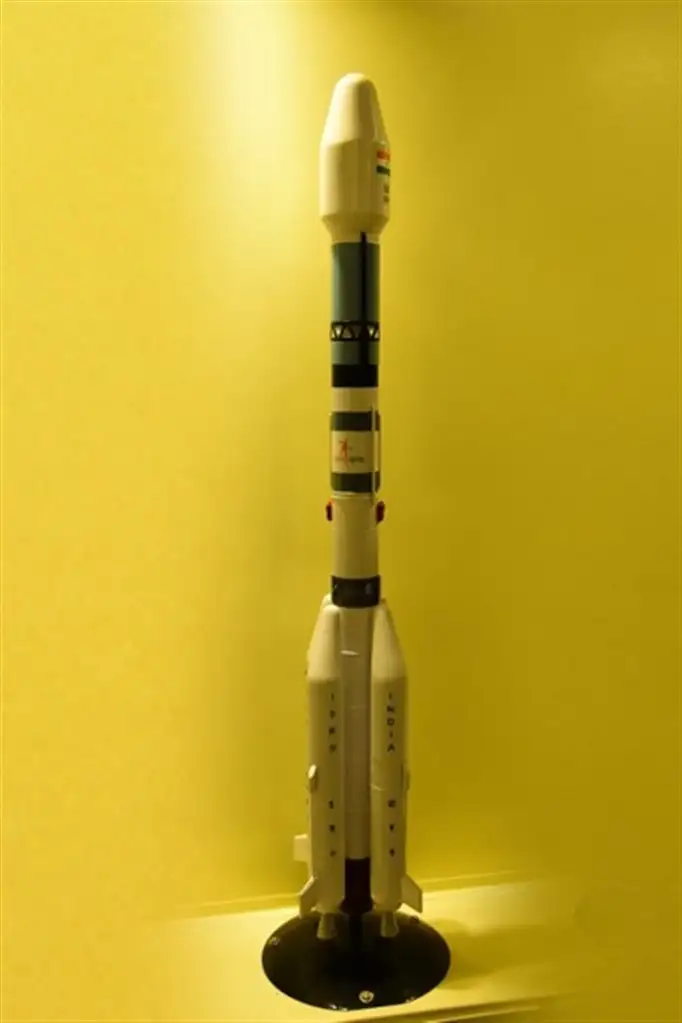
What further created hurdles for India’s manoeuvers to access this technology were international restrictions. This drove ISRO to pursue indigenous development.
It took years, numerous failures, setbacks, redesigns, and repeated testing to achieve mastery over technologies functioning at temperatures as low as minus 250 degrees Celsius, where liquid hydrogen and liquid oxygen transform into powerful rocket propellants.
After years of try-fail-repeat, ISRO finally achieved success. The first launch of GSLV was on 18th April 2001, and the last GSLV launch took place on 12th August 2021, which was unsuccessful.
During this time, fourteen launches were made, including the MK-I and MK-II series. Of these, eight were successful, two were partially successful, and four were failures. From 2014, GSLV marked six consecutive successful launches.
GSLV-F17-EOS-05 Mission
According to ISRO, GSLV-F17 is the 19th flight of India’s GSLV. The GSLV-F17 vehicle will place the EOS-05 satellite into a Sub-Geosynchronous Transfer Orbit (Sub- GTO). The launch will take place from the Second Launch Pad (SLP) at Satish Dhawan Space Centre, SHAR.
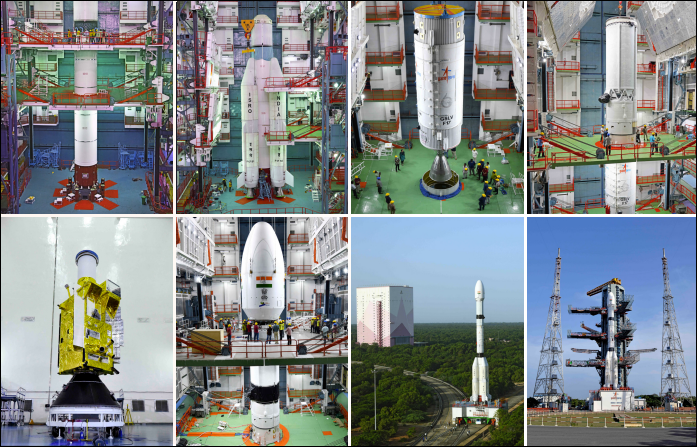
Unlike conventional Earth Observation Satellites (EOS) that orbit at lower altitudes, passing over regions periodically, the EOS-05 satellite will achieve a fixed position relative to the Earth’s rotation. The ISRO says that maintaining a fixed position will enable continuous monitoring of the Indian subcontinent and surrounding areas.
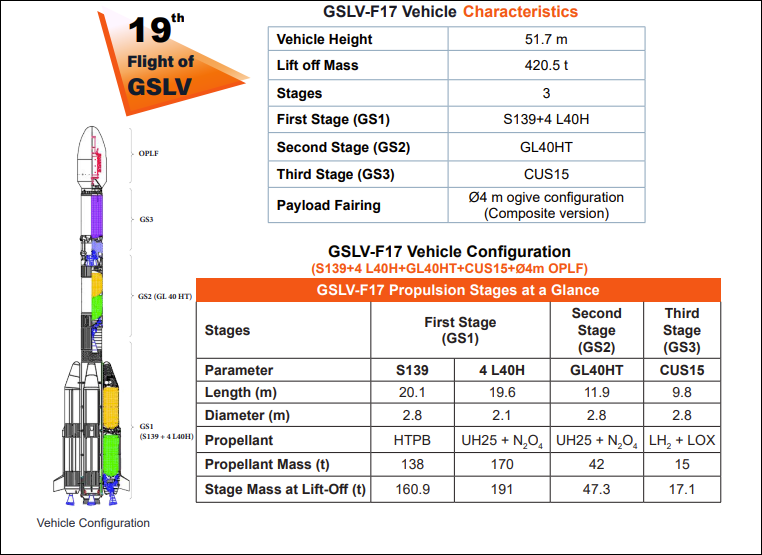
This EOS-05 satellite will provide the ISRO with near real-time images at 30-minute intervals, along with the capability to revisit priority targets every five minutes, particularly for rapid observation tasks.
The GSLV-F17 flight sequence goes as follows: S139 ignition, then 4L40Hs ignition, encapsulated assembly, GS2 ignition /GS1 separation, IS 1/2 M separation, OPLF separation, EOS-05 S/C separation, GS2 separation /CUS ignition, and CUS burnout.
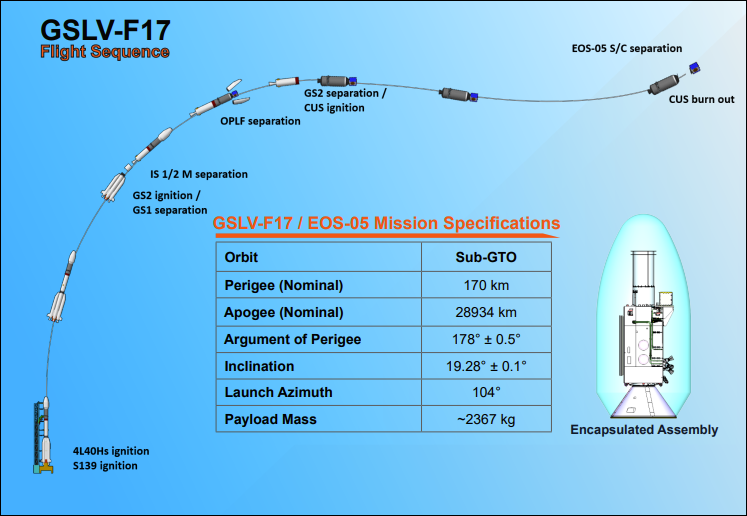
As per ISRO, the high-frequency imaging capability will aid applications in disaster management, agricultural monitoring, environmental assessment, as well as strategic surveillance. It will be even more useful during evolving emergencies when agencies would need fresh data for faster decision-making.
This mission acts as a replacement for a similar spacecraft lost in August 2021 when the GSLV-F10 cryogenic upper stage failed to deliver as intended during the EOS-03 launch attempt.
If a successful deployment is achieved, India will join an elite club of nations operating geostationary Earth imaging satellites.