

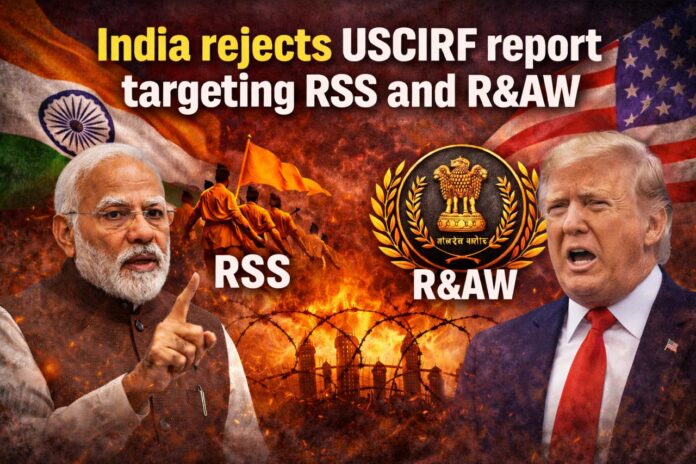
The Government of India on Monday issued a sharp rebuttal after a United States federal commission recommended that India be designated a “Country of Particular Concern (CPC) over alleged religious freedom violations and called for sanctions targeting the Rashtriya Swayamsevak Sangh (RSS) and the Research and Analysis Wing (R&AW).
Responding to the recommendations, Ministry of External Affairs (MEA) spokesperson Randhir Jaiswal said New Delhi “categorically rejects” the conclusions of the United States Commission on International Religious Freedom (USCIRF), accusing the body of repeatedly presenting a distorted picture of India.
“We have taken note of the latest report of the USCIRF. We categorically reject its motivated and biased characterisation of India. For several years now, USCIRF has persisted in presenting a distorted and selective picture of India, relying on questionable sources and ideological narratives rather than objective facts,” Jaiswal said.
He added that such repeated misrepresentations only damage the credibility of the commission itself and suggested that instead of selectively criticising India, the body should reflect on incidents within the United States, including attacks on Hindu temples and intimidation faced by members of the Indian diaspora.
USCIRF recommends sanctions on RSS and R&AW
The controversy stems from the USCIRF’s 2026 Annual Report, which reviews religious freedom conditions globally during 2025. In its recommendations concerning India, the commission urged the US government to designate the country as a “Country of Particular Concern”, a classification typically applied to nations accused of systematic and severe violations of religious freedom.
The report also called for targeted sanctions against the Rashtriya Swayamsevak Sangh (RSS) and India’s external intelligence agency, the Research and Analysis Wing (R&AW). According to the commission, such measures could include freezing assets linked to these entities and restricting their members from entering the United States.
The USCIRF further suggested that Washington consider linking future security cooperation and bilateral trade policies with India to improvements in religious freedom conditions. It also recommended halting certain weapons sales to India on the grounds of alleged persecution of US citizens and minority communities.
In addition, the commission urged the US Congress to reintroduce and pass the Transnational Repression Reporting Act of 2024, which would require annual reporting on alleged acts of transnational repression by foreign governments, including India, targeting religious minorities in the United States.
Allegations against RAW
The commission’s recommendations also referenced earlier allegations regarding India’s intelligence agency. In 2025, the USCIRF had called for action against R&AW, accusing it of involvement in alleged plots targeting Sikh separatists abroad.
Based on these claims, the body again urged the US administration to consider sanctions against the agency in its latest report.
India among 18 countries recommended for CPC designation
In its 2026 report, the USCIRF recommended that 18 countries be designated as Countries of Particular Concern. Along with India, the list includes Afghanistan, Myanmar, China, Cuba, Eritrea, Iran, Libya, Nicaragua, Nigeria, North Korea, Pakistan, Russia, Saudi Arabia, Syria, Tajikistan, Turkmenistan and Vietnam.
However, the commission’s recommendations are not binding. USCIRF functions as an independent advisory body that monitors religious freedom worldwide and submits policy suggestions to the White House and the US Congress. The US administration is not obligated to adopt its recommendations.
RSS’s long history
Among the organisations named in the report is the Rashtriya Swayamsevak Sangh, a socio-cultural organisation founded in 1925 and now more than a century old. The RSS has played a significant role in India’s socio-political landscape and is widely seen as the ideological parent of the ruling Bharatiya Janata Party (BJP).
India has consistently rejected USCIRF reports in previous years as well, arguing that the commission relies on selective narratives and fails to understand the constitutional protections and pluralistic social fabric of the country.
