

In the mist-laden green hills of Meghalaya, where the Khasi and Jaintia communities have long safeguarded their ancestral lands with fierce pride, the question of uranium mining has once again stirred deep emotions and firm political resolve. Recent statements from the state’s top leadership have made it abundantly clear that uranium extraction, particularly in the rich deposits of Domiasiat in the West Khasi Hills, will not take place unless locals agree to it. This stance is not a sudden development but the latest chapter in a decades-long saga of resistance rooted in environmental caution, tribal rights and political sensitivity.
As India continues its push for energy security and nuclear self-reliance, the story of Meghalaya’s uranium reserves offers a compelling illustration of why sometimes national ambitions must yield to local realities.
The latest developments unfolded in the last couple of weeks. On 5 July, the Khasi Students’ Union (KSU) raised a strong alarm over the issue, alleging that certain MLAs and outsiders were pressuring residents of Domiasiat and adjoining villages to sell their land at throwaway prices while trying to sway them towards accepting uranium mining. KSU president Raymond Kharjana met Chief Minister Conrad K. Sangma on 1 July and urged the government to pass a formal resolution opposing any revival of the project.
On 7 July, Deputy Chief Minister Sniawbhalang Dhar reiterated that the state government will not move forward with uranium mining unless it has the support of the people. “We are very clear. We are with the people of the state. Uranium mining cannot be allowed unless the whole state is on board,” he declared, adding that public interest would always remain the top priority and that allegations of cheap land purchases would be thoroughly verified.
The following day, Chief Minister Conrad K. Sangma himself reinforced this position. Responding to reports that officials of the Atomic Minerals Directorate (AMD) had visited Domiasiat, Sangma said he was unaware of any such movement but promised a full probe. He reiterated that the Meghalaya government is firmly opposed to uranium mining and that his word on the matter stands as the state’s final stand. “We are not in favour of uranium mining and we have made it very clear to the Government of India too,” he stated, emphasising that the government would never take a decision that went against the interests or concerns of its people. The CM added that the govt will work in line with the best interest of our people
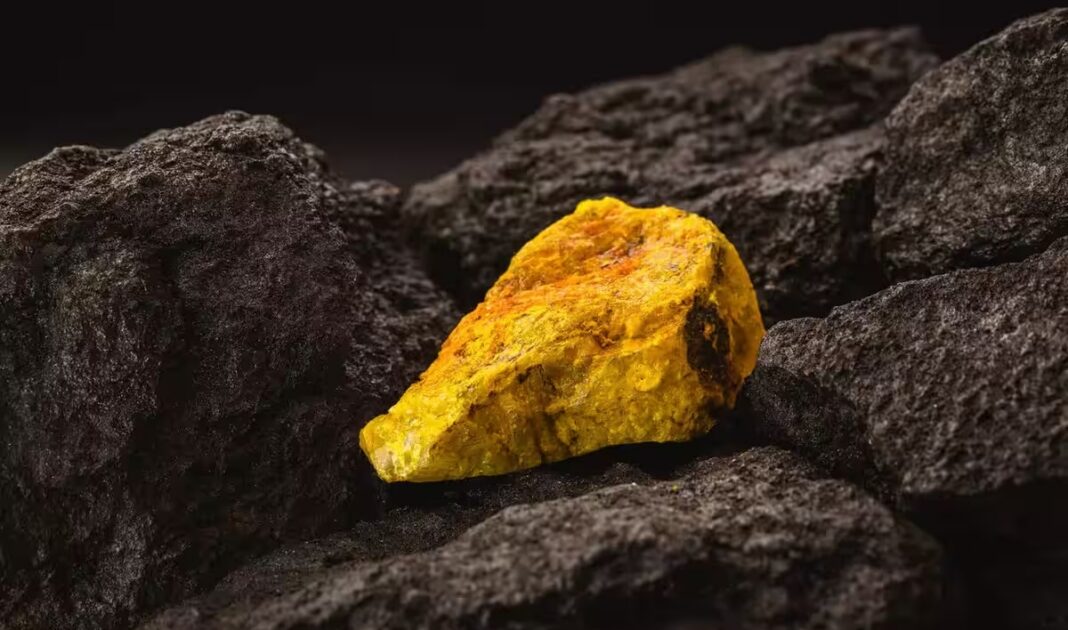
“It is not only about uranium mining. Whether it is railways or any other issue, the state government will move forward only after all stakeholders are on board,” Sangma said. These statements have effectively closed the chapter for the foreseeable future, even as the state continues to hold one of India’s largest discovered uranium reserves, estimated at around 9,500 to over 20,000 tonnes of uranium oxide in the Domiasiat-Wahkaji belt, ranking third after Jharkhand and Andhra Pradesh.
Both locals and govt oppose Uranium mining
The position of the state government has been consistent and unambiguous. The govt has repeatedly affirmed that the administration stands with the people and will not proceed without their full consent. Development, they insist, must be balanced and equitable; it cannot be imposed only in uranium-bearing areas. This echoes earlier commitments, including a 2016 decision to keep mining activities in abeyance, and aligns with the long-standing stance of the Khasi Hills Autonomous District Council (KHADC), which has refused to issue any No Objection Certificate for commercial mining.
The Hill Councils, which govern vast tracts of privately owned tribal land under the Sixth Schedule, remain a formidable institutional barrier. Even though atomic minerals fall under the Atomic Energy Act, giving the Centre the technical power to override state and local authorities, no government has chosen to exercise that power forcibly in Meghalaya.
Local communities and civil society groups have been even more opposed to uranium mining in the state. The Khasi Students’ Union, traditional heads, youth organisations and ordinary landowners view the deposits not as a resource to be exploited, but as a threat to their way of life. Domiasiat and the surrounding villages lie on land that is almost entirely privately owned by tribal families, protected under customary laws and the Hill Councils. For generations, these communities have drawn their livelihood from the forests, streams and fertile soil of the West Khasi Hills.
The state that observes Anti-Uranium Day
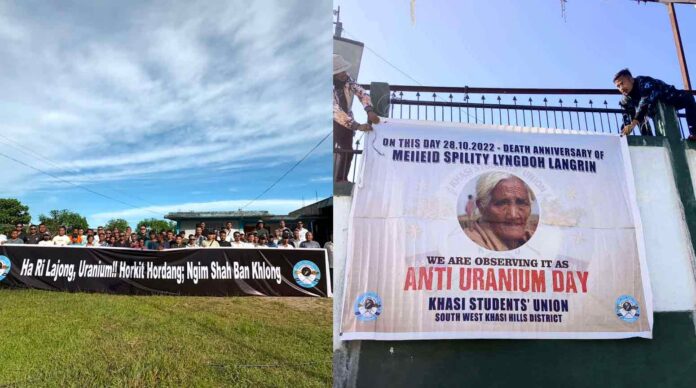
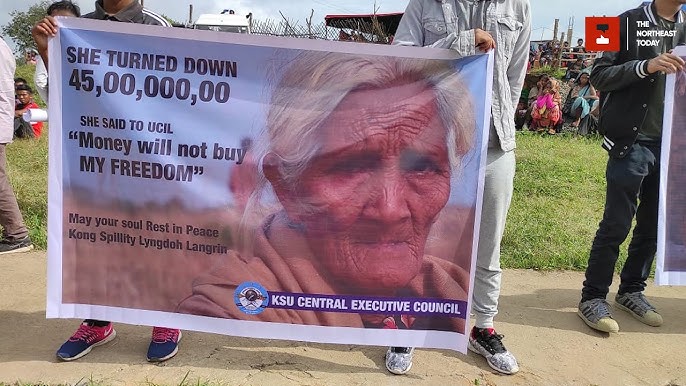
The memory of exploratory drilling in the 1990s and early 2000s, when thousands of boreholes were sunk, still remains fresh, accompanied by health concerns among villagers. Meghalaya is perhaps the only region where an Anti-Uranium Day is observed. Matriarch late Spillity Lyngdoh Langrin, who famously rejected lucrative offers with the words “Money cannot buy me freedom,” has become an enduring symbol of resistance. Her death anniversary on October 28 is observed every year by the Khasi Students’ Union (KSU) as the Anti-Uranium Day, keeping the collective memory alive.
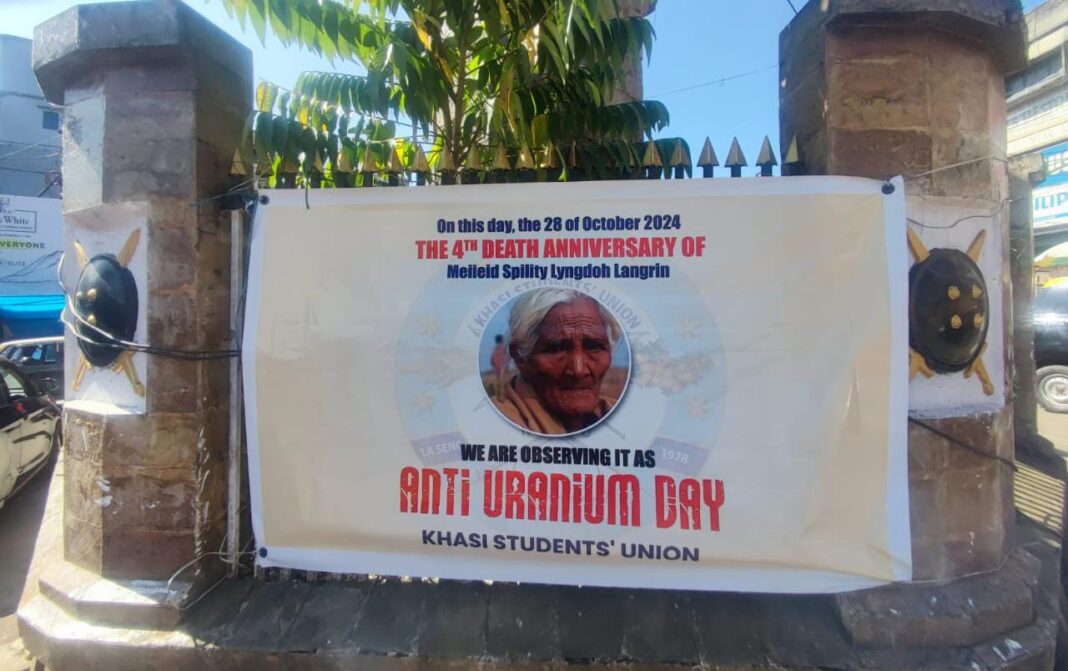
The Union remains firm in its stand that under no circumstance will it permit uranium mining or any pre-mining activities in Domiasiat and Mawthabah, whether undertaken by the state government or any central agency. The Anti-Uranium Day, which began in 2021, serves both as a tribute to Spility Langrin and as a reaffirmation of the people’s commitment to protect their land from uranium exploration.
Concerns around Uranium mining
The concerns driving this opposition are both scientific and cultural. The uranium ore in Domiasiat is a low-depth sandstone deposit, typically lying between eight and 47 metres below the surface. Mining would almost certainly involve open-cast methods, which raises fears that it would scar the landscape, destroy forests and contaminate the intricate network of waterways that criss-cross the hills. Radiation risks, groundwater pollution from tailings, and long-term health effects, ranging from cancers and respiratory illnesses to reproductive problems, have been cited repeatedly, drawing parallels with experiences in Jaduguda, Jharkhand.
Apart from environmental hazards, there is a deeper anxiety about cultural erasure. For the Khasi people, land is not merely an economic asset; it is the foundation of identity, community and spiritual life. Any large-scale industrial intrusion risks alienating communities and sparking social unrest in a state that already navigates complex ethnic and interstate border sensitivities.
Many locals, particularly in the Khasi Hills, remain wary of initiatives that could trigger a significant inflow of outsiders, fearing it would alter the state’s demographic balance, strain limited resources, increase competition for land and jobs, and dilute indigenous culture and identity. This sentiment has long stalled the extension of the railway network into the state. Groups like the Khasi Students’ Union have historically opposed rail projects, arguing that easier connectivity with Assam and beyond would accelerate migration without adequate safeguards. Chief Minister Conrad K. Sangma has acknowledged these public concerns, noting that the government avoids “bulldozing” such projects and insists on building consensus first, highlighting how even beneficial infrastructure faces resistance when perceived as a threat to the state’s fragile tribal fabric.
It is precisely this sensitivity that explains why there is no progress in mining uranium in Meghalaya, as the Central government is unlikely to push hard for the same. Although the Atomic Energy Act theoretically empowers New Delhi to take control of atomic minerals, overriding the state government’s decision, successive governments have recognised that forcing the issue would carry high political costs.
Forced mining may reignite anti-Delhi sentiments
Meghalaya is a sensitive border state with a strong tradition of tribal autonomy. Enforcing mining of the nuclear fuel against the will of the people, the Hill Councils and the state government could trigger prolonged legal battles, law-and-order problems and massive protests that no administration wants to risk. The tribal communities in the north-east have been historically suspicious of the centres, thanks to successive Congress governments ignoring the region for decades. The region saw so many separatist movements for such reasons.
Now, after the relentless efforts of the BJP government, tribes in the northeast have started trusting Delhi. They have seen the benefits of various development and infrastructure initiatives of the government. In this scenario, any attempt to forcefully mine uranium against the will of the locals will reignite the anti-Delhi sentiment. Anti-government and anti-national elements keep waiting for such instances to provoke vulnerable youths into joining militancy against the government. Therefore, it is unlikely that the centre will override the sentiments of the locals in this matter.
Uranium in Meghalaya
The Atomic Minerals Directorate for Exploration and Research (AMD), a unit of the Department of Atomic Energy, first identified potential uranium mineralisation in the region through surveys in the early 1970s, with its northeastern circle office established in Shillong in 1976. Aerial surveys around 1975 and detailed work in the early 1980s confirmed high-quality sandstone-type deposits in the Domiasiat area of the West Khasi Hills in 1984. Extensive exploratory drilling and geological studies were largely completed by 1992.
According to AMD assessments, Domiasiat alone holds approximately 9,500 tonnes of uranium ore (U₃O₈), making it the largest and richest near-surface sandstone-type deposit discovered in the country so far, with an average grade of about 0.1 per cent and depths ranging from 8 to 47 metres, suitable for open-cast mining. Broader estimates for Meghalaya place the total established reserves at nearly 16,000 tonnes of U₃O₈ across four main locations: Domiasiat, Wahkyn, Tyrnai and Lostoin. Domiasiat is the country’s largest sandstone-type uranium deposit.
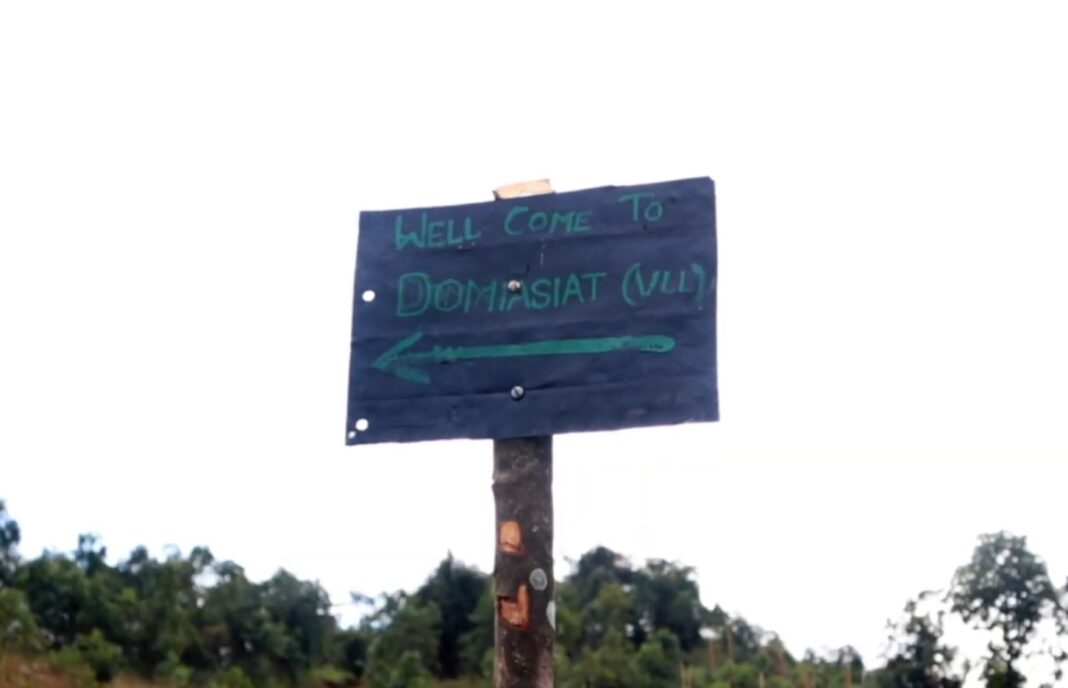
Some later figures have put the state’s overall identified resources higher, around 13,000 to over 20,000 tonnes, accounting for roughly 16 per cent of India’s uranium reserves and ranking Meghalaya third after Jharkhand and Andhra Pradesh. Uranium Corporation of India Ltd. (UCIL) under the Department of Atomic Energy (DAE) had already made a plan to develop the mineral resources at Domiasiat under the name of “Kylleng Phendengsohiong Mawthabah (KPM) Uranium Mining Project”
The Detailed Project Report of the KPM Uranium Mining Project was approved by the Atomic Energy Commission. Environmental clearance for this project was obtained from the Ministry of Environment, Forest & Climate Change (MoEFCC) in December 2007. An agreement was also signed between UCIL and the land owners of the project site in May 2007 for the acquisition of land on an annual lease rent basis. Approval to execute land lease with land owners, grant of mining lease and Consent for Establishment were taken up with the Meghalaya State Government.
Uranium ore remains buried in Meghalaya for now
However, these near-surface, low-depth deposits in the Upper Cretaceous Lower Mahadek Formation remain largely unexploited due to sustained local opposition. The Uranium deposits sit on privately owned tribal land under the Hill Council, and while the national act can override these layers in theory, no government wishes to alienate the tribals or open a political wound that would be difficult to heal. Instead, the Centre has chosen the path of least resistance: sourcing uranium from functional mines in Chhattisgarh and Rajasthan, where new projects such as Jajawal and Rohil are progressing, and importing the rest from friendly countries under civil nuclear agreements.
India already meets a significant portion of its nuclear fuel needs through imports from Kazakhstan, Canada and Russia, and domestic production elsewhere continues to expand. During the recent visit of PM Modi, Australia also agreed to supply uranium to India.
Given this backdrop, there is simply no compelling strategic necessity that would justify the headache of imposing uranium mining on an unwilling Meghalaya.
In the end, the refusal of uranium mining in Meghalaya is more than a local environmental victory, it is a quiet assertion of democratic and federal principles. The state government has chosen to listen to its people, the Hill Councils have stood by their traditional authority, and the Centre has wisely refrained from testing the limits of its legal powers. While India’s nuclear ambitions remain important for energy security and strategic autonomy, the Meghalaya story shows that development cannot come at the cost of trust, ecology and community consent. For now, the yellowcake beneath Domiasiat will stay buried, and there will be no fresh protests against the government, which often turn violent.


