

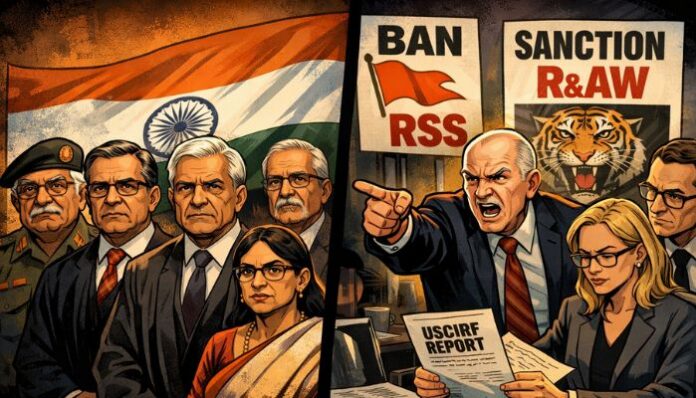
On 21st March, a group of 275 judges, retired civil servants, diplomats and armed forces officers strongly criticised the United States Commission for International Religious Freedom (USCIRF) for its latest report on India. They termed it “very disturbing and completely off the mark”.
In a joint statement, the signatories objected to the USCIRF’s recommendations to designate India as a “country of particular concern” and to impose targeted sanctions on organisations including the Rashtriya Swayamsevak Sangh (RSS) and India’s external intelligence agency, Research and Analysis Wing (R&AW).
Earlier, the Ministry of External Affairs rejected the report and called it “motivated and biased”.
Signatories question credibility and methodology
The statement was signed by several prominent figures including former Supreme Court judges Justice Adarsh Kumar Goel and Justice Hemant Gupta, former Himachal Pradesh Governor Justice Vishnu Sadashiv Kokje, former Chief Election Commissioners OP Rawat and Sunil Arora, and former Foreign Secretary Kanwal Sibal, along with over 130 retired armed forces officers.
They questioned both the credibility of the commissioners of USCIRF, and the methodology used in the report. The signatories argued that assessments of religious freedom must rely on long term demographic trends rather than “selective or episodic narratives”.
Demographic data cited to counter persecution claims
The signatories highlighted census data and noted that the Muslim population in India rose from 9.8% in 1951 to 14.2% in 2011. Furthermore, the Christian and Sikh populations remained stable at 2.3% and 1.7% respectively. When compared to neighbouring countries, the Hindu population sharply declined from 20% to 22% in undivided Pakistan to around 1.5% to 2% in Pakistan and 7% to 8% in Bangladesh.
According to the statement, such longitudinal trends “suggest that the overall ecosystem in India has not produced the kind of sustained demographic contraction among minorities that would ordinarily indicate systemic persecution or institutionalised exclusion”.
Criticism of sanctions recommendation
The group strongly objected to the USCIRF’s call for sanctions, including freezing assets and restricting movement of individuals associated with the RSS. They described the recommendations as “highly motivated” and reflective of “intellectual bankruptcy and deranged conclusions”.
They further argued that the USCIRF has displayed a recurring tendency to portray Indian state institutions and socio-cultural organisations in a negative light without sufficient macro level evidence.
Call for objective and evidence-based assessment
Though they acknowledged that organisations like the RSS can be subject to critique, the signatories emphasised that such criticism must be based on “verifiable evidence and contextual understanding” rather than broad generalisations.
They called India a “robust democracy” and stated that it has established judicial and parliamentary systems. The group urged the US government to review the basis of the USCIRF report and examine its contributors.
They stressed that any meaningful assessment of religious freedom in the region must adopt a more objective, long term and comparative approach across the Indian subcontinent.
