

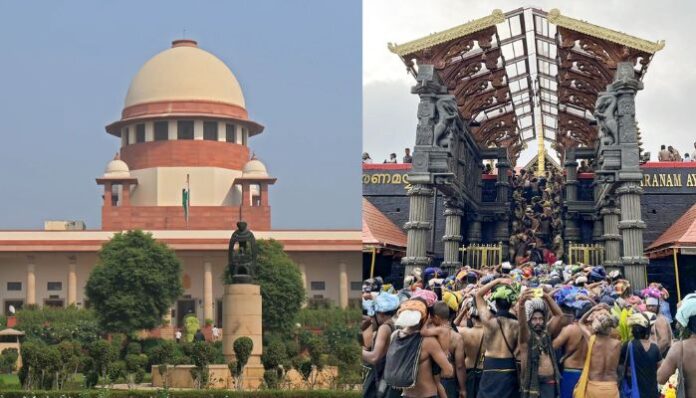
During the ongoing hearing in the Sabarimala reference case, the Supreme Court on Wednesday, 15th April, made an important observation on the limits of social reform. Justice BV Nagarathna, who is part of the nine-judge Constitution bench, said that while reform is important, it cannot come at the cost of weakening a religion itself. “In the name of social welfare and reform, you can’t hollow out the religion,” she remarked during the proceedings.
The bench is currently hearing arguments on how Articles 25 and 26 of the Constitution should be interpreted, especially when it comes to balancing religious freedom with social reform laws.
Debate over articles 25 and 26
While representing the Travancore Devaswom Board, Senior Advocate Dr Abhishek Manu Singhvi made an attempt to construe both the articles together, keeping in mind their balanced perspective. Article 25(2)(b) of the Constitution permits the State to make laws for social reform and opening of Hindu religious establishments to all classes and sections of society.
On the other hand, Article 26(b) gives religious denominations the right to manage their own affairs, especially in matters related to rituals.
Singhvi said that while people from different Hindu sects may seek entry into temples, the religious group managing the temple should still have the authority to decide how rituals are performed inside. He stressed that both rights should coexist without one overriding the other.
Questions from the bench
During the hearing, Justice Joymalya Bagchi asked whether Singhvi was suggesting that laws made for social reform should not interfere with essential religious practices. Singhvi responded by saying that the court should clarify these issues carefully, without relying too much on the “essential religious practices” doctrine.
Justice MM Sundresh also raised an interesting point, asking why Article 25(2)(b) specifically uses the term “social reform” instead of broader terms like “public order, morality or health,” which are mentioned in Article 25(1). Singhvi replied that social reform laws are meant to address practices that may not meet acceptable standards in society. Justice Sundresh agreed and cited laws like the Hindu Succession Act as examples of social reform.
Singhvi argued that Article 25(2) should not be seen as a restriction on religious freedom, but rather as an enabling provision that allows the State to step in for limited purposes. He said it should not reduce the main right to freedom of religion under Article 25(1).
He warned that if social reform is given unlimited power, it could end up overriding religious freedom completely. Referring to earlier judgments, he said that the Constitution does not allow the core of religious rights to be diluted in the name of reform.
The matter is being heard by a nine-judge bench led by Chief Justice Surya Kant, and this is the fourth day of arguments in the case.
