

Nearly two decades after the 2006 Malegaon serial blasts that killed 37 people and injured over 100 during Ramadan prayers near a mosque in Maharashtra, the Bombay High Court on Wednesday discharged four accused, effectively halting the trial against them.
The bench, comprising Chief Justice Shree Chandrashekhar and Justice Shyam Chandak, quashed a special NIA court order that had framed charges against the four men, Rajendra Choudhary, Lokesh Sharma, Dhan Singh, and Manohar Narwaria. The court cited lack of sufficient evidence, noting that the case against them heavily relied on a 2010 statement by Swami Aseemanand that was later retracted as allegedly given under pressure.
They were arrested 2013, and the High Court had granted them bail in 2019, noting that they were held in jail for more than six years without a trial.
The verdict comes less than a year after a special NIA court acquitted all seven accused in the separate 2008 Malegaon blast case, including former BJP MP Sadhvi Pragya Singh Thakur and Lt Col Prasad Purohit, citing insufficient evidence.
Rajendra Choudhary, a resident of Dhakad Seri village in Depalpur, about 42 km from Indore, had been arrested by the National Investigation Agency (NIA) on December 15, 2012, from Piploda Bagla village while he was reciting the Ramayana in nearby Pirlai village. He was accused in connection with the 2006 Malegaon blasts, as well as the 2018 Hyderabad Mecca Masjid blast and the 2019 Samjhauta Express blast.
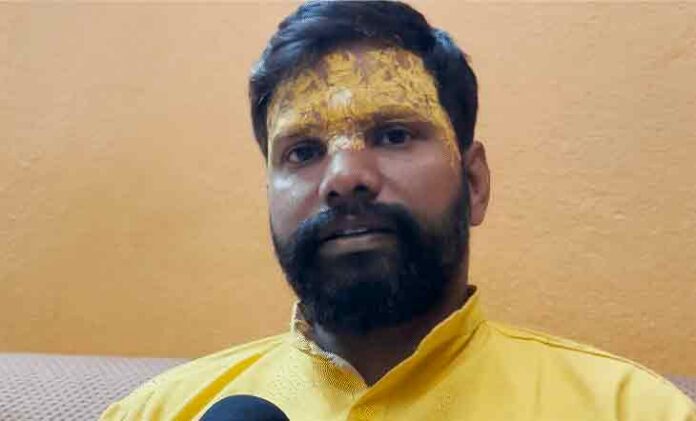
After the court verdict on Wednesday, Rajendra Choudhary narrated his ordeal and said that he was innocent and was framed under a conspiracy.
Choudhary, who had cleared the MPPSC (Madhya Pradesh Public Service Commission) preliminary exam in his first attempt after completing B.Com and aspired to become a government officer to serve society, described the arrest as life-altering. In an interview with Dainik Bhaskar, he said: “My dream was to become an officer and serve society. I cleared the PSC pre exam on the first attempt. I was reciting the Ramayana… when NIA surrounded and arrested me from all sides. I couldn’t become an officer, but they made me an accused.”
He also alleged severe torture during custody, including beatings that left his hands and feet numb, electric shocks, sleep deprivation, and attempts to force signatures on blank papers and pre-written statements. He claimed threats were made to implicate his family as well. Despite this, Choudhary expressed faith in the Indian justice system: “We had full faith in the Indian justice system and laws from the beginning. Today, that faith and belief have won.”
This was not Choudhary’s first brush with law. He was earlier declared a fugitive in Jammu & Kashmir under the alias “Samandar Singh” in connection with a 2002-2003 Ujjain murder case of Gunde Muzib Lala, but was acquitted in that matter on January 29, 2014. Choudhary, who spent over 16 years fighting the charges, told reporters he will now decide his future based on what society and his supporters want.
The 2006 Malegaon blasts were initially probed by the Maharashtra Anti-Terrorism Squad (ATS), and the ATS had blamed the bombings on the Students Islamic Movement of India (SIMI). But after taking over the case in 2013, NIA blamed right-wing group Abhinav Bharat for the bombing. The agency subsequently arrested Lokesh Sharma, Dhan Singh, Manohar Singh and Rajendra Choudhary, all belonging to Abhinav Bharat.
Before NIA taking over the case, the ATS has arrested 8 Muslim men in connection with the case. But the case against them was also dismissed by a Maharashtra court in 2016.
