

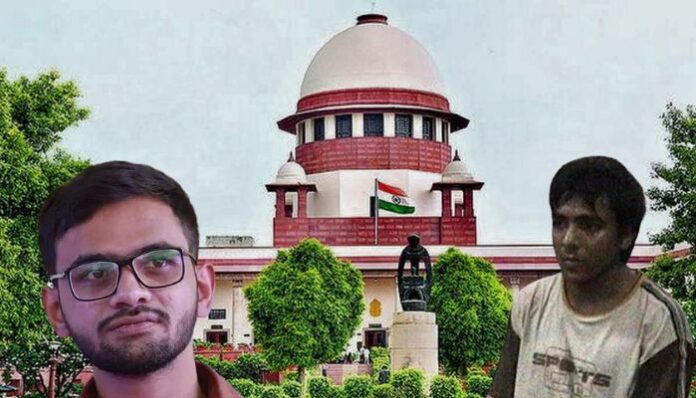
On Friday (22nd May), the Centre questioned the Supreme Court of India over conflicting orders on bail for accused in Unlawful Activities (Prevention) Act cases.
For the unversed, a 2-Judge Bench of the apex court comprising Justices B V Nagarathna and Ujjal Bhuyan granted bail to a UAPA case accused, Syed Ifthikar Andrabi, on 18th May this year. He had been in prison for 5 years in connection with a narco-terror case. The court ruled that ‘prolonged incarceration’ cannot be justified and that “bail is the rule and jail is the exception” even in UAPA cases.
The 2 Judges also criticised an earlier Supreme Court ruling from January 2026 (Gulfisha Fatima vs State (NCT of Delhi)). In that particular case, a Bench of Justices Kumar and N V Anjaria granted bail to 5 accused in the 2020 anti-Hindu Delhi riots case, but not to Islamists Sharjeel Imam and Umar Khalid. The court had observed that the duo “stood on a higher footing in the hierarchy of participation.”
In the 18th May ruling, Justices BV Nagarathna and Ujjal Bhuyan, however, claimed that rejecting bail to Umar Khalid and Sharjeel Imam diluted a binding precedent of the apex court, as ruled in the Union of India vs KA Najeeb case. “They cannot dilute, circumvent or disregard binding precedent,” Justice Bhuyan had observed.
Najeeb was a PFI extremist involved in chopping of the hand of Malayalam Professor TJ Joseph in 2010 over accusations of ‘blasphemy.’ In that case, a 3-Judge Bench granted bail to Najeeb, claiming that the violation of ‘right to speedy trial’ can be a ground for bail under UAPA cases.
The 18th May order by the Supreme Court in the Syed Ifthikar Andrabi case and the observations made with respect to the denial of bail to Islamists Umar Khalid and Sharjeel Imam prompted the Centre to question the apex court on its conflicting stances when it came to granting bail to those involved in serious terror charges under UAPA.
Additional Solicitor General S V Raju and Advocate Rajat Nair informed that bail should depend on the facts of each case. They cited the cases of 26/11 terrorists Ajmal Kasab and Hafiz Saeed.
“If you take the case of Ajmal Kasab, there are a large number of witnesses. Will you grant him bail, given that he has been in jail for 7 or 8 years? It can’t be done. Therefore, you have to examine the facts of each case,” asked the Additional Solicitor General.
“Suppose if Hafiz Sayeed is brought from Pakistan and tried, and he is in jail for 5 years because there are a large number of witnesses (because) you have to collect evidence from abroad, will you release him on bail (saying) no, no 5 years (has passed)?” he added.
ASG Raju further highlighted, “Latest (18th May) judgement says you don’t have to see the role, you don’t have to see the nature of the crime. So there is no categorisation. This can’t be done. This can’t be how it has to be applied. It has to be applied to the facts of each case. That’s what your Lordships have precisely done (in Gulfisha Fathima)”
“The Court must consider, in totality, whether continued detention has become constitutionally unjustifiable, having regard to the role attributed, the statutory context, the limited prima facie material, the trajectory of the trial, the causes of delay, and the availability of intermediate remedies…This is how Najeeb came to be interpreted…and currently and rightly applied. You can’t just say delay. Suppose the delay is caused by the accused, you can’t say grant bail,” he concluded.
