

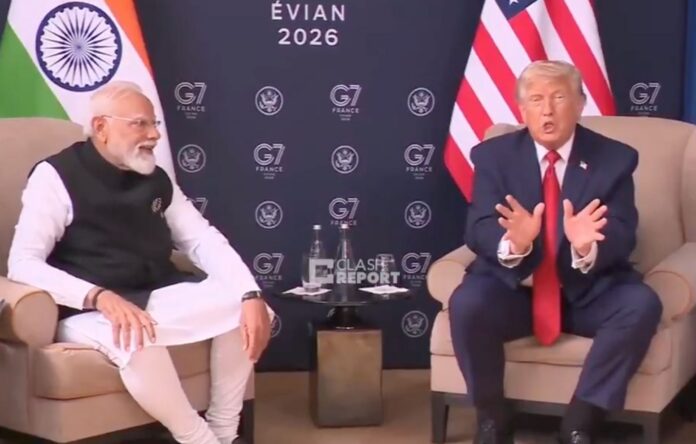
US President Donald Trump showered praise on Prime Minister Narendra Modi and offered an extraordinary security assurance to India during a joint press interaction on the sidelines of the G7 Summit in France on Wednesday, June 17, in what appeared to be a concerted effort to reaffirm ties after a period of rare turbulence in Indo-US relations.
The unusually warm public display came days after relations between New Delhi and Washington came under strain following the deaths of three Indian sailors in a US military strike on a merchant vessel in the Gulf region. The incident sparked outrage in India, with New Delhi raising concerns over the safety of Indian seafarers amid escalating military operations in West Asia.
Against this backdrop, Trump repeatedly highlighted his personal friendship with Modi, praised his leadership, and publicly declared that the United States would come to India’s aid if it ever faced an attack.
When asked about defence ties between the two countries, Trump described the relationship as “great” and suggested that a formal defence treaty was unnecessary to demonstrate American support for India.
“We don’t have a contract… but if they were attacked, we would be there to help them,” Trump said, gesturing towards Modi. “If they’re attacked and he’s the leader, we’re going to be there to help.”
Trump tries hard to please PM Modi, says the US will defend India if it is attacked, as long as Modi remains Prime Minister.
— OpIndia.com (@OpIndia_com) June 17, 2026
Speaking about India and PM Modi, Trump said:
"If they were attacked, we would be there to help them. If anybody attacks that man, we're going to be… pic.twitter.com/F5dntDl22y
The remarks amounted to one of the strongest public security assurances ever extended by a US President towards India despite the absence of a formal mutual defence pact.
Trump heaps praise on Modi
Throughout the interaction, Trump lavished praise on Modi, portraying him as one of the toughest leaders he has dealt with on the world stage.
Speaking about ongoing trade negotiations, Trump described the Indian Prime Minister as an exceptionally difficult negotiator who always prioritises India’s interests.
“He’s one of the toughest, actually,” Trump said. “People say he’s such a nice man. I said he’s very tough. He’s a tough trader, and he loves the Indian people.”
Trump also recalled the massive public receptions he received during his visits to India and at the “Howdy Modi” event in Houston, describing the relationship between the two leaders as unique.
“We had a great visit last time in India. We opened up that new stadium, and it seated about 150,000, and there were 250,000 people outside and another 100,000 on the grass. The relationship we have built is truly fantastic,” Trump said.
In one of the lighter moments of the press conference, Trump described Modi as a leader whose soft-spoken demeanour often masks his formidable negotiating skills.
“He’s a very tough negotiator… You look at this man. He’s the most beautiful-looking man. He looks so nice, like an angel. But actually, he’s as tough as he is a killer. But he looks so good. So he gets you by surprise,” Trump remarked.
Trump on the Prime Minister of India: Look at this man. He's the most beautiful looking man, he's so nice, he's like an angel. He looks so good. He's very tough pic.twitter.com/mQqynbBIPu
— Headquarters (@HQNewsNow) June 17, 2026
Repairing ties after recent tensions
The enthusiastic praise for Modi came at a sensitive moment in bilateral relations.
Over the past week, India and the United States found themselves navigating one of the most uncomfortable episodes in recent years after three Indian sailors lost their lives during a US military strike on a merchant vessel in the Gulf. The incident prompted India to raise the issue with Washington and reiterate the need to protect civilian shipping and maritime personnel operating in the region.
The deaths also drew attention to the growing risks faced by Indian seafarers amid escalating tensions in West Asia, where thousands of Indians work aboard commercial vessels.
Against this backdrop, Trump’s repeated emphasis on trust, friendship and strategic partnership appeared aimed at reassuring New Delhi that the broader relationship remains unaffected by recent disagreements.
The optics of the meeting were equally significant. It was the first face-to-face interaction between Trump and Modi in sixteen months and projected an image of complete political comfort between the two leaders despite the recent diplomatic unease.
Defence, technology and trade cooperation
Beyond the personal chemistry on display, both sides indicated that discussions were progressing on a range of strategic initiatives.
Trump signalled support for deeper defence cooperation, technology transfers and industrial collaboration, while officials from both countries continue negotiations on a broader trade agreement.
The leaders also discussed supply chain resilience, critical minerals, defence manufacturing and emerging technologies, all of which have become key pillars of the India-US strategic partnership.
Trump’s assurance that America would stand with India in the event of an attack further reinforced Washington’s view of New Delhi as a central pillar of its Indo-Pacific strategy.
Modi highlights Strait of Hormuz concerns
Prime Minister Modi, meanwhile, used the interaction to draw attention to India’s concerns regarding maritime security in West Asia.
Welcoming ongoing diplomatic efforts to stabilise the region, Modi stressed that the Strait of Hormuz must remain open and secure for international commerce.
The Prime Minister pointed out that Indian sailors constitute nearly ten per cent of the global maritime workforce and emphasised that their safety remains a critical national concern.
Trump echoed the economic dimension of the partnership, indicating that negotiators were working to finalise a comprehensive bilateral trade agreement in the coming weeks.
Coming immediately after tensions triggered by the deaths of Indian sailors in a US military strike, the highly public display of warmth between Trump and Modi appeared designed to send a clear message: despite occasional disagreements, Washington and New Delhi remain committed to expanding one of the world’s most consequential strategic partnerships.
