

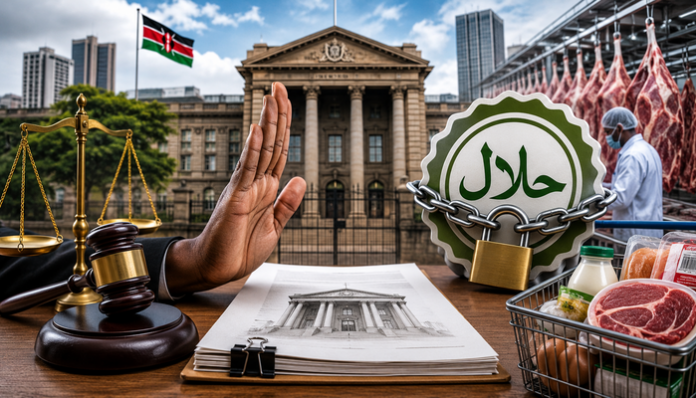
In April this year, a petition was filed in the High Court in Nairobi, Kenya, seeking urgent intervention to stop the increasing use of private certification systems, particularly Halal certification, as a mandatory requirement in the food and meat industries in the country.
According to the Estleigh Voice, a constitutional petition was filed before the High Court under multiple provisions, including Articles 43, 46 and 47, by the petitioners named Dennis Nthumbi, Dennis Owuor Ochanda and Henry Barasa. The petitioners submitted before the court that private certifications for Halal have been operating as a mandatory step for market access, procurement participation, and regulatory compliance without any supporting legal framework.
The petitioners have requested the court to restrain government agencies and public bodies from “enforcing, requiring, or treating any private certification system… as a mandatory condition” for licensing, trade, or public procurement unless anchored in law.
The petitioners mentioned their affidavit that the issue is not related to religion, but the manner in which the Halal certification is currently operating in the country. They argued that the certification process has been increasingly influencing access to supply chains and market participation. They further said that while Halal certification is a legitimate private religious assurance system, its growing influence in mainstream commerce risks undermining statutory mandates assigned to public health and veterinary officers under existing laws such as the Meat Control Act and the Public Health Act.
The petitioners further said that the consumers are incurring additional costs due to the private Halal certification system, which is raising concerns relating to consumer rights and public finance.
“Many consumers do not understand the certification or its cost implications, nor are they aware whether such costs are embedded in product pricing,” the affidavit stated, adding that where such costs are unavoidable, they may amount to a “de facto compulsory charge”, triggering scrutiny under constitutional provisions governing taxation and public finance.
Besides, the petition raises concerns about potential discrimination and market exclusion arising from private Halal certification, noting that businesses unable to meet certification requirements may be locked out of supply chains. “There is a real risk of confusion between statutory inspection and private certification, weakening regulatory clarity and potentially compromising public health systems,” the petitioners said. “Certification appears to operate as a practical requirement for participation, rather than a purely voluntary choice,” they added.
The petitioners requested that the court issue a directive compelling regulators, including the Kenya Bureau of Standards (KEBS), to clarify the legal status of certification systems and to enforce transparency in labelling and pricing. They warned that unless the court intervenes, “the public shall continue to be exposed to regulatory ambiguity, undisclosed economic burdens, and ongoing constitutional injury.”
What is Halal?
The word ‘Halal’ means permissible or lawful in Arabic. In the context of food, Halal means food and drinks complying with the Islamic dietary laws. As per Islamic law (Sharia), the ‘halal’ slaughter of an animal requires the use of a sharp knife, which is free of nicks and scratches. Although there is no directive to use any special kind of knife, unlike kosher, it is recommended that the blade of the knife be 2-4 times larger than the neck of the animal.
Halal slaughter must be performed by only a sane, adult Muslim who is familiar with Islamic rituals. “Animals slaughtered by a Non-Muslim will not be Halal. The name of Allah must be invoked (mentioned) at the time of slaughtering by saying: Bismillah Allahu Akbar,” says the Department of Halal Certification in the European Union.
