

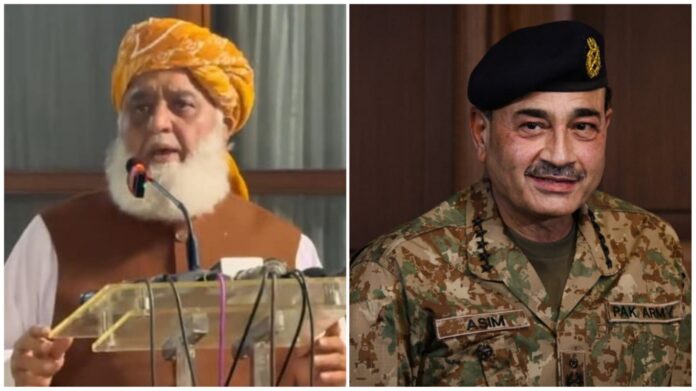
Pakistan Army Chief, Field Marshal Asim Munir, has drawn sharp criticism from Jamiat Ulema-e-Islam-F (JUI-F) chief Maulana Fazlur Rehman, who challenged him to quit the military and contest elections if he wished to engage in politics.
Addressing a public rally in Pakistan’s Punjab province on Sunday, Rehman took direct aim at Munir, accusing the country’s powerful military establishment of overstepping its constitutional role and exerting undue influence over Pakistan’s political landscape.
“If you want to do politics, then remove your uniform and enter the electoral arena. Contest an election and see how many votes a man in uniform actually gets,” Rehman remarked, asserting that the armed forces should remain within the limits prescribed by the Constitution rather than interfering in civilian governance.
‘Army has no mandate to decide governments’
Escalating his attack, the JUI-F chief accused the military of playing kingmaker in Pakistan’s politics by influencing who comes to power and who is removed from office.
“You believe you have the authority to install any government you like and dismiss whichever government you choose. Deciding who governs Pakistan is not the army’s constitutional responsibility,” he said.
Rehman further alleged that Pakistan’s institutions were weakening because of the military’s expanding footprint in civilian affairs, warning that the country’s political system was steadily being hollowed out.
His remarks come at a time when Field Marshal Asim Munir is widely regarded as the most powerful figure in Pakistan, with analysts frequently suggesting that his influence extends far beyond military affairs and often eclipses that of Prime Minister Shehbaz Sharif.
The criticism also follows Islamabad’s decision to induct Munir into a high-level committee on population management, a move that has intensified debate over the military’s growing role in governance.
Rejects calls for civilians to fight terrorists
Rehman also rejected suggestions that ordinary Pakistanis should organise armed militias to combat terrorism, insisting that safeguarding the country is the military’s responsibility.
“They say soldiers are laying down their lives. But soldiers wear uniforms and receive salaries precisely because defending the country is their duty. Why should the burden of their sacrifice be shifted onto ordinary citizens? Their salaries are paid through the taxes collected from the sweat and blood of the people,” he said.
Rejecting proposals for civilians to arm themselves, he added, “I have never taken a salary from the state, nor will I raise a militia.”
Warning against such an approach, Rehman argued that arming civilians would only sow the seeds of enduring feuds and prolonged violence.
“You may leave tomorrow, but you are pushing this land into generations of vendettas. You are paving the way for perpetual bloodshed,” he cautioned.
‘Government’s writ does not exist in Balochistan’
The JUI-F leader also painted a bleak picture of Pakistan’s internal security situation, claiming that the state had effectively lost control over large parts of Balochistan.
“There was an insurgency in the Baloch belt, and the entire region slipped out of Pakistan’s control. Even today, the government’s writ does not exist there,” he claimed.
According to Rehman, the unrest has now spread beyond Baloch-majority districts into Pashtun areas as well, underscoring what he described as the state’s deteriorating security situation.
His remarks come amid a surge in militant attacks across Balochistan and Khyber Pakhtunkhwa, fuelling fresh criticism of Pakistan’s security strategy and the military’s expanding influence over the country’s political and administrative affairs.
