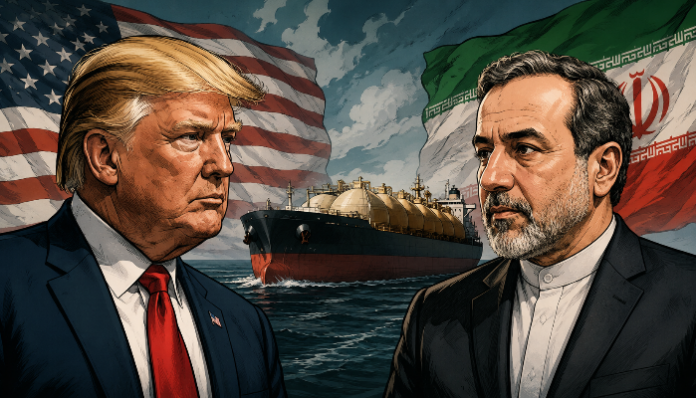
On 13th July (Monday), US President Donald Trump announced that the “Strait of Hormuz” is going to remain open and appointed the United States as its “guardian.” He also conveyed that countries will be required to pay “20 per cent on all cargo shipped” to traverse the critical maritime route.
He also stated that American forces will reinstate their blockade of Iranian ports near the waterway. Both sides are contending for authority over the strait, leading to a resurgence of tensions in the region, even after multiple initiatives to work out a peace settlement.
“The Hormuz Strait is open and will remain open with or without Iran. We are reinstating the Iranian blockade, so named because it is only stopping Iran’s ships or customers from entering or leaving,” Trump wrote on Truth Social, declaring the US as “the guardian of the Hormuz Strait.” He mentioned that all other nations would have the right to utilise the passage freely and justly, but only after Washington is “reimbursed at a rate of 20% on all cargo shipped for any and all expenses incurred in ensuring safety and security in this highly unstable region of the world.”
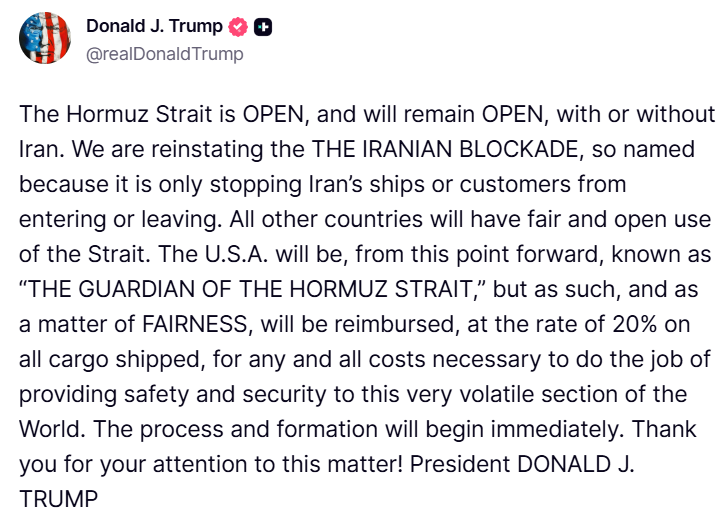
Trump referred to this as a “matter of fairness” due to the self-proclaimed designation of his country. “The process and formation will begin immediately,” he added. The US Central Command informed that the blockade would resume on Tuesday at 4 pm Eastern Time (ET). It is a turnaround of Washington’s policy which held that the strait should remain open as it was before the eruption of the fighting.
Iran responds after Trump’s statement
Notably, the Trump administration previously underscored that such monetary conditions cannot be enforced on international corridors in directly contradictory statements. Moreover, Iran faced severe backlash for allegedly imposing the same on the strait, as it reported to be charging up to $2 million per tanker.
However, the latest development offered a prime opportunity for the Islamic Republic to justify its demands under the guise of “compensation” and also project itself as the real guardian of the strait which deserved the payment. It is important to remember that containers were able to move through the area without encountering any of these issues prior to the dispute. They were not forced to cough up specific amounts to access the passageway. However, both parties are presently attempting to make other nations bear the cost of their enmity.
“POTUS is absolutely right. Whoever provides secure and safe passage of commercial vessels through the Strait of Hormuz should be compensated for this service. Iran has always been the guardian of the strait and will remain so forever,” retaliated Seyed Abbas Araghchi, Minister of Foreign Affairs of Iran, mocking that 20% is “too much” and the regime will be “fair” while slapping a similar tax on the vessels.
POTUS is absolutely right. Whoever provides secure and safe passage of commercial vessels through the Strait of Hormuz should be compensated for this service.
— Seyed Abbas Araghchi (@araghchi) July 13, 2026
Iran has always been the GUARDIAN of the Strait and will remain so FOREVER.
20% is of course too much. We will be fair
The U-turn by Washington and the insistence from Tehran
“No country is allowed to charge tolls or fees on an international waterway. That’s existing international law. That’s the way it is in international waterways all over the world, and that’s the way we expect it’ll be here.” United States Secretary of State Marco Rubio stated during a visit to the Middle East.
The US signed a joint statement affirming that the countries “rejected any tolls, fees or attempts to assert control over the strait” following his speech at a meeting of the Gulf Cooperation Council, a coalition of oil-exporting Gulf Arab states. “We believe international waterways should be free of tolls,” emphasised Vice President JD Vance while discussions were underway last month regarding a ceasefire agreement with Iran that aimed to reopen the crucial maritime route.
However, the Iranian government which has been unwavering in its demand for payments following the conflict’s outbreak, consistently leveraged its strategic position. According to Iran’s parliament speaker, Mohammad Bagher Ghalibaf, the situation cannot revert to what it was before the war, and “service fees” would be collected for navigation support, environmental protection, insurance coordination and maritime safety operations during the cessation of hostilities. It was also included in the Memorandum of Understanding (MoU) that formally established the truce to allow for talks on a comprehensive peace arrangement.
On the other hand, six days after Trump signed the accord he stressed, “There will be no toll in the Hormuz Strait for 60 days during the cease fire period, and there will be no tolls after the 60 day period has expired, unless they are imposed by and for the United States of America, should the deal not be completed, for services rendered as the Guardian Angel to the countries of the Middle East for purposes of both past, present and future reimbursement of costs.”
The transit avenue, which was originally functional, relatively secure and freely accessible was first converted into a toll plaza by Iran which began to target ships for not adhering to its mandates after US attacked the country and a similar intention has been articulated by Trump after criticising the Islamic regime for the very same action. However, Trump’s statement is unsurprising in light of his history of inconsistencies.
How the objective of the war went from ‘defeating Iran’ to ‘keeping the Strait open’
Meanwhile, the objectives set by the USA and Israel that sparked the confrontation and revolved around dismantling Tehran’s nuclear capabilities, eliminating its ballistic missile and naval arsenals, curbing regional proxy influence and ousting its hardline government have receded into the background as the entire focus has shifted to controlling the strait and seeking funds from countries who want to use it.
The US has been unsuccessful in achieving any of the above-stated goals while the face-off persists and Iran continues to hold its ground, much to Trump’s chagrin.
More importantly, commercial shipping has been jeopardised in one of the most prominent trade corridors in the world, and the global energy supply chain is severely disrupted with fuel prices remaining erratically high. It is apparent that these events would not have occurred without the existing tensions in West Asia.
Furthermore, the US is set to reintroduce a blockade on Iranian ports as a countermeasure to Iran’s alleged blockade of the strait, with both nations likely to again engage in attacks on ships that fail to follow their directives, thereby putting lives and trade at greater risk. Indian seafarers have particularly borne the brunt of these strikes.
An Indian crew member lost his life and 8 others, including 6 Indians and 2 Ukrainians sustained injuries after two UAE-flagged tankers were recently hit by Iranian cruise missiles in the strait, on Omani waters. The impact of this violent struggle clearly extends far beyond its scope, affecting the innocent persons who find themselves caught in the crossfire.
The blockade enacted by both the US and Iran is evidently a two-edged sword for ships and their occupants. Additionally, it would not be inaccurate to assert that Trump who failed to fulfill its aims in Iran has given the Islamic regime a basis to defend the obligatory charges imposed on its “unfriendly” countries for using the strait with the recent remarks as the route has taken the spotlight in the intensifying altercations with no relief in sight for energy-dependent economies.
Ironically, the global community will be compelled to confront these challenges stemming from the pivotal waterway that was once easily available without any diplomatic, financial or other complications before the US military offensive against Iran. In simpler terms, it is extortion masked as safety and service amount, regardless of the country making the demand.