

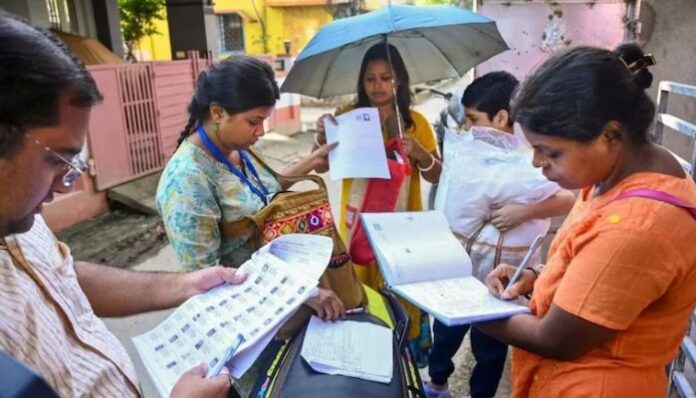
The Election Commission of India (ECI) has removed more than 1.5 crore names from electoral rolls during the third phase of the Special Intensive Revision (SIR), in an effort to keep voter lists updated and ensure that only eligible voters remain on the rolls. According to data shared by the ECI and analysed by The Hindu, 1,58,59,834 names have been removed so far from the draft electoral rolls published in 12 States and Union Territories.
11.51% names removed after verification
The 12 States and Union Territories where draft rolls have been published had a total of 13,77,27,807 voters before the revision. After the door-to-door verification and other checks, 1,58,59,834 names, or 11.51%, were removed.
These entries include voters who were found to be absent from their registered addresses, had shifted elsewhere, were reported dead or had registrations at more than one place. The exercise is aimed at keeping electoral rolls accurate and removing entries that do not meet the requirements for inclusion.
The final number of voters is not fixed yet. The ECI has provided a window for people to file claims and objections regarding additions or deletions in the draft rolls. Eligible citizens can also apply for registration, meaning the final electoral rolls may see further changes.
Andhra Pradesh sees highest number of deletions
Andhra Pradesh has recorded the highest number of names removed in absolute terms. A total of 44.89 lakh names, or 10.78% of its earlier voter list, have been removed. Its draft electoral roll has now come down from 4.16 crore electors to 3.71 crore.
Among the 44.89 lakh entries removed in Andhra Pradesh, 22.30 lakh were linked to voters who had shifted or were not found at their registered addresses. Another 15.22 lakh entries related to voters reported dead, while 7.37 lakh were found to have registrations at multiple locations.
Haryana recorded the second-highest number of deletions at 33.83 lakh, followed by Odisha with 20.12 lakh. Sikkim recorded the lowest number at 37,724, while Mizoram followed with 46,162 names.
Dadra and Nagar Haveli records highest percentage
Dadra and Nagar Haveli and Daman and Diu recorded the highest proportion of names removed at 29.64%. Arunachal Pradesh followed with 19.09%, Haryana with 16.38% and Chandigarh with 12.8%.
Mizoram recorded the lowest proportion of deletions at 5.2%.
In other States, Odisha recorded 6.02% deletions, Manipur 7.5%, Uttarakhand 10.39%, Chandigarh 12.8%, Meghalaya 7.67% and Jharkhand 16.48%. In Sikkim, 8% of the earlier entries were removed.
SIR 3.0 is underway in 16 States and 3 UTs
The third phase of SIR is being carried out in 16 States and three Union Territories: Delhi, Odisha, Mizoram, Sikkim, Manipur, Uttarakhand, Andhra Pradesh, Arunachal Pradesh, Haryana, Chandigarh, Telangana, Punjab, Karnataka, Meghalaya, Maharashtra, Jharkhand, Nagaland, Tripura, and Dadra and Nagar Haveli and Daman and Diu.
Draft electoral rolls have been released for 12 of these States and Union Territories.
The door-to-door enumeration and verification process has been extended in Delhi, Punjab, Telangana, Karnataka and Maharashtra. As a result, their draft rolls are yet to be published. Draft lists for Tripura and Nagaland are also awaited.
SIR already conducted in several States
The SIR exercise has already been completed in Bihar, West Bengal, Tamil Nadu, Kerala, Puducherry, Uttar Pradesh, Rajasthan, Madhya Pradesh, Gujarat, Chhattisgarh, Goa, Andaman and Nicobar Islands and Lakshadweep.
In Assam, a “special revision” was conducted because of legal considerations related to the National Register of Citizens (NRC).
Supreme Court upheld constitutional validity
The SIR process has led to differences between Opposition parties and the Election Commission and has also been challenged before the courts.
In March, the Supreme Court unanimously upheld the constitutional validity of the ECI’s decision to conduct the Special Intensive Revision.
With the third phase underway, the ECI is continuing to verify voter details and update electoral rolls. The process is intended to ensure that entries belonging to eligible voters remain on the rolls while names that no longer meet the requirements, including duplicate or outdated entries, are removed through verification. The claims and objections process allows eligible citizens to seek corrections or inclusion before the final rolls are published.
