

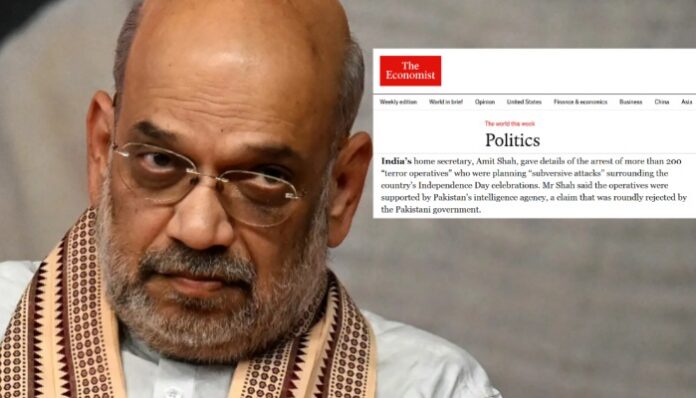
On 20th August (Thursday), the British magazine “The Economist” notorious for its bigoted and anti-India coverage, described Union Home Minister Amit Shah as “home secretary” in a segment focused on global political affairs.
It wrote, “India’s home secretary, Amit Shah, gave details of the arrest of more than 200 terror operatives who were planning subversive attacks surrounding the country’s Independence Day celebrations. Mr Shah said the operatives were supported by Pakistan’s intelligence agency, a claim that was roundly rejected by the Pakistani government.”

It bears mentioning that the Islamic Republic of Pakistan has always denied the presence of terrorists and terror organisations on its soil, most famously including Osama bin Laden. Yet, the country has been proven to consistently provide refuge and patronage to individuals and organisations designated as terrorists by the United Nations and the United States, such as Lashkar-e-Taiba and its founder Hafiz Saeed, as well as Jaish-e-Mohammed and its founder Masood Azhar, among others.
Meanwhile, the blunder, whether deliberate or otherwise, did not go unnoticed. The self-appointed “guardians” of world-class journalism soon found themselves under the spotlight, as social media users quickly picked up on the glaring lapse and began calling it out.
A user responded, “The desk interns of the media house are either slipping or doing it advisedly,” questioning if the Minister of Home Affairs would raise a protest.
The desk interns of @TheEconomist are either slipping or doing it advisedly. They call @AmitShah “India’s Home Secretary”. Will @HMOIndia object? #AmitShah pic.twitter.com/pQOWBPqpeH
— GhoseSpot (@TheRightGhose) August 22, 2026
Another person remarked, “Yet another reminder of how clueless-by-choice Western media is on Bharat.” He added that their prejudice and ignorance remain the same even after multiple decades.
Yet another reminder of how clueless-by-choice western media is on Bharat. Decades pass but nothing changes for the better regarding their ignorance and bias.
— Vikram K Malkani (@VikramKMalkani) August 22, 2026
It is important to highlight that The Economist has regularly adopted a profoundly biased stance towards India. In a recent report, it attacked the Bharatiya Janata Party (BJP) government over the introduction of the Uniform Civil Code (UCC), questioning the move and referring to it as “communal.” However, the platform raised its voice against Sharia councils in Britain and argued that the country’s secular law should take precedence over any religious regulation or statute, in a 2016 piece.
In another article, it went so far as to remove India’s deeply rooted Hindu cultural and civilisational heritage, portraying the Mughals as having introduced not only architecture and music but also food and literature to the country.
The Economist acknowledged that the Mughals demolished temples but asserted that this was not an insult to the native community. It then simply ignored the imposition of “jizya,” the slaughter of Hindus, and the forced conversions that the Islamic rulers had emphasised in their own works.
Given the media outlet’s long record of racist, Hinduphobic and anti-India propaganda, it is hardly surprising that it referred to Amit Shah as the “Home Secretary” and did not appear to bother correcting the striking error. The colonial hangover, it seems, is not leaving it anytime soon.
