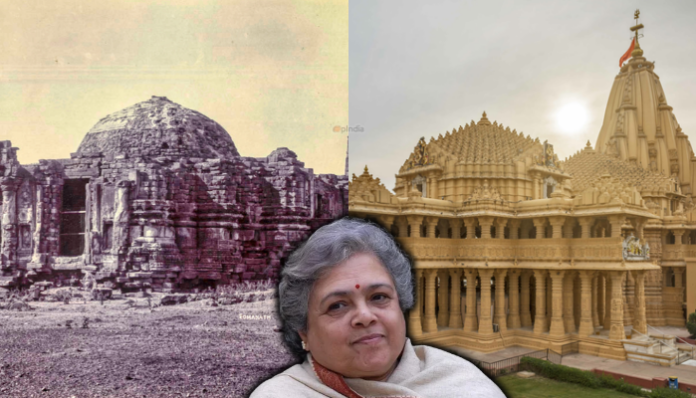
The Somnath Temple in Gujarat has been a symbol of devotion, resistance, and civilisational continuity. The holy abode of Someshwara Mahadev has been witness to around 18 Islamic jihadist attacks. While historical records document and folklore glorify how the temple priests and local devotees fought against Mahmud Ghazni’s Jihadis, Islamo-leftists today discredit their resistance using imaginary claims. In this vein, leftist propagandist Mrinal Pande recently claimed that the priests of Somnath Temple sat outside singing Bhajans when Islamic armies from Ghazni plundered the temple.
In an X post published on 25th September, Mrinal Pande wrote, “When the Somnath temple was being looted by the armies from Ghazni, the priests sat singing Bhajans outside the temple, asking for god’s blessings.”
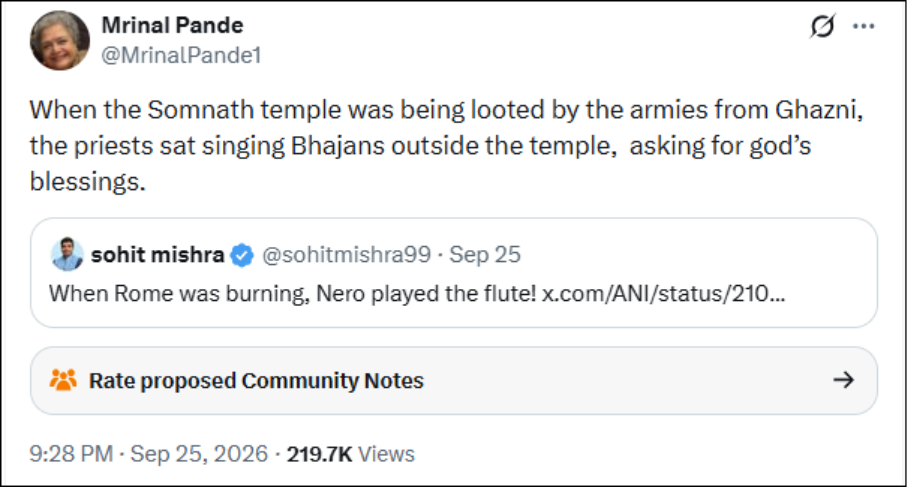
Pande drew equivalence between the myth of Roman Emperor Nero playing a flute while Rome burned, and the Islamo-leftists-concocted lie that Somnath Temple priests were singing Bhajans instead of fighting back when Mahmud Ghazni campaigned against the Hindu temple.
Before delving into the truth of whether Somnath Temple priests actually just sat outside and sang Bhajans or posed a strong fight against Jihadi invaders, let us revisit the history of Somnath Temple and its destruction.
The Somnath Mandir is a majestic temple situated near Prabhas Patan of Veraval in Gujarat. It is one of Lord Shiva’s twelve sacred Jyotirlingas and is mentioned in Chapter 13 of the Shiv Purana. Somnath is also described as Triveni Sangam, much like the one in Prayagraj, due to the meeting of the Kapila, Hiran, and Saraswati rivers.
For Muslims, especially the Islamic invaders in the medieval era, destroying the temples and idols of the Kafirs was upheld as their “religious duty,” and despite changes in times, this Islamist desire has not subsided. Although numerous Hindu temples were desecrated and destroyed during the Islamic invasions, Somnath in Gujarat and Jagannath Temple in Puri, Odisha, faced the maximum attacks, with each being invaded 17 and 18 times.
The first attack on the Somnath Temple came in 725 CE from an Arab named Junayd ibn Abd ar-Rahman al-Murri, also known as Al-Junayd during the Umayyad Caliphate. Junayd was appointed the governor of Sindh in 723. He invaded Gujarat and Rajasthan and ravaged, looted, and destroyed the Somnath Mandir in 725.
It was only in 815 CE that Nagabhata II, a Gurjar Pratihar monarch, visited the ruins of the Somnath Temple and rebuilt the temple using red stones.
The next major attack on the Somnath Temple was in 1025 by Mahmud of Ghazni, who went on to lead 17 invasions of Hindu temples.
In 1025, he plundered the holy idol of Somnath during his sixteenth expedition to India. “Somnath” is Sanskrit for “moon master.” Mahmud of Ghazni is said to have sworn to wage an annual Jihad against the country of Kafirs. Ghazni overthrew Hindu king Jayapala, defeated his successors Anandpala (in 1008) and Trilochanpala (in 1013).
In 1011, Mahmud of Ghazni attacked Thaneshwar and destroyed idols. He burned the temples in Mathura during 1018–1019, and the idols were taken to Ghazni. His Jihadi fanaticism also devoured Mathura, Kannauj, and the many temples on the way. However, Ghazni’s Somnath invasion became an unforgettable chapter in Bharat’s history, reflecting both the obsession and abhorrence Muslims harbour for Hindus, and the resilience of the Hindu civilisation to rise every time and continue the fight until the ultimate victory, no matter how long it takes.
Despite enduring heavy losses and fierce opposition, the Jihadi army of Mahmud of Ghazni demolished the sacred temple.
Defenceless guardians of the Somnath Temple fought till the end of their lives
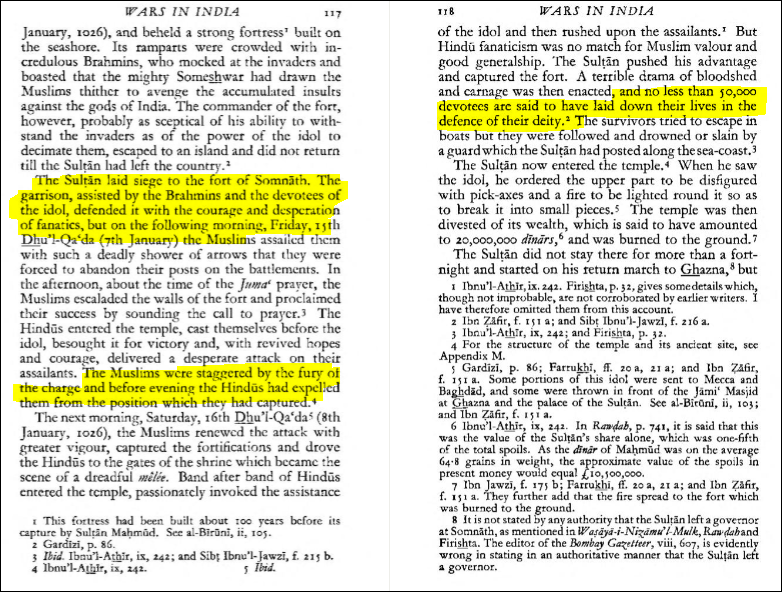
Contrary to the ‘sat outside singing Bhajans’ claims Mrinal Pande and her ilk have been making for long, the guardians of the Somnath Temple, including the Brahmin priests and local devotees, fought bravely till the end. Thousands sacrificed their lives. Mahmud Ghazni fought a battle against not trained warriors but common Hindus comprising the temple guards, Brahmins, and locals defending the temple; the battle resulted in over 50,000 deaths.
After the slaughter, Mahmud entered the temple’s sanctum sanctorum, dismantled the Shivalinga and stole all the riches, which totalled over 20,000,000 Dirhams.
The cruel ruler of the Ghaznavid Empire earned the disgraceful moniker ‘Butshikan’ or idol breaker due to his Jihad against Hindu temples.
In fact, the Brahmin priests of the Somnath Temple did everything in their capacity and what the short time span allowed to protect the temple and Jyotirlinga from destruction.
After the protectors of the Somnath temple were defeated, it is stated in Tariki-e-Alfi, a historical work compiled by a committee formed by Akbar, that Brahmins offered Mahmud of Ghazni an unheard-of amount of wealth in exchange for leaving the ling of Somnath undamaged. Mahmud, in response, said that after he died, he would rather love to be known in the presence of Allah as Butshikan (the destroyer of idols) rather than ButParast (the devotee of idols). He rejected the Brahmins’ offer and demolished the Somnath idol.

Moreover, Muhammad Nazim’s 1931 book The Life and Times of Sultan Mahmud of Ghazni, which elaborately documents Ghazni’s Somnath expeditions, mentions how Brahmin priests of the Somnath Temple and devotees not just prayed to Mahadev but also “defended it with the courage and desperation of fanatics…”
Historian Nazim synthesised earlier Persian and Arabic sources, principally Gardizi’s Zayn al-Akhbar, Ibn al-Athir’s al-Kamil fi al-Tarikh, and Sibt Ibn al-Jawzi.
“The Sultan Said siege to the fort of Somnath. The garrison, assisted by the Brahmins and the devotees of the idol, defended it with the courage and desperation of fanatics, but on the following morning, Friday, 15th Dhu’!-Qa‘da (7th January), the Muslims assailed them with such a deadly shower of arrows that they were forced to abandon their posts on the battlements. In the afternoon, about the time of the Juma‘ prayer, the Muslims scaled the walls of the fort and proclaimed their success by sounding the call to prayer.3 The Hindis entered the temple, cast themselves before the idol, besought it for victory and, with revived hopes and courage, delivered a desperate attack on their assailants. The Muslims were staggered by the fury of the charge, and before evening the Hindis had expelled them from the position which they had captured,” it reads.
Neither the more contemporary accounts, be it by Al-Beruni nor by Gardizi, make any mention of Somnath Temple priests invoking their revered deity alone and leaving the Lingam and temple’s protection in Mahadev’s hands, while they just sat and sang hymns.
One has to be as retarded as Mrinal Pande to even think of an implausible scenario that a Jihadist raiding army driven by Islamic zeal to subjugate top-tier Kafirs like Hindu would let priests sit comfortably and sing hymns as a sideshow instead of slaughtering them at the first instance.
Yes, the temple priests and devotees prayed to their deity, but those prayers did not follow abject surrender; rather, what followed was unimaginable resistance, a fight till their brutal end, and a legacy that ensured that those non-martial Hindus are remembered for their valour even after the passage of centuries.
The controversial shenanigans of Congress stooge Mrinal Pande
‘Journalist’ Mrinal Pande is no stranger to controversies. In 2024, she mocked BJP leader Tajinder Bagga over his visit to a Mahakaal Temple. “Bow your head in the Golden Temple too, or are you only following Sanatan Dharma?” she wrote.
While celebrating the release of controversial doctor Kafeel Khan’s release on bail from Mathura jail, Pande went on to compare him with Lord Krishna in 2021. Comparing his release from Mathura jail to Lord Krishna’s escape from the jail where he was born, Pande insinuated that he too will bring about the end of Uttar Pradesh Chief Minister Yogi Adityanath, just like Lord Krishna had eliminated Kans.
In 2020, Mrinal Pande made transphobic comments when she responded to an X post of another controversial ‘krantikari’ journalist, Punya Prasoon Bajpayee. PP Bajpayee, who had been thrown out of the job, had made a lewd comment asking people why PM Modi claps frequently during his campaign speeches. In a hurry to mock Prime Minister Modi, the Congress journalist Mrinal Pande tweeted to ask whether PM Modi does that to garner votes of the “Kinnars” — the transgender community.
Mrinal Pande has a penchant for peddling falsehoods about historical Hindu temples. In December 2021, she published a series of X posts, in which she claimed that in the Temple of Avimukteshwar, Shiva was the head of Old Kashi. Vishweshwara dates back to the 15th century. She added, “Padma Purana, Brahmavaivarta Purana, and Kashikhand have considered these two lingas as separate and Avimukteshwar as Swayambhu Adi Linga. It was destroyed along with the temple. Worshipping an ordinary Linga instead of Swayambhu Linga is not prescribed.”
However, he blatant lies were rebutted by X users with facts highlighted from historical sources.
More recently, in February 2026, Mrinal Pande joined an Islamo-leftist coterie in mocking an Indian national, Nikhil Gupta, who pleaded guilty after he was accused of being involved in the failed assassination plot of Khalistani terrorist Gurpatwant Singh Pannun.
Pande invoked the Dhurandhar analogy to mock India’s intelligence agencies, and wrote, “Dhurandhar ban gya chukandar”.
In another post, Pande insinuated that the intelligence agencies are inept; she wrote, “Dhurandhar destroyed the game of diplomacy…”