

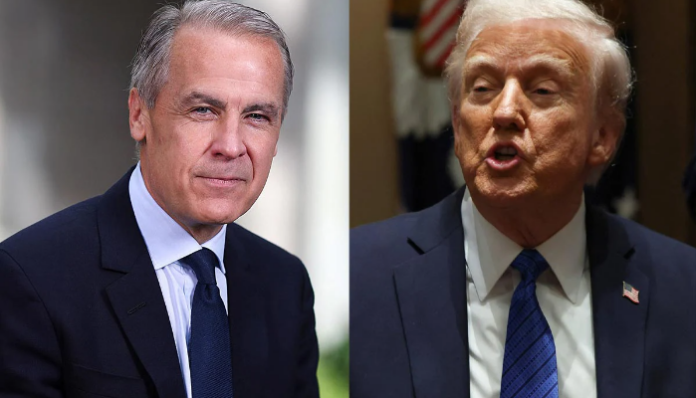
On 25th August (Tuesday), Canada announced retaliatory duties of 15%, 25% and 50% on around $20 billion worth of American imports, including steel, dairy products, appliances, farm equipment and other commonplace items, as the trade war between the two neighbours continues to intensify. The recent development transpired after US President Donald Trump slapped 50% tariffs on Canadian goods as the trade negotiations failed between the two sides last week.
Nearly $20 billion worth of American goods will be subject to the Canadian tariffs. The targeted product list is intended to correspond with Canadian commodities that the US has targeted. The Canadian levies are scheduled to take effect from 8th September. Meanwhile, both sides accused the other of making irrational demands at the last minute during the trade talks.
“We did not choose this conflict, but when our economic integration is used as a weapon rather than the foundation for a win-win partnership, we need to stand up,” Finance Minister François-Philippe Champagne expressed, referring to the situation as an “unprecedented challenge imposed on Canada.”
“Those tariffs will have real consequences for Canadian workers, businesses and communities across our nation. Canada must respond,” he mentioned while talking about the decision taken by Washington, terming the retaliatory move as “proportionate” and “strategic.”
Prime Minister Mark Carney later declared, “Canada will match the new US tariffs dollar for dollar. In addition, we are introducing $7.5 billion in new and enhanced measures to support Canadian workers and businesses. That builds on the nearly $25 billion in supports introduced since the implementation of the US unjustified tariffs.”
After the announcement of counter-tariffs, the White House issued a statement stating that the US was ready to give Canada “the most preferential market access of any country on Earth” in recent trade discussions and added, “Instead of partnership, Canada chose unreasonable demands, walk-backs, and flat-out rejection.”
According to US officials, Canada’s last-minute demands for more concessions caused the agreement to collapse. Now, about $20 billion worth of Canadian goods will be impacted by the US tariffs. Carney had argued that Canadian officials had put in a lot of effort in good faith but, “last-minute changes in the US proposed terms were unfair, uneconomic and called into question the reliability of any deal.” Ottawa then pledged to match Washington’s firm stance as Carney recalled his negotiators. No more discussions are scheduled between the two countries.
Trump attacks Canadian leadership
Leaders in Canada were warned by Trump to “fall in line” or risk repercussions “far worse” than the current tariffs. Additionally, he threatened to introduce fresh 50% tariffs on steel, cars and auto parts made in Canada. Trump also charged Canada with “ripping off” the United States for decades and imposing high tariffs on American farmers in a series of posts on Truth Social.
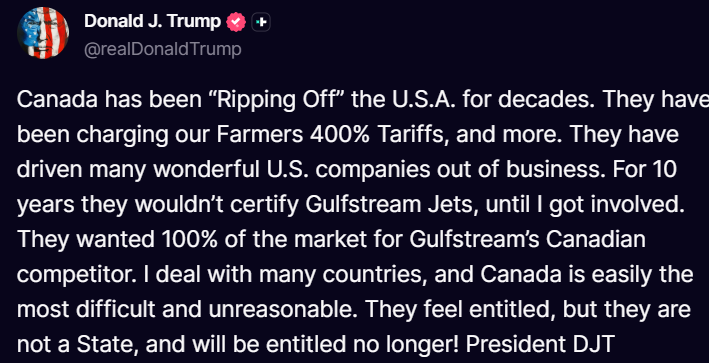
“America has been carrying Canada for decades, but no longer. The U.S.A. will always be far bigger, richer and stronger than Canada. Without the United States, Canada couldn’t survive — It’s where they get all of their money, and because of their current bad leadership,” he wrote and referred to PM Carney as Governor Carney, reigniting the provocation that Canada would become the 51st state of the United States. He added, “They will not be allowed to keep taking advantage of the United States — Their key to survival.”
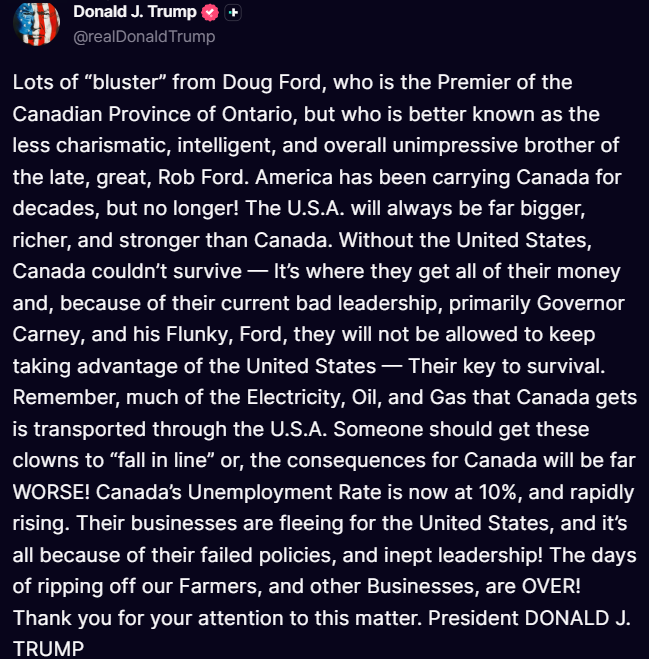
Trump escalated his conflict with Ontario Premier Doug Ford by adding another controversial statement that the United States was “seriously considering” naming Lake Ontario “Lake America.” He remarked, “We don’t expect to do much business with Ontario any longer.” Ford called him a loser recently and then admitted, “things got a little heated.”
On the other hand, Carney countered that these tariffs had “attacked” his nation and accused the Trump administration of using “economic integration as a weapon.” He accused Washington of inserting last-minute clauses that would have eroded protections for language, culture and sovereignty, limited Canada’s capacity to negotiate trade agreements with other nations and decreased tariff relief for cars manufactured in the country.
The requests were deemed “unacceptable” by him. Carney asserted, “They asked too much and offered too little.” Trump also threatened to raise US tariffs on Canadian cars to 50% starting on 1st January, after which Carney charged him with wanting to “destroy” Canadian businesses, such as the steel and aluminium industries and the car industry.
