

Amid the politically motivated backlash faced by IIT-Bombay following the suicide of Sahil Wakode, who was caught cheating in exam, the premier engineering institute is attempting to normalise unfair practices.
According to reports, if a student is caught cheating, he will be allowed to complete the exam on a fresh answer booklet. The invigilator-in-charge can record the cheating and take away the materials used.
At the same time, the quick response team (QRT) helpline should be alerted so the cheating student can be ‘supported’ after the exam. As such, the student’s name, roll number, course should be communicated to the QRT so that the accused isn’t alone after such an incident.
These are some of the proposals that have been suggested by an 8-member committee that was set up by IIT Director Shireesh Kedare to revise exam conduct rules.
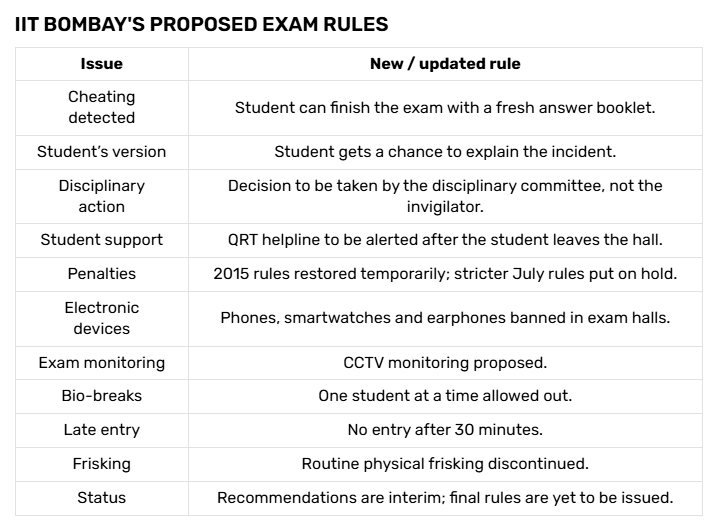
The 8 members include 4 students and 4 faculty members. The interim proposal was placed before the IIT Senate on Wednesday (7th October). It was also proposed that till a new set of punishment rules is drafted, the IIT Senate will go back to its much more lenient 2015 rules.
Under the July 2026 rules, a student found with a phone in an exam hall is suspended for a semester and receives a ‘Fail and repeat’ (FR) grade. Similarly, a student seen talking to another student got a straight FR.
The 2015 rules did not lead to suspension for a semester and only loss of one grade. The interim report states that the student be given a chance to record his version of events.
“An important point to note: When a suspected unauthorised academic practice is noticed, the invigilator’s responsibility is to stop that activity, collect related material and record details to the extent possible. Further proceedings will be carried out later by the Disciplinary Action Committee as per norms,” the interim report stated.
Under the new rules, the invigilator should communicate as little as possible with the cheating student.
