

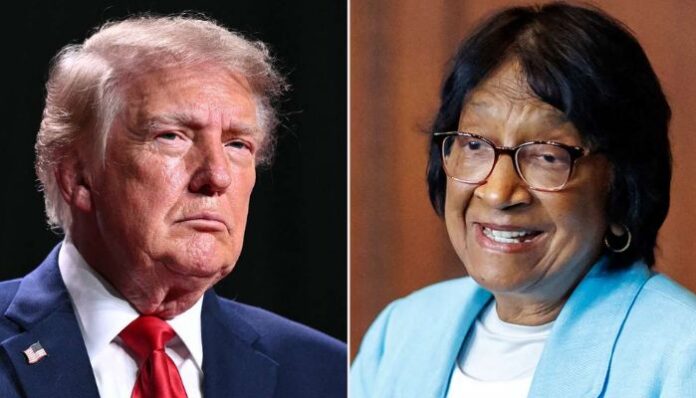
On Friday, October 9, the United States imposed sanctions on the International Criminal Court (ICC), hours after Indian-origin former ICC judge Navanethem “Navi” Pillay won the Nobel Peace Prize. The move marks a major escalation in President Donald Trump’s persistent action against the court and could increase tensions between Washington and its European allies.
US Secretary of State Marco Rubio said the sanctions aim to prevent the ICC from prosecuting American citizens. The measures target the court as an institution, raising concerns about its ability to investigate and prosecute war crimes, genocide and crimes against humanity.
Rubio warns of action against ICC
Announcing the sanctions, Rubio said the Trump administration would cut off the court’s access to resources and restrict its operations.
“President Trump will never allow the International Criminal Court to prosecute Americans,” Rubio said. “That is why, today, the United States is sanctioning the International Criminal Court. We will ban transactions with this rogue court, cutting off their resources and crippling its ability to operate.”
Today, the Trump Administration is sanctioning the ICC. This action should encourage our Allies within the Court to work for solutions to end this threat to U.S. sovereignty forever. https://t.co/D86dCqLUaZ
— Secretary Marco Rubio (@SecRubio) October 9, 2026
In a video posted on social media, Rubio also warned, “Either the ICC will end its threats, or we will end the ICC.”
Washington has repeatedly criticised the court over arrest warrants issued against Israeli Prime Minister Benjamin Netanyahu and former defence minister Yoav Gallant. The US has also opposed the ICC’s investigation into purported crimes committed by American personnel in Afghanistan, which the court has since deprioritised.
The latest sanctions follow earlier US action against individual ICC officials, including its president, Tomoko Akane, and senior trial lawyer Abdoulaye Seye. The new measures could restrict the court’s access to the US financial system and affect companies providing services to it. A six-month transition period has been announced for the restrictions, with certain exemptions.
ICC condemns sanctions, calls for support
The ICC responded to the move by claiming that it was an attack on international justice and the rule of law. The court urged its 125 member states to defend its independence.
“The Court cannot stand alone. Its fate now rests also in the hands of the states that created it,” the ICC said, warning that the consequences went beyond the institution itself.
UN Secretary-General Antonio Guterres also attacked the sanctions, arguing that they could seriously affect the court’s ability to carry out its work. The European Union described the sanctions as “deeply regrettable” and said it was ready to take necessary steps to ensure the court could continue operating. EU foreign policy chief Kaja Kallas said the transition period offered an opportunity for dialogue.
Trump lashes out after Nobel Peace Prize snub
Trump expressed his outrage at not being awarded the 2026 Nobel Peace Prize. He took to Truth Social and fumed, “This is the woman who received the Nobel Peace Prize over the Great United States of America, whose Representative, ME, settled eight Wars, and many other things.”
He added, “I know nothing about this woman, and neither does anyone else! In fact, to the best of my knowledge, no one ever heard of her other than the fact that she, very obviously, hates Israel. I don’t know what the woman has done. I settled 8 Wars, with letters being sent from every President and Prime Minister from the countries that I helped to the Norwegian Nobel Committee, and I’m about to settle, or win, two more, Iran and Russia/Ukraine.”
US President Trump has a meltdown after losing the Nobel Peace Prize to Indian-origin South African jurist Navi Pillay https://t.co/OmzhPBZ8H2
— Shashank Mattoo (@MattooShashank) October 10, 2026
Trump also stated that he intervened between warring countries to resolve their disputes, also mentioning India and Pakistan, a claim that New Delhi has repeatedly and categorically denied. He asserted that he prevented Iran from obtaining a nuclear weapon and from “blowing up the entire Middle East and, ultimately, far beyond! I saved more lives than anyone in History.”
He then cited Venezuelan opposition leader and last year’s Nobel Peace Prize recipient Maria Corina Machado, who dedicated the award to him, adding, “I removed the World’s Evil Dictator, Nicolas Maduro, from Venezuela, and am in the process of making Venezuela a rich Democracy. Likewise, with Iran, I stopped them from destroying Israel, the Middle East, and Europe.”
Trump then insisted on his continuous efforts to prevent armed conflicts between nations such as North Korea and South Korea, Japan and North Korea, and China and Taiwan. He claimed responsibility for persuading NATO countries to increase defence spending from 2% to 5% of GDP, thereby strengthening the alliance in ways previously considered unattainable.
The president asserted that he had negotiated the release and secured the return of more than 900 political prisoners from various Eastern European nations and brought 196 hostages home from captivity worldwide without paying a “ransom,” contrasting his approach with that of his predecessors Joe Biden and Barack Obama, who he said would have paid billions of dollars.
“On top of it all, I have created a soon-to-be very prosperous Arctic. Despite all of this, the Nobel Prize was given today to a liberal person who works at the United Nations, who nobody has ever heard of. In all of the Wars that I have settled, I never spoke to the United Nations; they were of no help. The United States of America, represented by me, as your President, should have received the Nobel Peace Prize, but didn’t. This is an indelible stain on Norway, one that will never be forgotten. The Nobel Peace Prize has been forever discredited by a handful of Radical Ideologues who are Anti-Democracy, and Enemies of Civilization,” he concluded.
Indian origin jurist awarded Nobel Peace Prize
Pillay, a South African jurist of Indian Tamil descent, has been awarded the 2026 Nobel Peace Prize for her efforts to advance international law and peace. The official announcement was made on 9th October (Friday).
The formal release read, “The Nobel Peace Prize for 2026 goes to a person who, with exceptional courage and integrity, has led the way towards a more comprehensive global legal order.” According to the Norwegian Nobel Committee, she has contributed to the advancement of the principle that crimes against humanity, war crimes, and genocide must be tried, even in cases when the accused are powerful.
It stated that the 85-year-old served as a judge in international criminal tribunals, defended opponents of apartheid, including Nelson Mandela, as an attorney, and contributed to the development of international law pertaining to sexual abuse and genocide.
The release further conveyed, “Navi Pillay’s commitment to universal legal principles and her firm moral compass are constants in a long career. Born into a family of Indian Tamil origin under apartheid in Durban, South Africa, Pillay became a lawyer and legal pioneer, confronting deep structural discrimination, segregation and exclusion. A common thread runs from her early work defending Nelson Mandela and others who stood up against apartheid to her service as a judge in some of the key international court cases of our time.”
