

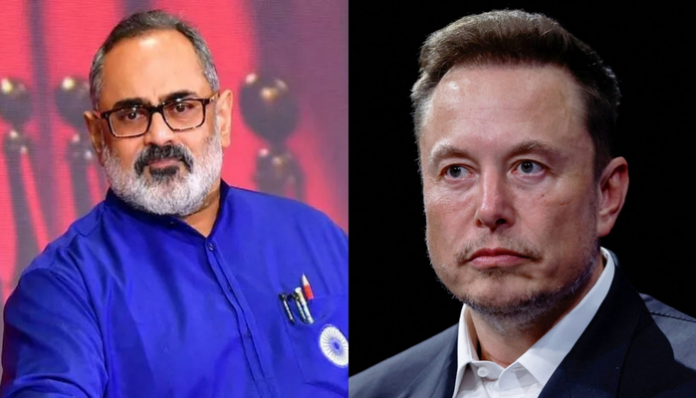
Kerala BJP President and former Union Minister of State for Electronics and Information Technology (MeitY), Rajeev Chandrasekhar, gave a fitting reply to American billionaire Elon Musk, who has been on an attacking spree against the Indian government over the license issue of his satellite internet service, Starlink.
In the past couple of days, Musk has launched a smear campaign against the Indian government by posting a series of messages on X, alleging that Starlink’s license application in India is being blocked by certain “oligarchs”. Musk later expressly named Indian businessman Mukesh Ambani as the one obstructing Starlink’s license in India. He suggested that India’s regulatory framework for satellite communication services was being applied in a discriminatory manner. Musk’s allegations were rejected by the Indian government.
Notably, Starlink has already received its telecom license in India. In June 2025, the Department of Telecommunications (DoT) granted Starlink a Global Mobile Personal Communication by Satellite (GMPCS) licence. It is awaiting further regulatory clearances to commence its commercial operations in India.
Former Union Minister Chandrasekhar gave an elaborate response to Musk’s unfounded allegations. He highlighted that India’s satcom sector, which was earlier ruled by cronies patronised by politicians and was plagued by opaqueness and corruption, has improved under the Modi government.
He said that, unlike earlier, the system is now not governed by vested interests but by three “OSTA” principles — Open, Safe & Trusted, and Accountable. Chandrasekhar said that the existing framework supports free and fair competition, safe and trusted infrastructure, networks and platforms, and legal accountability.
Dear Elon @elonmusk You hv certainly stirred up plenty of reaction with ur posts. But this needs a response from me, as did ur “Electronic Voting machines can be hacked” post from some time ago. As someone who knows a little bit abt Telecom as someone who played a decent-ish role in building Indias wireless sector as an Entrepreneur and then as a policy maker , let me share my thoughts. It is true that Indias Telecom was a sector beset with opaqueness and corruption for several decades – where cronies ruled under the benevolent love and the politics of ur latest fan (name not withheld – @RahulGandhi ) But under PM @narendramodi , 3 principles govern the tech (including Telecom/Internet) sector. Open, Safe & Trusted and Accountable. #OSTA ✅ Open – Free from any monopoly-duopoly. Free and fair competition. ✅ #SafeAndTrusted – Infra, Network , Platforms must be safe and trusted. ✅ Accountable – Every participant should be legally accountable for safety and trust. I was a MP first and then part of PM @narendramodi jis team when this framework was developed. I have more than a little experience of fighting years of political and bureaucratic opaqueness and corruption, which shaped these principles. so todays India is not that old crony driven India. I am not in govt anymore and certainly dont speak for it. But it seems to me that Govt has made it clear: all three satcom licensees are at broadly the same stage of ensuring security clearance by verifying its safety and trust first, then spectrum. Satellite IP services have many security implications. More so in a country like India which has faced years of Terror and insurgency supported by inmical state actors in our neighbourhood. From 26/11 terror attacks to recent ones in Pahalgam, satcom has been preferred comm for Terrorists. Satellite VOIP and encryption creates more challenges security wise. Not insurmountable but new capabilities and capacity hv to be built to ensure Safety and Trust. I hv used @Starlink and I think its awesome technology – and represents a new era in mobility innovation. No doubt. But a country has to plan for itself and its interests before every new choice. Thats what India is doing. Patience is unavoidable and in this case is a necessity.
— Rajeev Chandrasekhar 🇮🇳 (@RajeevRC_X) October 9, 2026
Further explaining the reasons behind the rigorous scrutiny in awarding satcom licenses, Chandrasekhar pointed out that satcom communication has been preferred by terrorists during several terror attacks, including the 26/11 Mumbai terror attacks and the recent Pahalgam terror attack.
“Satellite IP services have many security implications. More so in a country like India, which has faced years of Terror and insurgency supported by inimical state actors in our neighbourhood. From 26/11 terror attacks to recent ones in Pahalgam, satcom has been the preferred comm for Terrorists. Satellite VOIP and encryption create more challenges, security-wise. Not insurmountable, but new capabilities and capacity have to be built to ensure Safety and Trust,” the former MP said.
“…a country has to plan for itself and its interests before every new choice. That’s what India is doing. Patience is unavoidable and, in this case, is a necessity,” he added.
Apart from Starlink, two Indian companies: Reliance Jio’s Satellite Communications Limited and OneWeb India Communications Private Limited, have received Global Mobile Personal Communication by Satellite (GMPCS) licences. However, they are all undergoing security assessments. The companies will be able to launch their commercial services after they pass the assessments.
