

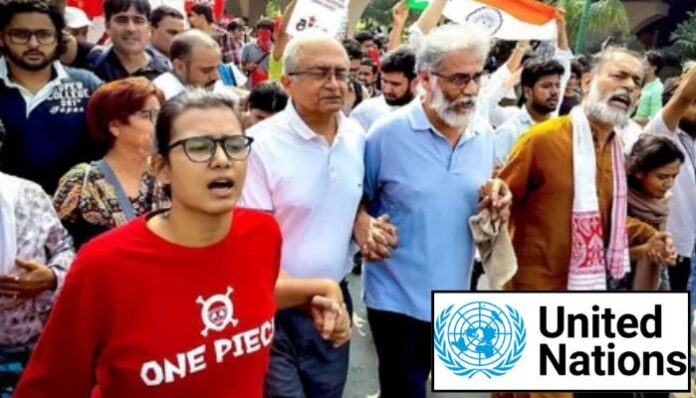
India has strongly responded to the United Nations human rights office on Saturday, 10th October, over its statement about the detention of protesters in Delhi, calling the remarks “misplaced” and an “unwarranted interference” in the country’s internal affairs.
The response came after the Office of the United Nations High Commissioner for Human Rights (OHCHR) claimed to be concerned about reports of alleged mass detentions during large-scale demonstrations called by the Cockroach Janta Party (CJP). The protests were organised against Chief Election Commissioner Gyanesh Kumar over alleged irregularities in electoral rolls and the Special Intensive Revision (SIR) exercise.
In a statement posted on X, India’s Permanent Mission to the UN in Geneva defended the country’s democratic institutions and said the Constitution guaranteed citizens the right to peaceful assembly.
We have seen the OHCHR’s remarks about today’s events in New Delhi. India is the world’s largest democracy, where the right to peaceful assembly is guaranteed by our Constitution and safeguarded by robust institutions, an independent judiciary and a free media. As in every democracy, Indian citizens exercise this right subject to reasonable restrictions in the interest of public order. The authorities, for their part, act in accordance with the law, and our courts remain available to all for redressal of any grievances. The OHCHR’s concerns are therefore misplaced and constitute an unwarranted interference in the internal affairs of India. In this context, OHCHR would also do well to devote comparable attention to large-scale protests elsewhere, consistent with its mandate of impartiality and non-selectivity. @MEAIndia @IndianDiplomacy @PMOIndia @DrSJaishankar @abagchimea
— India at UN, Geneva (@IndiaUNGeneva) October 10, 2026
India says UN remarks amount to interference in internal affairs
India rejected the OHCHR’s concerns, maintaining that strong institutions protect democratic rights. The mission said India’s independent judiciary and free media safeguard citizens.
#India: We are concerned by reports of mass detentions of demonstrators, protest leaders, members of civil society organisations, lawyers and journalists, before and during today’s large-scale demonstrations in Delhi. We call on the authorities to ensure that the right to peaceful assembly is fully respected and fulfilled. https://t.co/tqrQyZoXBJ
— UN Human Rights (@UNHumanRights) October 10, 2026
“The OHCHR’s concerns are therefore misplaced and constitute an unwarranted interference in the internal affairs of India,” the mission said.
India also called on the UN human rights office to pay comparable attention to large-scale protests in other parts of the world. It said the organisation should follow the principles of impartiality and non-selectivity while carrying out its responsibilities.
India’s position is that foreign governments and external organisations should not interfere in its internal matters. New Delhi maintained that authorities acted under Indian law and that citizens could approach the courts if they had grievances.
India defends restrictions on protests
The Indian mission said the right to peaceful assembly was protected by the Constitution, but added that it was subject to reasonable restrictions in the interest of public order.
“The authorities, for their part, act in accordance with the law, and our courts remain available to all for redressal of any grievances,” the statement said. The response came amid heightened security in Delhi after police prevented demonstrators from reaching Jantar Mantar for the planned protest.
All the bodies of the United Nations are permeated with a foulness of bigotry, Hinduphobia and antagonism against India, and they essentially operate as a pressure arm of the global Islamo-leftist alliance. The use of anti-India rhetoric, including invoking purported hate speech directed at specific groups or accusations of discrimination and violations of “human rights,” has become a convenient refuge for such organisations to advance their agenda of demonising India. The recent so-called concern over the protests is yet another case in point.
