

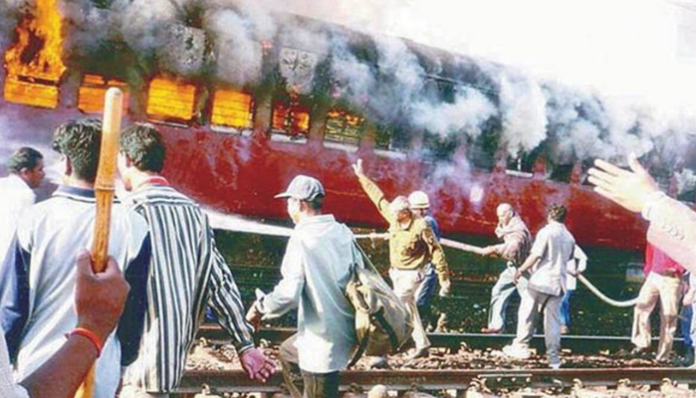
On Monday, 23 November, the Supreme Court suspended the life sentence of Irfan Siraj Pada, a convict in the 2002 Godhra train burning case. The court granted him bail on medical grounds after more than 18 years of incarceration. The order, passed by a Bench of Justices M.M. Sundresh and P.B. Varale. It has revived a familiar legal debate, but this time, the silence surrounding it stands in sharp contrast to the liberal – islamist outrage that greeted a strikingly similar relief in the Bilkis Bano case just days earlier.
The Godhra Convict and the Medical Grounds
Irfan Siraj Pada was among 31 people convicted by a special SIT court in 2011. He was convicted for the burning of the S-6 coach of the Sabarmati Express near Godhra railway station on 27 February 2002. The fire killed 58–59 Hindu kar sevaks returning from Ayodhya and triggered one of independent India’s worst episodes of communal violence across Gujarat.
11 convicts were sentenced to death, while 20, including Pada, received life imprisonment. The Gujarat High Court commuted the death sentences in 2017, and appeals have remained pending before the Supreme Court since 2018.
On Monday, the Supreme Court took note of Pada’s serious cardiovascular condition and his long years in custody. “Primarily, the application has been filed on medical grounds,” the Bench observed. “In view of the aforementioned factual scenario, we are inclined to grant suspension of sentence to the petitioner on medical grounds”. The Gujarat government, represented by Advocate Swati Ghildiyal, stated that while the case was “very serious,” it had no objection to the suspension of sentence on medical grounds. Pada’s appeal against his conviction remains pending; the relief is temporary and does not amount to an acquittal.
The Bilkis Bano convicts and the selective outrage
The Supreme Court last month suspended the life sentences of two convicts, one of whom is physically disabled, in the Bilkis Bano Case. On 28 October 2026, the court granted bail to the convicts Bipinchand Kanaiyalal Joshi and Pradip Ramanlal Modhiya, noting that they had been in jail for over 17 years.
A Bench of Justices M.M. Sundresh and Prasanna B. Varale that suspended the sentence of the convicts also considered the fact that one of the convicts suffered a severe handicap.
That order, uploaded on 15 November, triggered widespread condemnation. Bilkis Bano issued a statement expressing “pain, shock and disbelief,” stating that she was neither informed nor heard before the relief was granted. She said, “How could the Honourable Supreme Court simply suspend the sentence if the men who did this to me? How could they not even inform me? How could they not even make sure my voice was heard in their courtroom?”.
Political parties, including the Congress and the CPI(M), criticised the decision. CPI(M) general secretary M.A. Baby termed the Supreme Court order “shocking and reprehensible”.
A comparison that must be made
The legal architecture of the two orders is nearly identical: long incarceration of over seventeen years, a medical or disability-related ground, and a suspension of sentence while appeals remain pending. Yet the public and political responses have diverged almost entirely.
The Bilkis Bano bail order was met with editorials, opposition statements, and survivor testimony framed as a crisis of judicial conscience. The suspension of Irfan Pada’s sentence, who killed dozens of Hindus and catalysed mass communal violence against Hindus, has drawn no comparable outrage. There has been no survivor statement, no political condemnation, and no primetime debate.
This asymmetry is not a comment on the correctness of either order in isolation. Both rest on grounds the Supreme Court has applied in numerous cases: the prolonged duration of custody and the severity of a prisoner’s medical condition are legitimate factors in the suspension of sentence.
But the selective moral energy that surrounds one and not the other reveals a hierarchy of outrage, one that assigns greater gravity to some victims and some crimes than to others. If the Bilkis Bano order warranted national reckoning, the Godhra order warrants at least the same scrutiny. The silence, in this case, is the story.
