


On 10th November, Reporters Collective published a report claiming a mismatch between votes cast and votes counted in the 2024 Lok Sabha elections and some assembly elections. The report, published to coincide with the ongoing attack on the Election Commission and India’s election process by Congress and other opposition parties, claims the Election Commission didn’t record all the votes in some constituencies, and that the votes counted from EVMs mismatched the votes cast by lakhs. They made the allegations based on the ECI’s alleged internal record, which they claimed to have accessed.
However, a glance at the published results shows that the entire report is fundamentally flawed. Reporters Collective made the sensational claims relying on a glaring misinterpretation of basic electoral data. A closer look at the official records reveals that the authors, Sumedha Mittal and Venkatesh Nayak, have confused the total number of registered electors with the total number of votes actually polled. The only purpose of such fake news seems to be to fuel baseless campaigns against the election machinery of India. They undermine public trust without a shred of actual evidence.
The impossible myth of cent per cent turnout
The entire premise of the report falls apart when its core assumptions are examined. The authors implicitly suggest that the total registered electorate reflects the number of votes polled. But the fact is, a hundred per cent voter turnout in any Indian constituency is a logistical impossibility.
Electoral rolls are dynamic documents. They include people who have migrated for work to other states, students studying in different cities, and individuals who may have passed away just before election day. Add to this the significant number of people who are simply unwell, travelling, or who consciously choose not to exercise their franchise. No constituency in the history of Indian elections has ever recorded a turnout where the number of votes polled exactly matches the total registered electors. Assuming that the electorate size equals the votes polled is a rookie mistake that forms the foundation of this fictional report.
Interestingly, the Reporters Collective claims that ECI officials had recorded the total number of registered voters in the constituency as the number of votes polled. But there is no evidence of the ECI making such a mistake, and the report makes it clear that the Reporters Collective made that wrong assumption to allege a data mismatch in election results.
Badkhal Assembly Polls
Take the Badkhal assembly constituency in Haryana as the prime example. The journalists allege that 3.32 lakh votes were polled here, but the commission reported that it counted only 1.60 lakh votes on the EVMs. This claim is destroyed the moment one looks at the official election results.

The constituency of Badkhal has a total registered electorate of 3,32,253, or 3.32 lakh. This is the number of people eligible to vote. It is not the number of people who actually voted. It is impossible that there will be 100% polling in the constituency.
The data clearly shows that the total valid votes polled on EVMs were 1,59,786, while there were 198 postal ballots, taking the total to 1,59,984. The voter turnout was 48.15 per cent. The ECI said ‘it counted only 1.60 lakh votes,’ because that is the total number of votes polled in Badkhal.
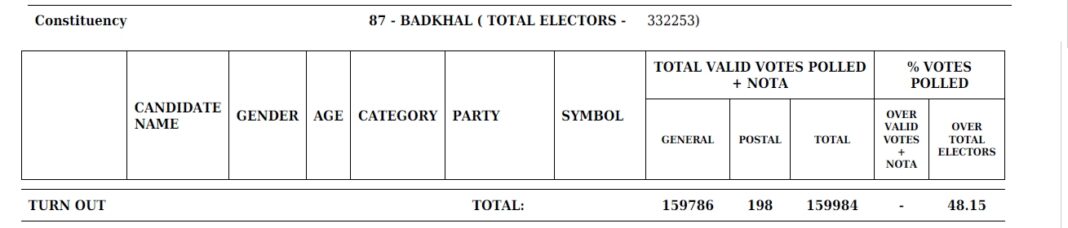
The Election Commission can’t count the votes not cast. Presenting the entire electorate size as the number of votes polled is a severe factual error.
Mumbai North in Lok Sabha Polls
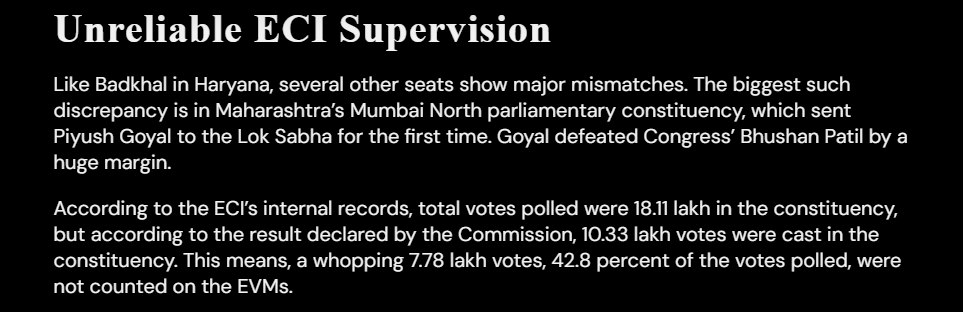
This exact same statistical blindness is applied to the Mumbai North Lok Sabha constituency by the report. The official data summary for Mumbai North shows a total registered electorate of 18,12,115. However, the report claims that “According to the ECI’s internal records, total votes polled were 18.11 lakh in the constituency”. Again, it is impossible that there will be 100% voting in a parliamentary constituency with over 18 lakh voters. The reporters just took the total number of voters and claimed that it was the total votes polled as per ‘ECI’s internal record’.
During the election, a total of 10,33,267 voters turned up to vote on the electronic voting machines. The total votes registered on the machines was 10,33,268, which includes one test vote under Rule 49 MA. The Election Commission is legally mandated to deduct test votes, votes not retrieved from control units as per instructions, and the none of the above votes from the candidate tally. For Mumbai North, these deductions amounted to 14,013 votes. After removing these 14,013 votes, the total valid votes counted from the machines stood at 10,19,255. There were 2892 valid postal votes.
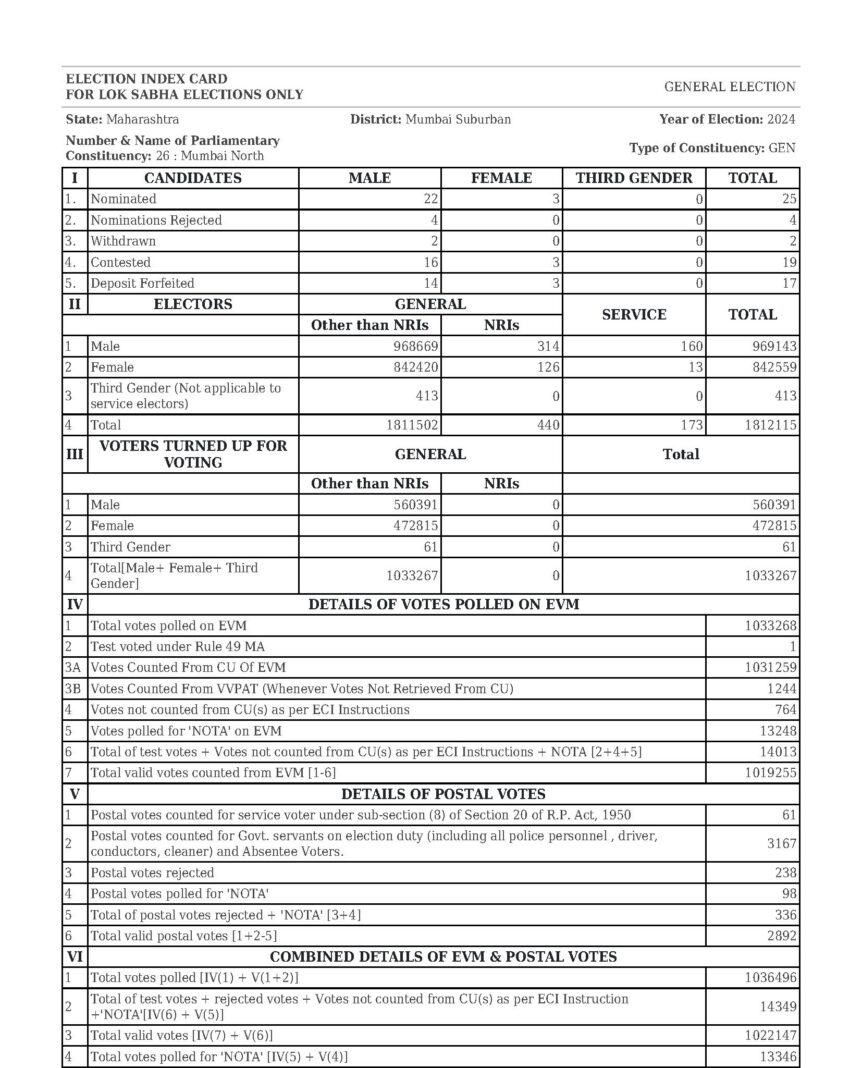
So the total number of votes polled for Mumbai North was 1036496, and the total number of valid votes was 10,22,147. BJP’s Piyush Goyal got 6,80,146 votes, far ahead of Congress candidate Bhushan Patil’s 3,22,538, and Goyal won by a margin of a massive 3,57,608 votes.
The reporting completely ignores the actual election results and deliberately conflates the total electorate numbers with the final valid vote count.
The Srinagar deduction reality
The case of the Srinagar Lok Sabha constituency further exposes the flawed methodology of the report. The authors claim that the Election Commission counted 6,896 extra votes in the 2024 Lok Sabha elections. The report says, “in Jammu & Kashmir’s Srinagar parliamentary seat, 6,72,942 votes were counted on the EVMs. But the internal records show only 6,66,046 votes were polled. The ECI counted 6,896 extra votes here.” However, basic arithmetic proves nothing such happened.

The official records show that 6,72,942 votes were polled on the machines. Out of these, 6,896 votes were deducted to account for rejected votes, test votes, and the none of the above option. When 6,896 is subtracted from 6,72,942, the final number of valid votes counted is exactly 6,66,046. The 6,896 invalid votes were removed from the pool of valid candidate votes.
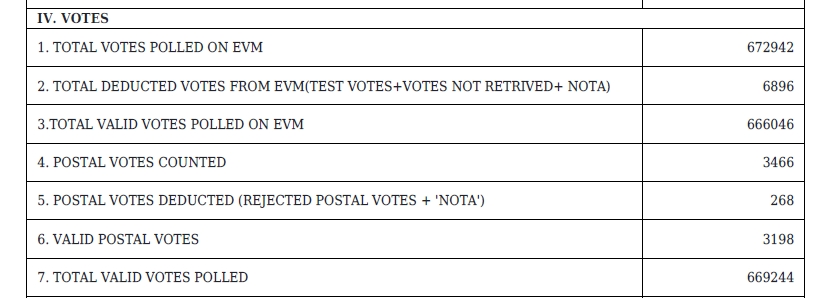
This means the ECI didn’t count 6,896 extra votes, as claimed by the report. Instead, 6,896 votes were deducted for being not valid, and the balance 6,66,046 votes were counted. Claiming these are extra votes counted by the election officials shows a complete failure to understand basic arithmetic.
The Kaithal Fake Numbers
The report also mentions the Kaithal assembly constituency in Haryana. The authors claim that the internal audit records of the Election Commission show only 215 citizens voted across the entire constituency. They then express shock that officials counted 1,67,285 votes on the machines, suggesting a massive fraud.

Just like 100% polling is impossible, only 215 votes in an assembly constituency is also not possible. The election would be cancelled in case of such low turnout. The official results for Haryana clearly state that the Kaithal constituency has a total electorate of 2,23,449 voters. The total valid votes polled on the machines is recorded as 1,67,285. With 1,429 postal votes, the total votes polled in the assembly election for the constituency were 1,68,714.
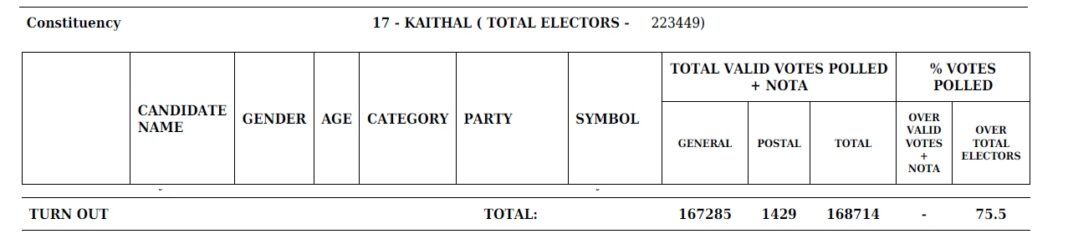
It is absurd to believe that only 215 citizens voted in a constituency of over two lakh electors. The report claims it was recorded in ‘ECI’s internal audit’, but no such audit report is attached or linked in the report. It seems to be nothing more than a fertile imagination of the authors, or a gross misreading of official data.
A coordinated campaign against democracy
This report by the Reporters Collective is not investigative journalism. It is a severe misreading of published data to create doubt about the elections in the minds of electors, over two years after the conclusion of the elections. The Election Commission data includes total voters, EVM votes, postal votes, deducted votes and every other relevant data. One can’t replace one number with another to claim a mismatch in numbers.
All such allegations of data mismatch ignore one crucial aspect: the results were accepted by the candidates who lost the elections. During the elections, it is not only the ECI that keeps the records. Agents of candidates are authorised to be present at polling booths, and they keep a record of every vote polled, including the details of the voters. After the conclusion of voting, the returning officer enters the total number of votes polled on Form 17C, which has to be signed by the Returning Officer, the counting supervisor and the candidates or their authorised agents.
Similarly, during counting of votes, candidates or their agents are allowed to be present in the counting hall, and they keep a record of votes displayed for each candidate in every single EVM. At the beginning of counting, the counting agents of candidates sign Part II of Form C after verifying that the polling numbers have not changed. The results are recorded on Form 20 by the Returning Officer, and in case of any discrepancy between polled and counted votes, candidates and their authorised agents can raise it immediately. If not satisfied, they can approach the courts.
But to publish such a report over two years after the elections, when losing candidates didn’t question the numbers, points to one motive: to raise doubt about India’s election process as part of the ongoing campaign against democracy.
The Chief Electoral Office of Maharashtra has debunked the report, pointing out the above-mentioned procedures. They asserted that no complaints regarding difference in figures of voting werre received from anyone in this regard. They further added that Reporters’ collective could have contacted them for any clarification.
#FACTCHECK The actual figures of votes polled on poll day are shared with polling agents of candidates in Form 17 and these figures are tallied with figures on EVMs at the time of counting of votes . https://t.co/BN7N7fcHOV
— ChiefElectoralOffice (@CEO_Maharashtra) November 11, 2026
The article by the Reporters Collective relies heavily on these basic errors to construct a false narrative. This report seems to be a calculated part of the ongoing opposition campaign against the election machinery of India, seeking to manufacture doubt where there is only transparent data.
A Track Record of Manufactured Narratives
This election data report is not an isolated incident of fake news published by the Reporters Collective. A brief look at their background reveals a consistent pattern of publishing sensational claims that collapse under basic scrutiny.
In late 2024, the group attempted to discredit India’s poverty reduction achievements. They published reports alleging that the government had rigged the National Multidimensional Poverty Index by manipulating weightages. This claim was thoroughly exposed as a flawed and baseless narrative. The reality was much simpler. The national index had integrated relevant local parameters, such as maternal health and financial inclusion, to capture the true impact of grassroots welfare schemes. While global institutions and think tanks were confirming the sharp decline of extreme poverty in India, the collective chose to misinterpret standard data additions as statistical manipulation.
The group previously alleged mass voter deletions in Uttar Pradesh, claiming thousands of citizens were arbitrarily removed from the rolls. The Uttar Pradesh Chief Electoral Officer outright rejected these allegations in October 2026. Official records clarified that the 85,854 Form 7 deletion entries in question were generated only after following strict due process. This included formal notices, administrative hearings, and official orders as mandated by the Representation of the People Act. The Special Intensive Revision was a standard statutory cleanup to remove duplicate, shifted, and deceased voters to ensure a stronger electoral roll. The collective completely ignored these documented, quasi-judicial proceedings to push an alarmist narrative of mass disenfranchisement.
Following such instances of peddling fake news under the guise of journalism, the central government revoked their non-profit status in early 2025. The group has funding links to foreign entities like George Soros’s Open Society Foundations, which explains why the group routinely targets India, as Soros has vowed to destabilise nationalist governments across the world.


