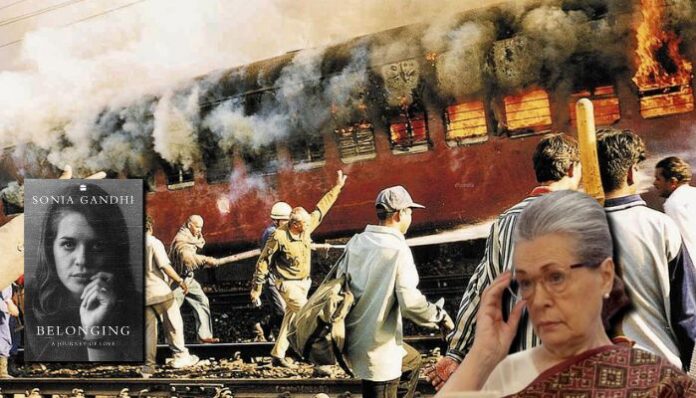
Since the memoir of Sonia Gandhi, Belonging: A Journey of Love, was published on 10 November 2026, the veteran Congress leader’s political-ideological positions, dishonesty, and anti-Hindu biases have become clearer. In her memoir, Sonia Gandhi wrote that the cause of the fire in the 2002 Godhra train carnage, in which 59 Hindu Karsevaks returning from Ayodhya were burnt alive, is ‘disputed’.
Sonia Gandhi defies facts to claim in her memoir that the cause of the 2002 Godhra train burning is ‘disputed ‘, and blames the Bajrang Dal for riots
Demonstrating her ideologically driven dishonesty, on the one hand, Sonia Gandhi called the cause of the Godhra train burning disputed given the Muslim involvement; on the other hand, she quite conveniently placed the sole blame for the riots that followed the killings of Kar Sevaks on Bajrang Dal and then Gujarat Chief Minister Narendra Modi. She also incorrectly described Ahmedabad as Gujarat’s capital.
“When I was leader of the opposition in Parliament, I met the victims of many tragedies, and each time I was haunted by the misery I had witnessed. In 2002, the state of Gujarat was ravaged by communal riots; much of the carnage was televised live with the advent of cable TV and shook the country with its fearsome images. The riots were triggered when four coaches of the Sabarmati Express were set on fire, and fifty-nine pilgrims died. The train was returning to the state capital, Ahmedabad from Ayodhya carrying Hindu kar sevaks volunteers for the Ram temple. The cause of the fire remains disputed, but the turmoil that followed spread to many parts of the state, and the victims were overwhelmingly Muslims,” Sonia Gandhi’s memoir reads.
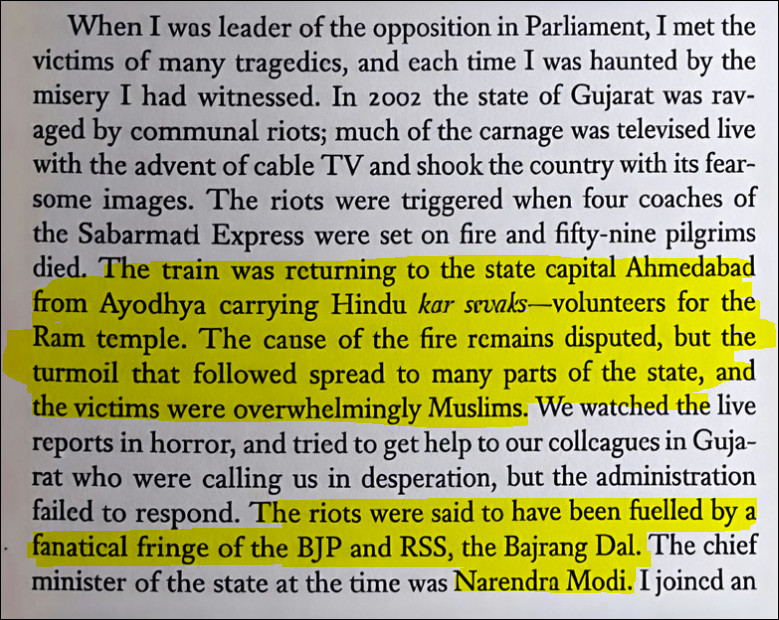
“We watched the live reports in horror and tried to get help to our colleagues in Gujarat who were calling us in desperation, but the administration failed to respond. The riots were said to have been fueled by a fanatical fringe of the BJP and RSS, the Bajrang Dal. The chief minister of the state at the time was Narendra Modi,” the book continues.
No, Sonia Gandhi, the cause of the fire in the Godhra train carnage is not ‘disputed’; it was Muslim conspirators who targeted and killed Hindu kar sevaks
Sonia Gandhi could prevent herself from laying bare how Congress appeases and shields Muslim perpetrators and villainises Hindus. The Congress leader defied convictions and judicial findings to push the Islamo-leftist narrative that either the Godhra train burning was an accident or a self-sabotage by Kar Sevaks to concoct an excuse to execute an anti-Muslim pogrom.
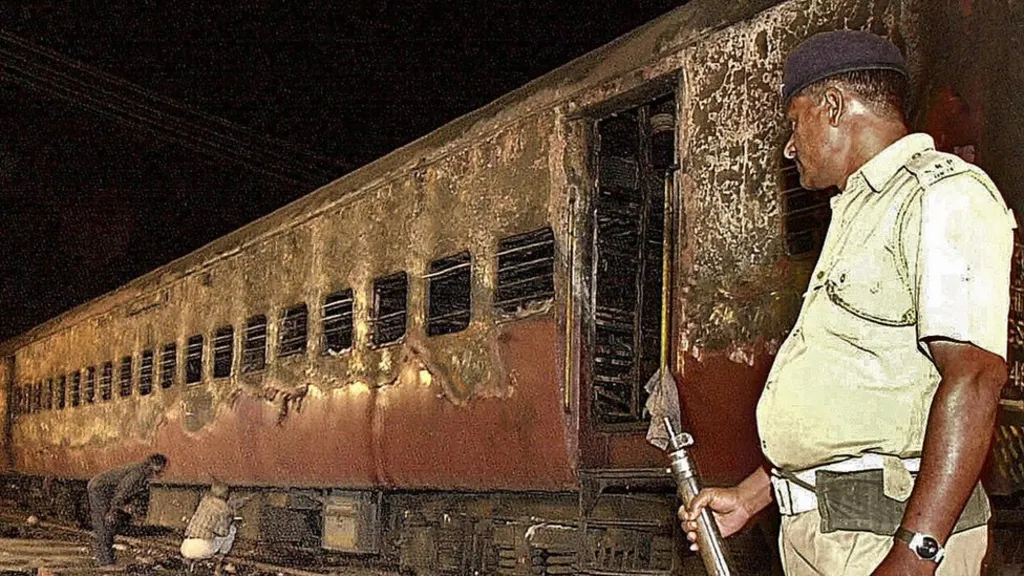
It must be recalled that the Godhra massacre took place on 27th February 2002, in which 59 innocent Hindu pilgrims were killed as the Islamic jihadis set on fire the S6 coach of the Sabarmati Express near the Godhra railway station in Gujarat. This incident is known as the Godhra carnage or massacre.
On that day, the Sabarmati Express was scheduled to reach Godhra station at about 3:30 am. On that day, the train was running four hours late. As such, it arrived at Godhra at 7:40 am. 8 minutes later, a mob of 2000 Islamists set 59 Hindus, including 25 women and 15 children, on fire in the coach S6 of the train on fire in Godhra’s predominantly Muslim area – Signal Falia.
While Sonia Gandhi claims that the cause of the fire is ‘disputed’, 31 Islamists were found guilty of the Godhra massacre on February 22, 2011, by the trial court (with only 11 receiving the death penalty and 20 receiving life imprisonment), and all 31 convictions were affirmed by the Gujarat High Court in October 2017, resulting in everyone receiving a life sentence.
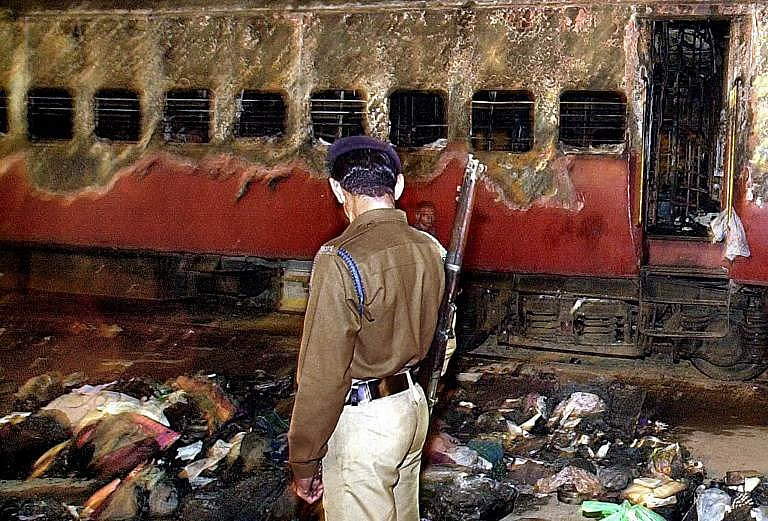
One of the convicts, Hassan Ahmed Charkha alias Lalu, reportedly shouted slogans of ‘Burn down Hindu infidels, Pakistan Zindabad, Hindustan Murdabad’ during the Sabarmati train burning in Godhra.
In March 2011, when he was sentenced by a sessions court, it was confirmed that he was part of a pre-planned criminal conspiracy under which a mob armed with dangerous weapons and explosive chemicals poured petrol on the train full of pilgrims and set it on fire.
Before that, based on the testimony of witnesses and survivors, it was established that it was not an accident; rather, the Islamists had set the train on fire.
In 2019, a Special SIT court in Ahmedabad convicted Yakub Pataliya and sentenced him to life imprisonment. Pataliya was arrested by Godhra Police in January 2018. He was accused of being part of the mob that set the two coaches of the Sabarmati Express on fire near Godhra railway station.
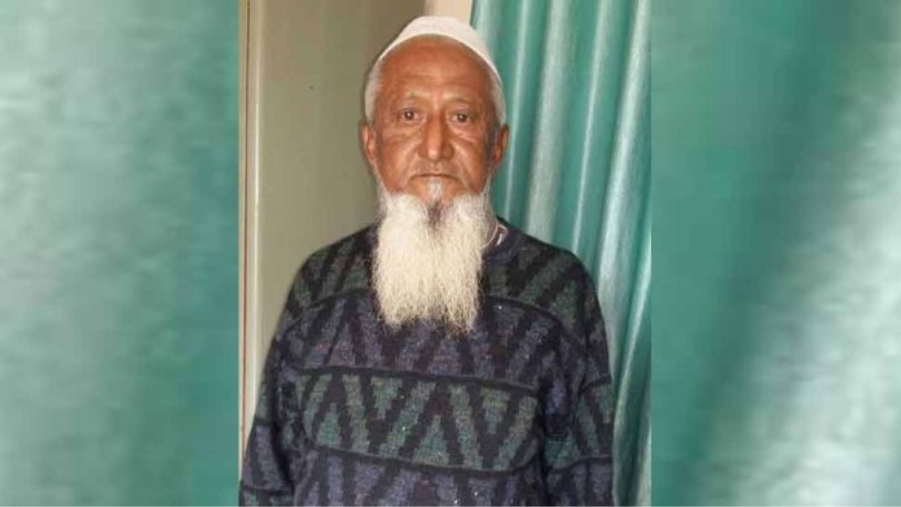
In August 2018, a Special SIT court sentenced two other accused, Farukh Bhana and Imran alias Sheru Batuk, to life imprisonment.
In July 2022, the Godhra Sessions Court sentenced a labourer named Rafiq Hussain Bhatuk, who worked at Godhra Railway Station, to life imprisonment for setting the Sabarmati Express on fire.
Bhatuk was part of the core team that hatched the conspiracy to kill Hindus. Rafiq also incited the Muslim mob and arranged petrol bombs to set Hindus on fire.
The judicial confession of an accused
In February 2003, an accused person made a judicial confession in which he acknowledged that Godhra was a well-planned attack and that he had personally participated in it. A judicial confession is conclusive evidence. This proved that the Godhra carnage was a preplanned attack on the innocent Kar Sevaks.
Christian man’s letter exposed a pre-planned conspiracy, describing a Congress councillor as the main culprit in the Godhra train burning
Nearly two months after the deadly Godhra train burning incident that claimed the lives of 59 Hindu kar sevaks returning from Ayodhya, in April 2002, a Christian man named George Joseph from Pazhoor wrote a letter to Mathrubhumi Daily describing the day of the incident in his own words. The letter was published in the newspaper in Malayalam.
George, who had been running a small business for 12 years near the Godhra Railway Station, wrote that Godhra experienced a deep communal divide and tension for many years. Non-Muslims like him lived under great fear and constant tension, as any communal unrest across the country used to have a drastic impact in Godhra.
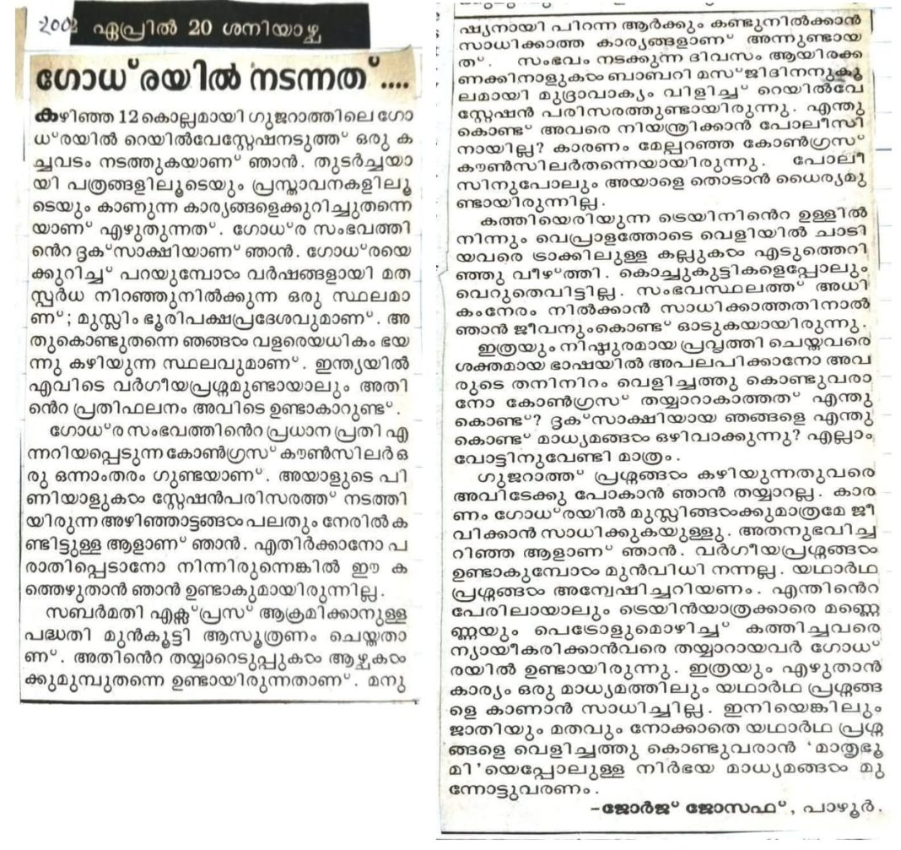
The letter stated that it the Congress councillor and his cronies who the attack on the Sabarmati Express was a pre-planned exercise. The plan was made many weeks before the incident, and it was impossible to witness what had happened on the day of the attack.
“Thousands of people, shouting slogans in favour of the Babri Masjid, were present in the railway station surroundings on that fateful day. Why did the police not try to control them? The Congress councillor was the main reason for that. Even the police did not have the guts to touch him,” George wrote.
“Why is the Congress Party not prepared to condemn and expose the real colour of the culprits? Why is the media selectively avoiding eyewitnesses like us?” he questioned, while asserting it was all about Muslim appeasement and vote politics.
Eyewitness Gayatri Panchal, who lost her family members in the Godhra carnage, refuted ‘accident’ claims
Published in March 2006, an Outlook report contained the following two paragraphs on the statement of an eyewitness to the Godhra train carnage:
“Gayatri Panchal, a resident of Ahmedabad, who survived the incident on February 27, 2002, but lost both her parents, in her reaction to the report has said, “The report of the Banerjee Commission is absolutely wrong. I have seen everything with my own eyes and barely escaped myself but lost both my parents.”
“Panchal, who has three sisters, said the Banerjee Commission report was not correct, as the fire could not have been accidental, as no one was cooking in the S-6 coach and it was packed with passengers.”
“Mobs pelted stones at the coach for a long and then threw in burning rags and also poured some inflammable material so that the coach was on fire. I will maintain the same wherever I am called to depose on the matter,” Panchal said.
Disregarding the judicial findings, eyewitness accounts, and convictions of Muslim men who burnt kar sevaks alive, the Islamo-leftist coterie has continued its propaganda to shift the blame from the Muslim mob and whitewash, and even sometimes justify the cold-blooded massacre of Hindus.
In fact, Congress veteran Shankersinh Vaghela had earlier this year claimed that the Sabarmati Express coach in Godhra was set on fire from the inside, not the outside, and the local Muslims did not even know what time the train was due to arrive and who was in which coach.
In an interview, Vaghela further argued that someone inside had set the box on fire. He further said that this was done so that the BJP could benefit in the elections by creating enmity between Hindus and Muslims.
Evidently, Sonia Gandhi blatantly lied in her memoir.
Given the Congress party’s Muslim appeasement history, it is not surprising that Gandhi chose to downplay the role of Muslims.
What is surprising is why this lie was not flagged and corrected during the editorial fact-checks the memoir’s publisher, HarperCollins India, must have conducted?
This question becomes even more pressing as the original publisher, Penguin Random House, announced in August this year that it will not publish Sonia Gandhi’s memoir in India following the discrepancies in the fact-checking process.
Penguin Random House India had said the book was not factually ready for publication.
‘Disputed’ framing of Godhra fire cause, Communal violence bill, saffron terrorism bogey, sympathy for Jihadis and Sonia Gandhi at the heart of it all
Sonia Gandhi’s ‘disputed’ framing of the Godhra carnage cause and one-sided blame on Hindus reflects the ‘Muslims are perennial victims, Hindus natural aggressors’ mindset seen in the draconian communal violence bill.
In 2005, UPA1 introduced a communal violence bill. In 2011, under the guidance of the Sonia Gandhi-led National Advisory Council (NAC), the de facto cabinet, UPA2 introduced a revised draft of the same. Although the bill had to be dropped in 2014, grounds for its withdrawal were primarily due to concerns about overlap with the powers of the State government.
The bill’s 2005 version said that a “group” that has become a victim of communal attacks could seek redressal. However, in 2011, a new definition of the “group” which is protected was introduced.
“group means a religious or linguistic minority, in any State in the Union of India, or Scheduled Castes and Scheduled Tribes within the meaning of clauses (24) and (25) of Article 366 of the Constitution of India”
This essentially meant that only minorities and SCs/STs could be “victims” and the perpetrators of communal violence would always be the majority, which is Hindus.
In addition, the definition of “offences” itself was so wide that any kind of crime could be brought under the ambit of this Act.
While the Congress party rhetorically preached secularism, it tried to frame Hindus for terrorism and shame them with the bogey of saffron terrorism. Digvijay Singh even went to the extent of endorsing a book which tried to pin the 26/11 terror attack on the RSS and absolve Pakistan of all blame in the process.
Not to forget, Sonia Gandhi had, as per statements from Congress leader Salman Khurshid, “wept bitterly” when she was shown the images of two Indian Mujahideen terrorists in the Batla House encounter that took place on 19 September 2008.
Sonia Gandhi downplaying the role of Muslims in setting the Sabarmati Express bogey ablaze to kill Hindu kar sevaks returning from Ayodhya makes sense; she, in a recent interview with The Guardian, spoke about breaking down in tears while watching the demolition of the Babri Masjid on television in 1992.