

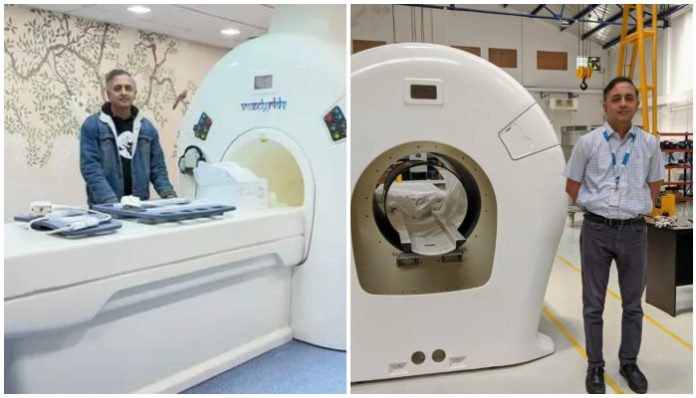
Bengaluru-based startup VoxelGrids, backed by Zoho Corporation, has achieved a major milestone by developing and deploying India’s first fully indigenous 1.5 Tesla Magnetic Resonance Imaging (MRI) scanner, The Hindu BusinessLine reported.
Unveiled on December 25, 2025, the advanced machine is the result of a 12-year effort led by founder Arjun Arunachalam to reduce India’s heavy dependence on imported diagnostic equipment from global giants like Siemens and GE Healthcare.
The scanner has been installed at the Chandrapur Cancer Care Foundation near Nagpur, where it is now operational for patient diagnostics.
Voxelgrids marks a significant milestone with its first successful clinical installation, advancing homegrown medical technology in India.
— Zoho (@Zoho) December 22, 2025
Through our investment, we’re proud to support the deployment of India’s first indigenous MRI scanners at Chandrapur Cancer Hospital on… pic.twitter.com/Y5fM4P523v
The scanner developed by VoxelGrids employs a helium-free “dry magnet” design, eliminating the need for expensive liquid helium coolant. This makes the system approximately 40% cheaper to manufacture, significantly more energy-efficient, lighter (2-3 tonnes vs. traditional 6 tonnes), and compact, ideal for smaller hospitals and potential mobile deployments in rural areas.
VoxelGrids states that their scanner also consumes less power, is resilient to electrical disruptions, and has a flexible pay-per-use model that reduces upfront costs for healthcare providers.
Market research indicates that there are only around 5000 MRI scanners in India, roughly 3.5 machines per million population. VoxGrids aims to make the scanners available more widely, so that more patients across the country can avail the facility, and smaller hospitals can afford the scanners.
The indigenous MRI scanner marks another milestone in the Aatmanirbhar Bharat goal. VoxelGrids has developed the MRI scanner under the National Biopharma Mission. In a 2023 press release, the government of India had informed that from the total amount of Rs 17 crore spent to develop the scanner, the Biotechnology Industry Research Assistance Council (BIRAC) under the Department of Biotechnology (DBT) provided Rs 12 crore.
