

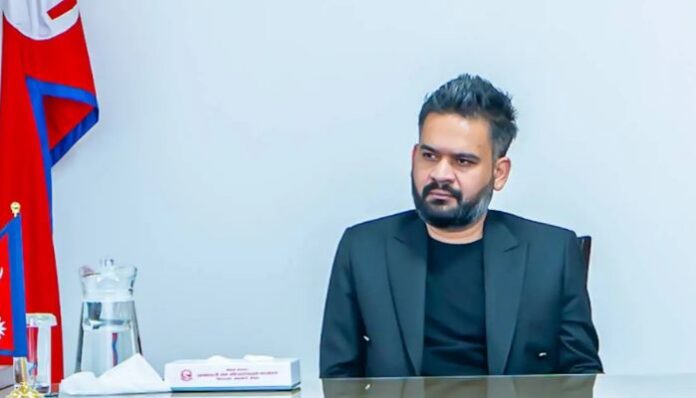
Nepal Prime Minister Balen Shah has found himself at the centre of a political storm after stating in Parliament that Nepal has occupied Indian territory in several places, a remark that sparked sharp criticism from opposition parties and experts in his own country.
PM Shah’s remark sparks debate
Speaking in Parliament on Sunday, 31st May, Shah said he had learned after becoming prime minister that Nepal was also occupying land on the Indian side in some locations. He said both countries should examine the facts carefully and resolve border-related issues through dialogue, with the help of historians, surveyors and other experts.
Shah commented while responding to questions on the long-running border issue involving Limpiyadhura, Lipulekh and Kalapani. He also said Kathmandu has discussed the matter with China and the United Kingdom, noting that the dispute has historical roots dating back to the colonial period.
Backlash from the opposition
Shah’s statement immediately triggered protests inside Parliament. Opposition lawmakers, including Basana Thapa of the Nepali Congress and Ramesh Malla of the Nepali Communist Party, demanded that the remarks be removed from the parliamentary record.
They argued that the prime minister should either present evidence to support his claim that Nepal occupies Indian territory or withdraw the statement. Former foreign minister Pradip Gyawali also reportedly sought an apology from Shah.
The remarks drew criticism on social media as well, with many Nepalese users questioning the claim.
Experts disagree
Several experts rejected the prime minister’s assertion. Nepal-India border expert Buddhi Narayan Shrestha said Nepal has never occupied Indian territory. He explained that in some border areas, people from both sides have cultivated or used land across the border because of open movement and the absence of clear boundary markers in certain locations.
Foreign Ministry issues clarification
As the controversy grew, Nepal’s Foreign Ministry issued a clarification hours later. It said technical studies had found that in some places, land currently being used by Nepal may fall on the Indian side, while land being used by India may fall on the Nepali side.
The ministry said Shah’s remarks should be understood in the context of cross-border land use and occupation, not as a formal territorial claim. It added that Nepal remains committed to resolving all border issues with India through diplomatic talks based on historical treaties, agreements and maps, while reiterating that its position on the 1816 Sugauli Treaty remains unchanged.
