

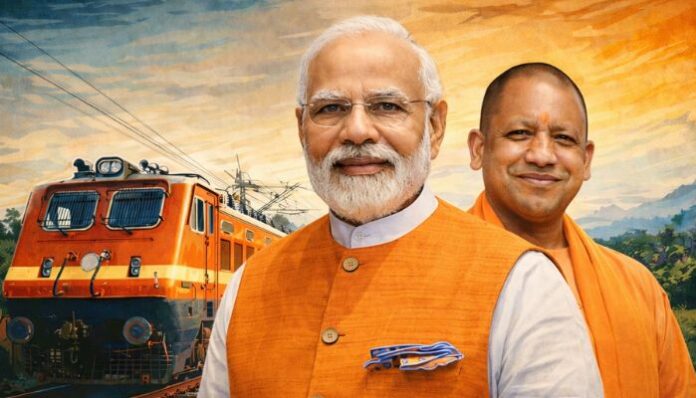
On 18th April, the Union Cabinet approved the construction of third and fourth railway lines between Ghaziabad and Sitapur in Uttar Pradesh. The estimated cost of the project is Rs 14,926 crore and it will cover 403 km. It is expected to significantly enhance railway capacity, improve service reliability, and reduce congestion on one of the country’s busiest corridors.
Project to ease congestion on high-density route
The Ghaziabad–Sitapur section is a crucial part of the Delhi–Guwahati High Density Network. It is currently operating beyond capacity, and the utilisation reaches up to 168%. Without expansion, this is projected to rise to 207%. The additional two new lines are aimed at addressing this bottleneck and ensuring smoother movement of both passenger and freight trains.
UP CM lauds PM Narendra Modi-led govt decision
In a social media post, Chief Minister of Uttar Pradesh, Yogi Adityanath, lauded the decision by Prime Minister Narendra Modi-led Union government. Welcoming the decision, CM Yogi called it a strong reflection of the strengthening railway connectivity in a “New India” under the leadership of PM Narendra Modi.
आदरणीय प्रधानमंत्री श्री @narendramodi जी की अध्यक्षता में आज केंद्रीय मंत्रिमंडल द्वारा लगभग ₹14,926 करोड़ की लागत से गाजियाबाद-सीतापुर तीसरी एवं चौथी रेल लाइन (403 किमी) को मिली स्वीकृति 'नए भारत' की सुदृढ़ होती रेल कनेक्टिविटी का सशक्त प्रमाण है।
— Yogi Adityanath (@myogiadityanath) April 18, 2026
यह परियोजना न केवल क्षेत्रीय…
He added that the project would accelerate regional development, create new employment and self-employment opportunities, and significantly improve the operational efficiency and service reliability of Indian Railways.
He further noted that the decision would provide fresh momentum to the vision of an Atmanirbhar Bharat and expressed gratitude to the Prime Minister for the forward-looking and people-centric initiative.
Coverage across key districts and industrial hubs
The project will pass through several districts in Uttar Pradesh, including Ghaziabad, Hapur, Amroha, Moradabad, Rampur, Bareilly, Shahjahanpur, Lakhimpur Kheri and Sitapur. These regions house major industrial centres known for machinery, electronics, brassware, textiles, carpets, and thermal power production, making the corridor critical for economic activity.
New stations and bypass routes planned
The project includes a plan to bypass heavily crowded junctions, including Hapur, Moradabad, Bareilly, and Sitapur, to reduce congestion at major stations. Six new stations will be constructed along these bypass routes to ensure seamless connectivity while maintaining operational efficiency.
Boost to freight movement and logistics efficiency
According to a statement issued by the government, this expanded corridor is expected to handle additional freight traffic of 35.72 million tonnes per annum, which will include commodities such as coal, food grains, fertilisers, steel, and cement. It is likely to reduce logistics costs by approximately Rs 2,877 crore every year compared to road transport.
Employment generation and environmental impact
The project is projected to generate around 274 lakh human days of employment. It is also expected to reduce carbon emissions by approximately 128.77 crore kilograms, which is equivalent to the environmental benefit of planting over 5 crore trees.
Improved connectivity to religious and tourist destinations
The enhanced rail network will also improve access to prominent religious and tourist sites in Uttar Pradesh, including Dudheshwarnath Temple, Garhmukteshwar Ganga Ghat, Dargah Shah Wilayat Jama Masjid in Amroha, and Naimisharanya in Sitapur.
The government has stated that the project aligns with the broader vision of strengthening multi-modal connectivity under the PM Gati Shakti framework, while also contributing to regional development and employment generation.
