

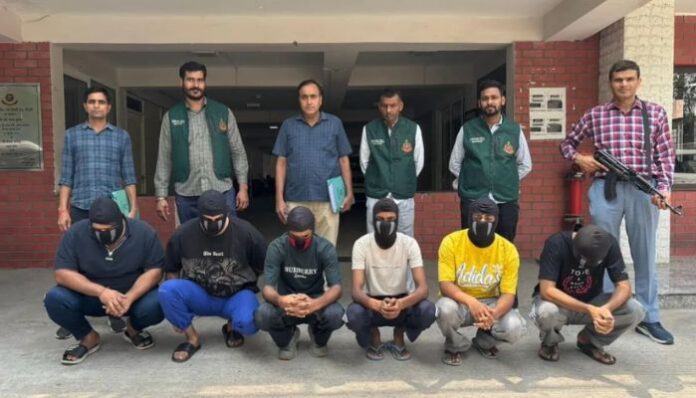
The Special Cell of Delhi Police has busted an inter-state terror, arms smuggling, and espionage network on Friday, 10th April, linked to handlers in Pakistan and its intelligence agency, the Inter-Services Intelligence (ISI). The operation, carried out in two coordinated phases, led to the arrest of 11 people and exposed a wider conspiracy connected to the banned Khalistani terror outfit Babbar Khalsa International.
According to officials, the group was involved in spying activities, illegal arms supply, and collecting sensitive information about defence installations, posing a serious threat to national security.
9 Spycams, 11 Arrests & A Pak Link
— TIMES NOW (@TimesNow) April 10, 2026
Sinister Terror Plot Busted
Delhi, Punjab & Rajastan
9 Defence Sites On Target
Inside The ISI-Linked Spy Ring
What Was The Ultimate Target?
Standby for EXPLOSIVE EXCLUSIVE with @MadhavGK pic.twitter.com/56Hq80pr7f
Solar-powered cameras used for surveillance
One of the most shocking parts of the investigation was the discovery of a hidden surveillance network. The accused had set up solar-powered CCTV cameras at strategic military and paramilitary locations in different states.
Additional Commissioner of Police (Special Cell) Pramod Singh Kushwah said, “These locations included Kapurthala, Jalandhar, Pathankot, Patiala and Moga in Punjab, as well as Ambala in Haryana, Kathua in Jammu and Kashmir, and Bikaner and Alwar in Rajasthan.”
He explained that these places are highly sensitive due to the regular movement of Army personnel and their proximity to international borders. The CCTV cameras were fitted with SIM cards taken using fake identities, and the footage was being sent in real time to handlers sitting in Pakistan through mobile apps.
Direct links with Pakistan-based handlers
Police said the entire module was working under instructions from terrorists based in Pakistan. Communication was being done through encrypted platforms to avoid detection.
In a major blow to cross-border intelligence networks, the #DelhiPolice special cell has busted an espionage module backed by #Pakistan’s Inter-Services Intelligence (ISI) and arrested at least 10 operative.
— The Times Of India (@timesofindia) April 10, 2026
More details 🔗 https://t.co/qNCriLnCnw#Delhi #DelhiNews #CrimeNews pic.twitter.com/Q6B3z4LDLa
“The accused were tasked with capturing visuals of defence establishments, monitoring troop movements, and relaying critical information across the border,” Kushwah said.
The use of solar-powered devices made the operation even more dangerous, as they could function without electricity and remain active in remote areas for long periods. Officials believe this shows that the network was well-planned and had external technical support.
Delhi Police Special Cell busts an ISI and Babbar Khalsa International–sponsored terror, arms and espionage module.
— All India Radio News (@airnewsalerts) April 10, 2026
Additional CP Pramod Singh Kushwaha says 11 accused have been arrested from Punjab and Delhi for being in contact with Pakistan-based operatives on encrypted apps… pic.twitter.com/ZVCzzMcXhy
Arrests and seizures in two operations
In the first operation, teams from the Northern Range of the Special Cell arrested six accused from Punjab and Delhi. Acting on technical surveillance and human intelligence, the police recovered nine CCTV cameras, four pistols, including three foreign-made weapons, and 24 live cartridges.
The second operation was carried out by the Southwestern Range based on inputs from Military Intelligence. Five more accused were arrested from Punjab for their role in conducting reconnaissance and sharing visuals of the Army and Border Security Force (BSF) locations.
Key accused and their roles
During questioning, the accused revealed that they were lured into the network with money earned from cross-border smuggling of arms and drugs. They were also responsible for arranging SIM cards, installing cameras, and transporting equipment.
“One of the key accused, identified as Manpreet Singh from Tarn Taran in Punjab, was in direct contact with Pakistan-based handlers and played a central role in coordinating arms deliveries and facilitating communication channels,” Kushwah said.
Another accused, Anmol, along with his associate Sahil, was involved in installing the CCTV cameras at different locations. These cameras were strategically placed to capture movements near Army cantonments and border routes.
Larger conspiracy and possible attack plans
Police said the network was also trying to expand by recruiting local youth and building a long-term espionage setup. Some members had already carried out a recce of military bases and shared photos and videos with their handlers.
Apart from spying, the investigation uncovered an arms trafficking racket. Illegal weapons were supplied on instructions from Pakistan-based operatives, and the money generated was used to fund further activities.
Officials believe the crackdown may have prevented a possible terror attack. There were inputs suggesting that the group was planning to target security installations using grenades and other weapons.
“Security agencies are now analysing digital evidence, including mobile phones and data retrieved from the CCTV systems, to identify additional links and possible sleeper cells. Further investigation is underway,” Kushwah added.
A similar spy network was busted in Ghaziabad last month
This is not the first such case. Just last month, a similar Pakistan-linked espionage network was uncovered in Ghaziabad, where 22 people, including minors, were arrested. This module was a major conspiracy to target the Hindu community. That module had also installed CCTV cameras near sensitive locations and used social media and encrypted apps to send real-time information to foreign handlers.
Investigators found that the accused were paid between ₹500 and a few thousand rupees for sharing visuals, GPS coordinates and other sensitive details. Like the present case, they used fake identities, hawala routes and digital payments to operate quietly.
