

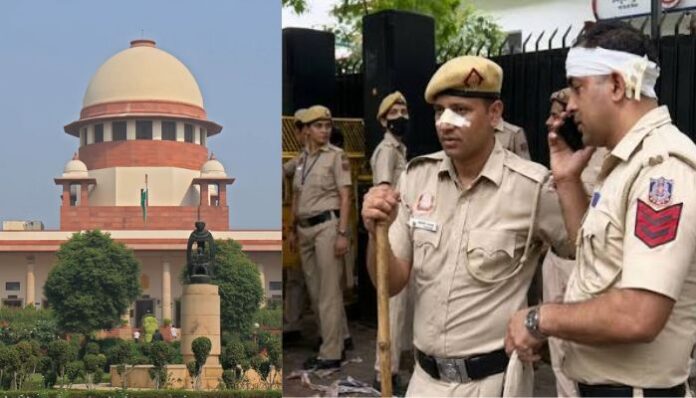
The Delhi Police has told the Supreme Court that its personnel used “maximum restraint but minimum required force” while dealing with the Cockroach Janta Party (CJP) protest at Jantar Mantar. The Delhi Police made the statement in an affidavit filed before the Supreme Court in response to petitions questioning the use of force during the CJP protest.
The affidavit, sworn by Deputy Commissioner of Police (New Delhi District) Sachin Sharma, said the situation became violent when protesters broke through several layers of barricades and tried to move towards Parliament.
How the protest escalated
The protests at Jantar Mantar began on 6th June over concerns about irregularities in the NEET-UG and CBSE examinations. The protesters also demanded the resignation of Union Education Minister Dharmendra Pradhan.
According to the police, permission for a dharna was given only for 20th June after 5 PM, but the protesters did not leave the site. The situation further escalated after a call was made for a “Chalo Sansad” march on 20th July, the first day of the monsoon session of Parliament.
The police said no permission was sought or granted for the march. It also pointed out that prohibitory orders under Section 163 of the BNSS had been in force in New Delhi District since 21st June.
Police account of violence
The affidavit said protesters attacked police and other security personnel positioned behind the barricades. The police referred to digital footage showing groups of protesters throwing stones and using sticks against individual police personnel.
It also said a group damaged the building of the Registrar of Cooperative Societies on Sansad Marg and used bricks from the building to attack officers.
The police estimated that more than 30,000 protesters, including “rioters and miscreants”, were present against around 5,000 uniformed personnel. The deployment included CAPF, CRPF and RAF companies, along with more than 3,600 barricades.
The affidavit said over 240 police personnel and other uniformed officers suffered injuries. Around 200 members of the public and protesters also underwent medico-legal examinations. The police said the injuries reported by 218 protesters may not be treated as proof of excessive force.
Dispute over lathis and facial recognition
On the issue of lathis with nails attached, the police described the matter as based on “only a solitary video”. It said the object shown was actually a stick with a national flag attached, possibly carried by a protester. The police also said no medico-legal certificate mentioned nail injuries to any protester.
Regarding facial recognition technology, the police said it does not automatically create or maintain profiles of peaceful protesters. According to the affidavit, the system only flags people with previous criminal records for verification.
Between 20th and 26th July, the system identified 2,873 people matching criminal records. Of them, 92 had involvement in more than 10 cases, and 47 were history-sheeters. Their previous cases included murder, rape, POCSO and NDPS offences. The police clarified that investigations related to the protest would be limited to these 2,873 people.
Supreme Court to examine police action
The Supreme Court had earlier indicated that it was considering forming a committee to examine the use of force by security personnel. It had asked the Central government and Delhi Police to present their versions.
The Delhi Police said its latest affidavit does not respond to each petition separately. It added that silence on any particular claim should not be treated as an admission. The police said its complete position would be placed before the committee if one is formed.
The affidavit also said more than 4,600 women police personnel were deployed over the six days of the protest to protect female participants. It maintained that the lathis used by police officers were permissible support equipment and that protective gear issued to personnel was properly recorded.
