

Apple has removed Bitchat, the offline messaging application developed by Twitter (now X) co-founder Jack Dorsey, from the India App Store following a request from the Ministry of Electronics and Information Technology (MeitY). Dorsey announced the removal in a post on X on Saturday, 3rd October.
government of India officially removes bitchat from the App Store pic.twitter.com/9oHHiwquec
— jack (@jack) October 3, 2026
“Government of India officially removes Bitchat from the App Store,” Dorsey wrote, sharing a screenshot of a notice from Apple’s App Review team.
According to the notice, Apple said the application would be removed from the India App Store “per demand from the Ministry of Electronics and Information Technology (MeitY)” because it contained content that was illegal in India and did not meet Apple’s App Review Guidelines.
The notice said apps available in a country must follow the laws applicable in that country. It also said developers are responsible for understanding and complying with the local laws.
The removal was carried out under Section 69(A) of the Information Technology Act, 2000, according to Dorsey’s post. Apple also said the developer could approach MeitY for information about the removal and the legal requirements involved.
BitChat has not been removed from App Stores in other territories selected by the developer. Apple also said its TestFlight version would not be available for testing in India and that public TestFlight links would no longer work in the country.
CJP supporters link Bitchat removal to protests
The removal has triggered a strong reaction from supporters of the Cockroach Janta Party (CJP), who have connected the government action with the protests which took place at Jantar Mantar in New Delhi.
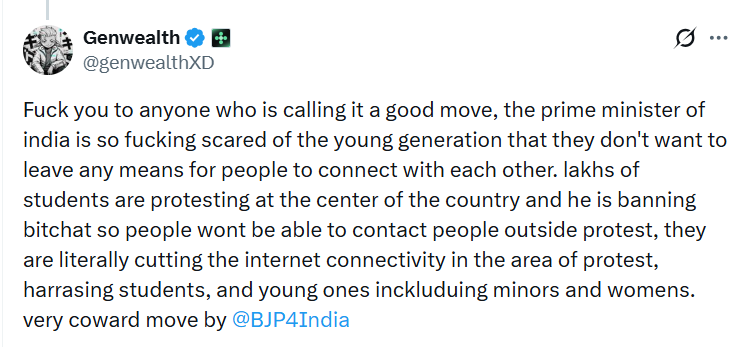
A CJP supporter criticised the move and accused the government of trying to prevent protesters from communicating with people outside the protest area.
“Fu*k you to anyone who is calling it a good move. The Prime Minister of India is so fucking scared of the young generation that they don’t want to leave any means for people to connect with each other. Lakhs of students are protesting at the centre of the country, and he is banning BitChat so people won’t be able to contact people outside the protest; they are literally cutting the internet connectivity in the area of protest, harassing students and young ones, including minors and women. Very cowardly move,” the X user wrote.
Meanwhile, Congress leader Priyank Kharge wrote, “Bitchat access removed in India after Centre’s demand. First, the Narendra Modi government shuts down the internet around Jantar Mantar. Then, when protesters turn to an offline Bluetooth messaging app, the Modi government moves against that too. When citizens keep finding ways to communicate, the government keeps finding ways to silence them. Democracy cannot not run on shutdowns, secrecy and censorship.”
Bitchat access removed in India after Centre’s demand. First, the Narendra Modi government shuts down the internet around Jantar Mantar. Then, when protesters turn to an offline Bluetooth messaging app, the Modi government moves against that too. When citizens keep finding ways to communicate, the government keeps finding ways to silence them. Democracy cannot not run on shutdowns, secrecy and censorship.
— Priyank Kharge / ಪ್ರಿಯಾಂಕ್ ಖರ್ಗೆ (@PriyankKharge) October 4, 2026
The reaction is linked to Bitchat, which was used by protesters when mobile networks stopped working during the CJP protests. BitChat’s ability to work without the internet. Because the application communicates through Bluetooth, it can continue to function even when mobile internet services are restricted.
Bitchat use during CJP protests
The Bitchat app was used at the Cockroach Janta Party protests at Jantar Mantar in New Delhi, where mobile internet has been suspended multiple times in recent days along with the reported deployment of signal jammers. When mobile networks stopped working after the CJP protests turned violent, the protestors switched to the Bluetooth mesh application to stay connected. This made the blocking of internet services useless, as protest organisers were still able to broadcast messages using the app.
The government had ordered GitHub to remove BitChat in July
On July 23, 2026, the Indian Cybercrime Coordination Centre (I4C), under the Ministry of Home Affairs, directed GitHub to remove and disable access to three repositories linked to BitChat within three hours. The repositories contained the app’s main source code, its Android application, and release files.
The order was issued after Bitchat was found to be used during the CJP protests at Jantar Mantar, where temporary internet restrictions had been imposed.
The July notice was issued under Section 79(3)(b) of the Information Technology Act, 2000, read with Rule 3(1)(d) of the Information Technology (Intermediary Guidelines and Digital Media Ethics Code) Rules, 2021. The government warned that failure to comply could result in GitHub losing its safe-harbour protection and facing possible criminal prosecution.
At the time, Dorsey had said on X that the Government of India did not like technologies such as BitChat and wanted the application taken down.
The I4C said the app’s ability to function during network restrictions created a risk of misuse by anti-national elements, terrorist organisations, organised criminal groups and cybercriminals seeking to avoid lawful detection and continue communication despite restrictions.
The notice also cited concerns over unlawful assemblies, violent protests, misinformation, radicalisation and criminal conspiracies. It said the app’s decentralised design could make lawful interception, identification and investigation difficult because there was no central service provider from which agencies could obtain subscriber information or communication records.
The notice referred to Sections 43, 84B and 84C of the IT Act, along with Section 61 read with Sections 196 and 197.
How does Bitchat work?
BitChat is a free and open-source decentralised messaging application developed by Jack Dorsey. Unlike regular messaging apps, it does not depend on mobile networks, Wi-Fi, the internet, or a central server.
The app uses Bluetooth Low Energy (BLE) to connect nearby smartphones. Users do not need 4G or 5G connectivity to send messages.
Its system works like a chain. A phone sends a message to nearby phones running Bitchat, and those devices can pass the message to other nearby users. In a crowded area, several phones can therefore form a Bluetooth mesh network and extend communication across a larger gathering.
The app is designed for situations where mobile networks or internet services may not be available. Its ability to continue communication without internet access is also why it has been used during large protests and other gatherings where connectivity is restricted.
Government cites security concerns
The government’s action against Bitchat has been based on security and law-enforcement concerns over its decentralised design and ability to work during internet restrictions.
The July I4C notice said such platforms could be misused to coordinate unlawful assemblies, violent protests and other criminal activities, while also making it harder for agencies to identify users or obtain communication records.
The government’s stated position is that the action against the Bitchat messaging application was taken for security and law-enforcement reasons, and not to suppress dissent or simply prevent people from communicating. The focus, according to the notices, was on preventing the technology from being used to bypass lawful restrictions and evade detection during situations involving public disorder, riots, terrorism, organised crime ,or other security concerns.


