

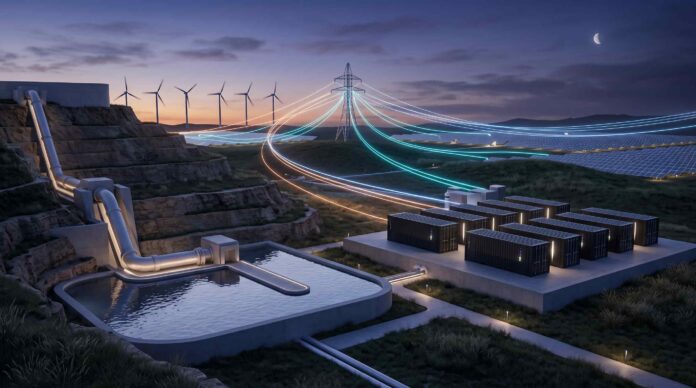
India’s energy transition has crossed a historic threshold. With non-fossil fuel capacity now exceeding 50% of the national grid—amounting to approximately 283 GW of solar, wind, and hydro generation—the fundamental challenge is no longer merely generating clean electrons, but firming them. The sheer intermittency of renewable energy dictates that the massive solar surges absorbed during the day must be strategically stored to prevent severe baseload shortages during the evening peak hours. This structural reality has catalysed what is now a gigawatt-scale renewable energy storage revolution across the subcontinent.
At the core of this transition is a diversified, multi-vector storage architecture designed to secure India’s sovereign energy future and achieve the ambitious target of 500 GW of non-fossil capacity by 2030. The state apparatus has recognised that reliance on spinning thermal reserves is outdated, and has consequently initiated a massive infrastructure pivot towards advanced storage technologies.
The primary pillar of this strategy relies on Pumped Storage Projects (PSP), frequently termed “water batteries”. By leveraging India’s vast topographical variations, the government is aggressively pursuing gigawatt-scale closed-loop pumped hydro systems. These massive civil engineering marvels use off-river reservoirs to store gravitational potential energy, providing critical long-duration baseload capacity without disrupting natural riverine ecosystems.
In parallel, electrochemical storage is being deployed at an unprecedented velocity to act as the grid’s agile shock absorbers. Battery Energy Storage Systems (BESS), predominantly utilising thermally stable Lithium Iron Phosphate (LFP) chemistries, provide the sub-second response times necessary for frequency regulation and immediate voltage support. The national network of battery storage is rapidly expanding, currently reaching over 92 GWh in total capacity. Furthermore, to break reliance on imported supply chains, the strategic horizon is actively shifting towards Advanced Chemistry Cells (ACC), Sodium-ion alternatives, and deep-storage Vanadium Redox Flow Batteries (VRFB). Other emerging vectors, including green hydrogen and thermal storage, are also being integrated to decouple power generation from immediate demand.
This physical infrastructure boom is entirely underwritten by a drastic overhaul of the national policy framework. The most decisive intervention is the historic Green Energy Corridor Phase-III (GEC-III) scheme, commanding a massive ₹1.86 lakh crore outlay. This scheme structurally mandates the concurrent deployment of 50 GWh of battery storage alongside major transmission upgrades, effectively ending the era of unbuffered renewable transmission.
Supplemented by robust Viability Gap Funding (VGF), comprehensive Central Electricity Authority (CEA) guidelines, and ₹18,100 crore Production-Linked Incentive (PLI) schemes for domestic ACC manufacturing, the Indian government has successfully transformed dormant topography and raw chemical cells into highly bankable grid assets. Ultimately, this coordinated strategy effectively replaces thermal baseload dependency with dispatchable green power, marking a structural maturation of the national grid and ensuring a resilient energy storage foundation.
Read the full article on Chapter 1 Magazine.


