

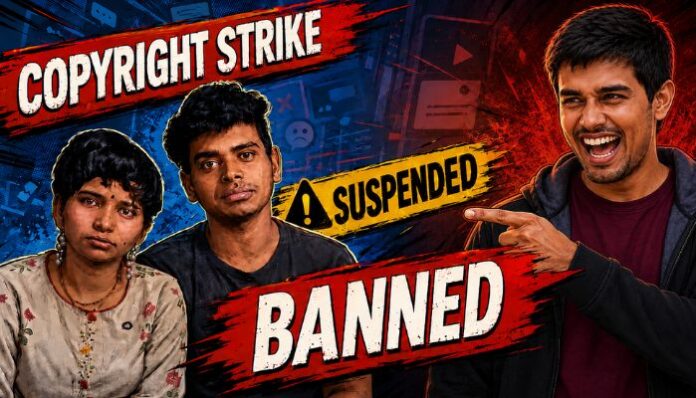
On 8th June, a budding influencer, Shivam Kumar, published a video on Instagram informing his followers that his account ‘beyondberry07’ had been suspended by the platform. The suspension came following a copyright strike by propagandist YouTuber Dhruv Rathee’s team. The account reportedly had over 40,000 followers when it was taken down.
The issue began after Shivam made a mimicry video of Rathee where he reportedly used Rathee’s image and some clips but without audio. The video was made in a parody format. However, instead of treating it as satire or mimicry, Rathee’s team issued a copyright strike, which eventually led to the suspension of Shivam’s Instagram account.
Shivam questions Rathee’s free speech stand
In a video explaining the matter, Shivam questioned how Rathee, who often speaks about freedom of speech and expression, could take such an action against a smaller creator.
While big creators talk about democratic values and free expression, smaller creators often end up facing the consequences when copyright tools are used against them. Notably, this is not the first time Rathee and his team have used copyright tools to suppress someone’s voice. Around two months ago, YouTuber Abhishek Sharma informed his followers that he had received a copyright strike on his video exposing Dhruv Rathee’s ‘AI Fiesta’ venture.
What Instagram says about fair use
According to Instagram’s own explanation of fair use, the strict application of copyright law may, in some cases, stifle creativity and stop people from creating original works. It lists criticism, commentary, parody, satire, news reporting, teaching, education and research as common examples where copyright exceptions may apply.
The platform also states that parody may be considered fair use if it imitates a work in a way that criticises or comments on the original work. In Shivam’s case, the video was a parody clip and, as per his version, was meant for commentary.
Instagram also says that one key factor in fair use is whether the new work transforms or changes the original by adding new meaning, context or expression. Another factor is whether the use replaces the original work in the market.
Based on these points, Shivam’s video appears to have a fair use argument, especially if it was transformative and did not replace Rathee’s original content.
Repeated abuse of copyright tools by Rathee’s team has raised serious questions about how copyright strikes are used by large creators and whether smaller influencers are being silenced despite using the content under the fair use policy.
