

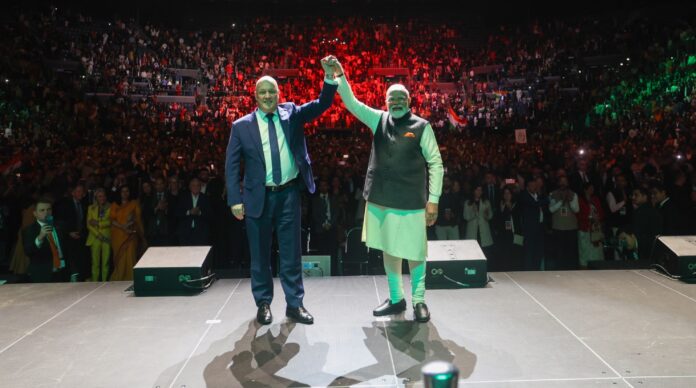
Prime Minister Shri Narendra Modi’s official visit to New Zealand on July 10 and 11, 2026, marked a historic milestone as the first such visit by an Indian Prime Minister in four decades. The visit resulted in the elevation of India-New Zealand relations to a Strategic Partnership, the conclusion and signing of a comprehensive Free Trade Agreement, and the endorsement of a detailed Roadmap to 2030 to guide future cooperation across multiple sectors.
The two leaders, Prime Minister Modi and New Zealand Prime Minister Rt Hon Christopher Luxon, held wide-ranging discussions at Government House in Auckland following a ceremonial welcome. They also interacted with business leaders and members of the Indian community, while Prime Minister Modi observed a showcase of New Zealand’s sporting innovation. The visit built upon the momentum generated during Prime Minister Luxon’s trip to India in March 2025, when Free Trade Agreement negotiations were launched, and several memorandums of understanding were signed in areas such as defence, education, customs, horticulture, forestry and sport.
In a Joint Statement issued on July 11, 2026, the Prime Ministers reaffirmed the long-standing friendship between the two countries, rooted in shared democratic values, deep people-to-people links and common interests in the Indo-Pacific region. They decided to upgrade the relationship to a Strategic Partnership and endorsed the India-New Zealand Strategic Partnership: Roadmap to 2030 as the guiding framework for joint action over the next four years. The Roadmap outlines concrete steps across six pillars, political and diplomatic engagement, defence and security cooperation, trade and economic cooperation, people, culture and sport, education, research, science and technology and disaster management, as well as regional and multilateral cooperation, with an emphasis on regular high-level visits, parliamentary exchanges and annual senior officials’ meetings to review progress.
On the economic front, the leaders welcomed the signing of the balanced, comprehensive and mutually beneficial India-New Zealand Free Trade Agreement, which is expected to remove trade barriers, enhance market access, promote investment flows, particularly New Zealand investment into India, and support India’s Viksit Bharat@2047 vision through collaboration in agriculture, skills, innovation, clean energy and other areas.
They set an ambitious target to double bilateral two-way trade in goods and services to NZ$7 billion, approximately ₹35,000 crore, by 2030. A Memorandum of Arrangement on Tourism was signed to boost visitor flows and cultural understanding, with both sides encouraging airlines to commence direct non-stop flights under the updated Air Services Agreement.
Cooperation in primary industries received fresh impetus through the implementation of existing arrangements on horticulture and forestry, alongside a new Memorandum of Cooperation on Animal Husbandry and Dairying. An Agricultural Productivity Partnership under the FTA will focus on action plans for kiwifruit, apples and honey, including the establishment of Centres of Excellence in kiwifruit in India and institutional collaborations for skills development and industry linkages.
Defence and security cooperation advanced significantly during the visit. The leaders welcomed progress in implementing the 2025 Memorandum of Understanding on Defence Cooperation and agreed to regular structured engagement at ministerial and service levels. New instruments concluded include a Maritime Cooperation Arrangement, an Implementing Arrangement on Cooperation in Hydrography and Nautical Cartography, and a Mutual Logistics Support Arrangement focused on the maritime domain. Bilateral naval exercises will be conducted under the Maritime Cooperation Arrangement.
Both sides also agreed to establish an annual Maritime Security Dialogue and welcomed New Zealand’s nomination of maritime security as its priority under the Indo-Pacific Oceans Initiative. Practical cooperation against transnational organised crime, including illicit drug trafficking and cyber-enabled crime, will be strengthened through work towards formal arrangements between the National Investigation Agency of India and the New Zealand Police, as well as a Joint Working Group on Counter-Terrorism.
Climate change and sustainability emerged as key areas of convergence. Prime Minister Modi welcomed New Zealand’s decision to join the Global Biofuels Alliance. Both countries committed to deepening cooperation through the International Solar Alliance and the Coalition for Disaster Resilient Infrastructure to advance research, innovation and practical solutions for climate-resilient agriculture and food systems. A new Memorandum of Cooperation between India’s National Disaster Management Authority and New Zealand’s National Emergency Management Agency will cover preparedness, emergency response and capacity building.
Education, science, technology and innovation were recognised as foundational to the partnership. The leaders acknowledged progress in implementing the 2025 Education Cooperation Arrangement and encouraged further growth in institutional partnerships, student mobility and collaborative research in areas such as agriculture, climate, digital transformation and emerging technologies.
People-to-people ties received special emphasis. The Indian community in New Zealand was hailed as an integral and valued part of New Zealand’s diverse society and a vital bridge between the two nations, contributing significantly to its economy, society, culture, public life and sporting achievements. The India-New Zealand Joint Action Plan on Sport was welcomed to strengthen cooperation in high-performance sport, coaching, sport science and national sporting organisation exchanges. Cultural cooperation was deepened through an Arrangement on Cultural Cooperation and a Memorandum of Arrangement linking India’s National Maritime Heritage Complex at Lothal with New Zealand’s Maritime Museum. Dialogue also continued on recognising seafarer competency certificates to support maritime industry resilience.
On the multilateral front, the Prime Ministers exchanged views on the Indo-Pacific, reaffirming their commitment to a free, open, peaceful and prosperous region based on respect for sovereignty, territorial integrity and the rules-based international order, including freedom of navigation and overflight and peaceful resolution of disputes in accordance with international law, particularly UNCLOS. They underscored ASEAN centrality and supported bold United Nations reform, including expansion of the Security Council in both permanent and non-permanent categories, with New Zealand reiterating its support for India’s permanent membership. Both sides condemned terrorism in all its forms and manifestations, including cross-border terrorism, and called for zero tolerance, disruption of financing networks and safe havens, and dismantling of terrorist infrastructure.
Prime Minister Modi, addressing a gala lunch hosted in his honour by Prime Minister Luxon, noted that bilateral trade has grown by more than 50 per cent in the last three years and expressed confidence that the Free Trade Agreement would inject greater depth and dynamism into economic ties while opening new opportunities for market access, investment and talent mobility. He also welcomed New Zealand’s investment commitment in India as a means to create fresh opportunities for New Zealand companies to become long-term partners in India’s growth story.
The Strategic Partnership and the Roadmap to 2030 provide a clear, action-oriented blueprint for the coming years without creating legally binding obligations. They institutionalise regular engagement mechanisms and focus on practical outcomes in trade facilitation through the Authorised Economic Operators Mutual Recognition Arrangement, expanded naval and maritime activities, counter-terrorism collaboration, educational exchanges, cultural linkages and coordinated positions in regional and global forums.
Prime Minister Modi’s visit has infused new energy and direction into India-New Zealand relations, transforming a traditionally warm friendship into a forward-looking Strategic Partnership. With the Free Trade Agreement in place, an ambitious trade target, strengthened defence and maritime cooperation, and enhanced people-to-people and cultural connect, the two countries are well positioned to realise mutual prosperity, contribute to regional stability in the Indo-Pacific and work together on global challenges in the years leading to 2030 and beyond.
