

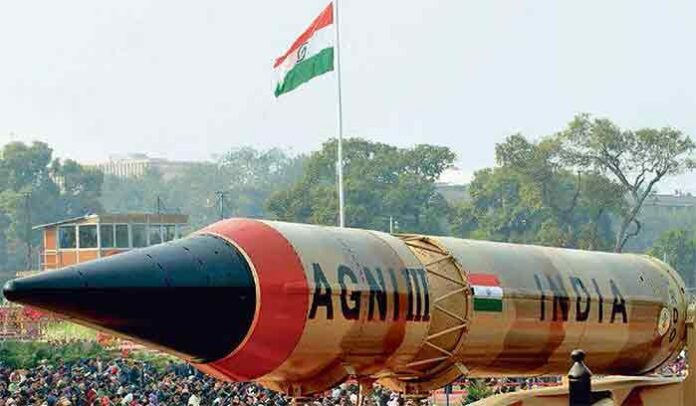
India today conducted a successful test launch of the Agni-III intermediate-range ballistic missile (IRBM) from the Integrated Test Range (ITR) in Chandipur, Odisha. The test, carried out under the aegis of the Strategic Forces Command (SFC), validated all operational and technical parameters of the missile system, according to an official statement from the Ministry of Defence.
The launch took place earlier today, and the defence officials confirmed that the missile met all mission objectives. The test was monitored using advanced tracking systems, including radars, telemetry stations, and electro-optical devices positioned along the Odisha coast. All data points confirmed a textbook trajectory and successful achievement of mission goals.
The Agni-III, a key component of India’s strategic deterrence arsenal, is designed to carry nuclear warheads and has a range of approximately 3,000 to 3,500 kilometres, enabling it to target locations deep within potential adversary territories, including entire Pakistan and large parts of China.
This test reaffirms the reliability and readiness of the Agni-III, which has been inducted into service and forms part of India’s credible minimum deterrence posture. The missile measures about 16.7 meters in length, 2 meters in diameter, and has a launch weight of around 48,300 kg. It features a two-stage solid propellant system and is capable of carrying a payload of up to 1.5 tons.
The Agni series represents a cornerstone of India’s indigenous missile development program under the Integrated Guided Missile Development Programme (IGMDP) and subsequent efforts. The family includes Agni-I (short-range, ~700 km) Agni-II (medium-range, ~2,000 km) Agni-III (intermediate-range, ~3,000+ km) Agni-IV (~4,000 km) Agni-V (intercontinental, ~5,000+ km). DRDO has also developed and tested the Agni Prime missile, which can be launched from a Rail based Mobile launcher system.
Today’s successful firing comes amid ongoing efforts to modernise and strengthen India’s nuclear triad, comprising land-based, air-delivered, and sea-based delivery systems. India has already operationalised its nuclear triad, with assets like the INS Arihant-class submarines providing second-strike capability.
