

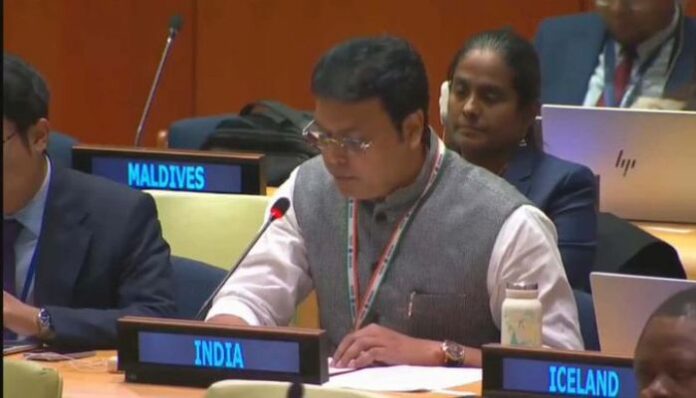
On Tuesday, 6th October, India has hit back at the Organisation of Islamic Cooperation (OIC) over its remarks on New Delhi’s action against terrorist infrastructure in Pakistan and Pakistan-occupied Jammu and Kashmir. Speaking at the United Nations, BJP MP Biplab Kumar Deb accused the OIC of failing to distinguish between those responsible for terrorism and its victims.
Deb was responding to a statement delivered by Saudi Arabia on behalf of the OIC at the UN General Assembly’s Sixth Committee, which deals with international legal issues. He was delivering India’s national statement during a discussion on measures to eliminate international terrorism.
Watch: At the UN General Assembly, BJP MP Biplab Kumar Deb says, "…Terrorism in all its forms, including cross-border terrorism, remains one of the most serious threats to humanity. This threat has serious implications for international peace and security, economic progress, democratic institutions and human rights. It attacks the most fundamental right of every human being- the right to life. Terrorism is contrary to the values of the United Nations. Deliberately targeting civilians can never be justified in any manner. There is no distinction between good and bad terrorism. India considers terrorist attacks as crimes against humanity. As India’s Prime Minister Narendra Modi has said, ‘We consider that even a single attack is one too many and even a single life lost is one too many’…"
— IANS (@ians_india) October 7, 2026
India defends action against terror infrastructure
Responding to the OIC’s remarks, Deb said India had carried out “focused and measured” action against terrorist infrastructure in Pakistan and Pakistan-occupied Jammu and Kashmir. “I now respond to the statement made by the OIC Chair regarding India’s focused and measured action against terrorist infrastructure in Pakistan and Pakistan-occupied Jammu and Kashmir, from where terrorist attacks against India have been planned and directed,” Deb said.
He then criticised the OIC’s position, saying, “It is unfortunate that the speaker is unable to distinguish between fact and fiction and cannot differentiate between the victim and the perpetrator.
“India has the full right to protect its people against terrorism on the border coming from Pakistan. The consequences of being involved in terrorism will not be tolerated,” he added.
India recalls Pahalgam terror attack
During his address, Deb also referred to India’s experience with cross-border terrorism and the human cost of attacks.
He said the threat was not theoretical for India but a “persistent and daily reality”. According to Deb, terrorism affects not only security but also economic development, democratic institutions and human rights.
He specifically referred to the Pahalgam terror attack in April 2025, in which 26 tourists were killed. Deb described the attack as a calculated assault on India’s sovereignty and alleged that it was planned and carried out by networks receiving support from across the western border.
“Terrorism is contrary to the values of the United Nations. Deliberately targeting civilians can never be justified in any manner. There is no distinction between good and bad terrorism. India considers terrorist attacks as crimes against humanity,” Deb said.
He also repeated Prime Minister Narendra Modi’s position that “even a single attack is one too many and even a single life lost is one too many.”
Deb raises Jammu and Kashmir issue
Deb also rejected what he called the OIC’s “unwarranted reference” to Jammu and Kashmir. “The OIC chair would do better to focus on Pakistan’s illegal occupation, especially in Rawalakot, where wanton killings, brutal violence and the denial of basic rights to the people living there are so visible,” Deb said.
He further accused the OIC of “willful blindness” and said such a position reflected what he described as “bigotry and intolerance.”
India pushes stronger global action against terrorism
The UN intervention also formed part of India’s wider push for stronger international action against terrorism. Deb called for the early adoption of the Comprehensive Convention on International Terrorism (CCIT), a proposal India first introduced in 1996.
He also stressed the need to hold not only terrorists but their organisers, financiers and sponsors accountable. India has additionally raised concerns about terrorist groups using emerging technologies for recruitment, radicalisation, propaganda, planning and financing.
Deb is part of a 15-member Indian parliamentary delegation visiting the UN for a familiarisation programme. His remarks came amid continued diplomatic differences between India and the OIC over Jammu and Kashmir and Pakistan-linked terrorism.
